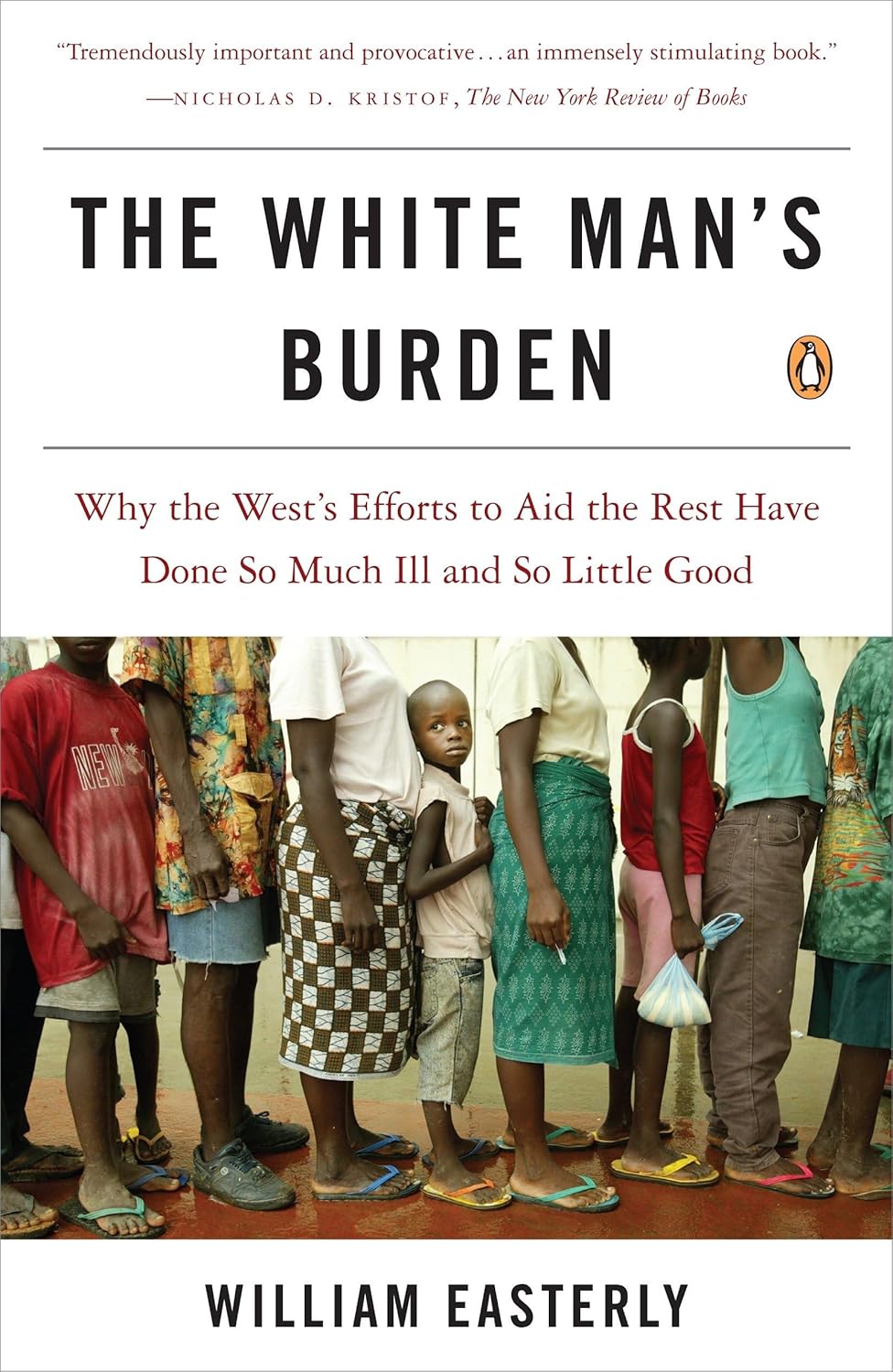
In 2011, Eric Ries made a big splash in Silicon Valley with his book “The Lean Startup: How Today’s Entrepreneurs Use Continuous Innovation to Create Radically Successful Businesses.” He defines “startup” rather loosely (“an organization dedicated to creating something new under conditions of extreme uncertainty”) and encourages organizations of all sizes to avoid creating elaborate business plans and instead work “to test their vision continuously, to adapt and adjust…” This is almost precisely the same argument made by NYU economist William Easterly in his controversial 2007 bestseller, “The White Man’s Burden: Why West’s Efforts to Aid the Rest Have Done So Much Ill and So Little Good,” which is a direct assault on traditional development economics, the very field he has dedicated his life to. For the past half century, he argues, development economics has been beholden to a “legend”, a legend he once very much believed in: That poverty traps constrain impoverished nations and these poverty traps can be overcome with a “Big Push” – massive Western foreign aid packages and tops-down plans for eradicating poverty, disease, and illiteracy, while promoting various forms of economic growth.
This attempt at a big fix – massive programs of aid with lofty goals but little accountability – has been the world of classically trained development economists, who he derisively dubs “The Planners.” They think they have the answers, he says, and rhetorically they have the advantage because they promise great things, such as “the end of poverty.” Reality, however, is much different according Easterly. There are no easy answers. “The only Big Plan is to discontinue the Big Plans,” he says. “The only Big Answer is that there is no Big Answer.” The promises of the Planners, such as his professional rival Jeffrey Sachs, “shows all the pretensions of utopian social engineering,” he writes rather caustically. Yet they flourish in a world without feedback or accountability, and where big plans and big promises play well with politicians and celebrities. Nobody (especially those with no direction connection to the problems) wants to promote small but achievable objectives. They want “to do something” – and do it big. Easterly claims that the West, perhaps innocently and unintentionally, has written itself into the hero role in saving the uncivilized world. Indeed, he writes, “…the development expert…is the heir to the missionary and the colonial officer.”
In contrast to the Planners, the author encourages those who want to help to “think small”: the little answers that work and that can make a material, if not revolutionary, difference on the lives of the impoverished. He calls these people, mostly locally-based activists, “The Searchers.” They possess an entrepreneurial and experimentation mindset, and naturally embrace the iterative testing model promoted by Ries in “The Lean Start Up.” They get regular feedback from the poor they serve and are held accountable for their work. They don’t promise to solve world hunger, but they often make incremental yet substantive impact where they work. “The dynamism of the poor at the bottom,” he writes, “has much more potential than plans at the top.”
The book is broken into four parts, each of varying interest and value. The first part, “Why planners cannot bring prosperity” is dedicated to undermining the theory of the “Big Push,” which Easterly writes is demonstrably false. He claims that “Statistically, countries with high aid are no more likely to take off than are those with low aid – contrary to the Big Push idea.” Likewise, attempts to promote free markets from the top down, as is often the case with IMF and World Bank-led structural reforms, ambitious schemes to promote capitalist growth that Easterly admittedly once believed in wholeheartedly, are doomed to failure. The same goes for top down efforts to promote democracy, although he sees democracy as important because it can supply the two things most important for meaningful reform: feedback and accountability.
In Part two, “Acting out the burden,” Easterly accentuates “The tragedy of poverty is that the poorest people in the world have no money or political power to motivate Searchers to address their desperate needs, while the rich can use their money and power through well-developed markets and accountable bureaucracies to address theirs.” He highlights the insanity of the international development industry, which he likes to repeat has pumped $2.3 trillion (yes, “trillion”) into the developing world since the end of World War II – and for what? He says. He cites Tanzania as a typical case study in development economics absurdity, as that country was forced to produce 2,400 reports and host over 1,000 donor visits in a single year. The author hammers home on his two main themes of feedback and accountability, noting what little input the poor actually have on the aid that they receive and that the Planners at the top are usually divorced from reality on the ground. Easterly writes that development aid is a classic “principle/agent” relationship, where the principle is a rich donor country and the agent is the aid agency. The actual target, the poor, are nowhere in the system of response. The principle wants to see big results, and yet is in no position to check on the work and achievements. The agents are thus cloaked in a sort of invisibility – and it’s under this invisibility, the author claims, that the Planners take over. The Planners thrive in the dark, Easterly says; the Searchers in direct light. The Planners benefit from the fact that there are so many aid agencies, all with very similar missions, all supposedly coordinating efforts, yet no single entity is ultimately accountable for achieving results. The smaller and more focused an NGO’s mandate, the better. Or, as Easterly complains, “If the aid business were not so beguiled by utopian visions, it could address a more realistic set of problems for which it had evidence of a workable solution.”
If the aid agencies have failed because their mandates are too broad, what about the IMF, which has the relatively narrow mission of promoting “trade and currency stability”? Easterly argues that the IMF suffers from poor data, a misplaced one-size-fits-all approach, and is all too willing to forgive loans. What should be done? Simple, Easterly says, focus the IMF on emerging markets only and reserve the true bottom billion for aid agencies, thus removing the politically unpopular conditionality that has marked IMF interventions over the past several decades.
Part 3, “The White Man’s Army,” is lengthy and the least insightful in the book. Easterly’s core message, as told through vignettes about Pakistan, the Congo, Sudan, India, and Palestine/Israel is that Western meddling with the Rest has been damaging, whether it was colonialism, de-colonialism or well-intentioned aid intervention. He further argues that US efforts to restructure societies via military force, either directly or through proxies, has all the hallmarks of utopian planner mentality, as suggested by case studies on Nicaragua, Angola and Haiti. In other words, neo-conservatives are the Right wing on “The Planner continuum”, with idealists like Sachs on the Left.
In Part 4, “The Future,” Easterly argues that 60 years of Planners in control of the economic development agenda is enough. It is time to drop the utopian goals of eradicating poverty and transforming governments. “The Big Goals of the Big Plan distract everyone’s attention…” he writes. “The rich-country public has to live with making poor people’s lives better in a few concrete ways that aid agencies can actually achieve.” Even worse, he writes, “The Planners’ response to failure of previous interventions [has been] to do even more intensive and comprehensive interventions.” It is time to empower the Searchers, those who probe and experiment their way to success with modest efforts to make individuals better off, even if only marginally.
As far as the aid agencies are concerned, Easterly recommends: 1) end the system of collective responsibility for multiple goals; 2) and instead encourage individual accountability for individual tasks; 3) promote aid agencies to specialize rather than having many all pursue significant goals; and 4) employ independent auditors of aid activities. The central theme developed by the author throughout this book is that aid agencies need to be constantly experimenting and searching for modest interventions that work. And they must employ more on-the-ground learning with deeply embedded staff. Thus, Easterly encourages the idea of “development vouchers” that would empower local communities to get the aid they most need from the agencies that are most effective. Theoretically, those agencies that either don’t deliver value and/or don’t deliver as promised would be put out of business. It’s a compelling idea that Easterly nevertheless stresses is no panacea.
Easterly writes with a certain punch, which I’m sure ruffled more than a few feathers not only with his arguments but with his style, which can be cynical and snarky. For instance, when looking to catalog the redeeming benefits of U.S. interventions over the past several decades, he cites an “Explosion of Vietnamese restaurants in the United States” for Vietnam, “Black Hawk Down was a great book and movie” for Somalia, and “Salvadoran refugees became cheap housekeepers of desperate housewives” for El Salvador. He goes on to characterize U.S. Angolan ally Jonas Savimbi as “to democracy what Paris Hilton is to chastity.” Amusing commentary, for sure, although perhaps a bit misguided given the gravity of the subject matter.
In closing, Easterly makes a compelling case to “go small” with development efforts and always seek feedback and accountability. He may not be on the Christmas card list of Bono and Angelina Jolie, but I’m afraid he is much more insightful and directionally correct than their hero, Jeffrey Sachs.
 What's Tim Reading Now?
Leave a comment