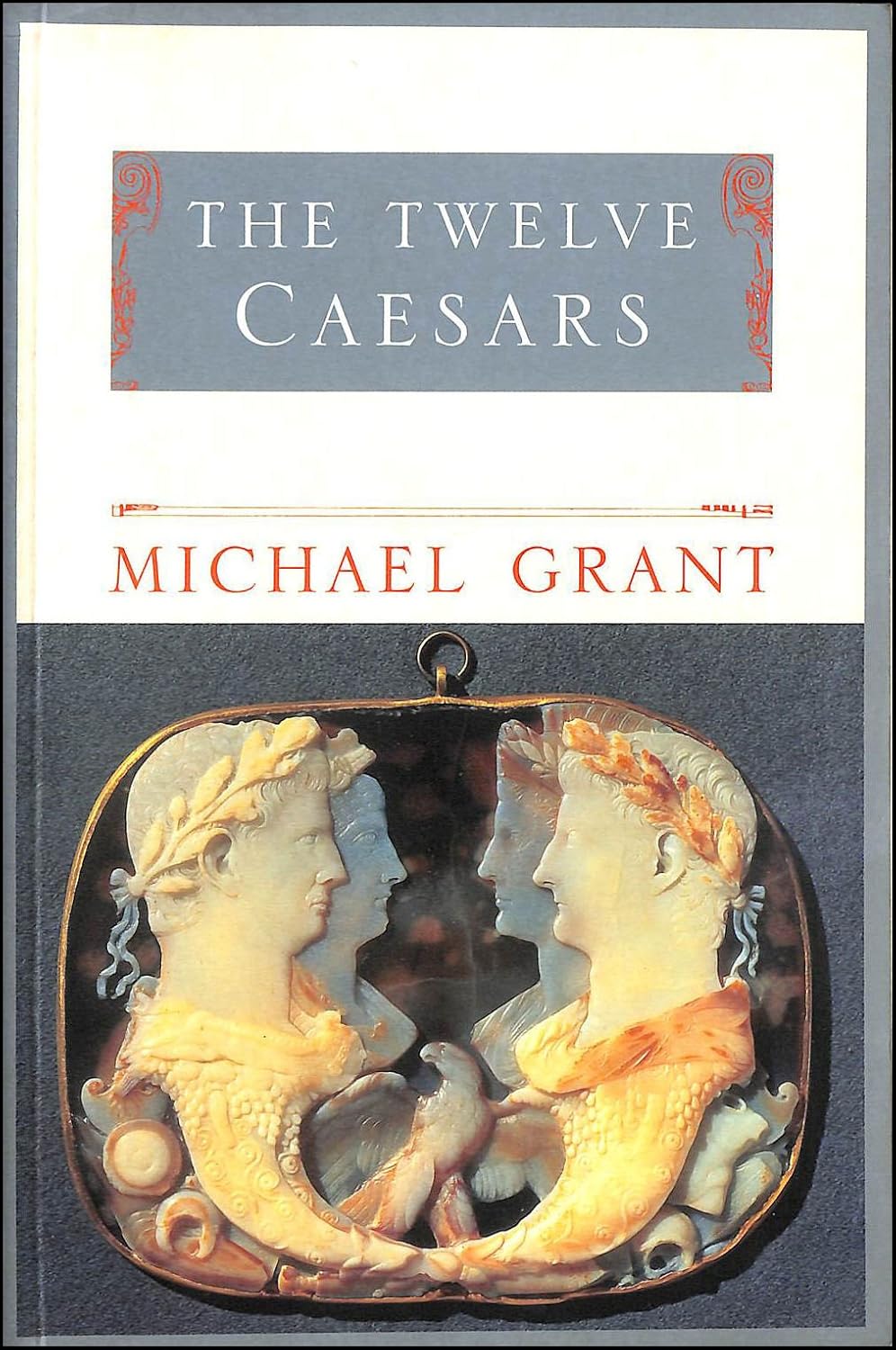
British ancient historian Michael Grant is a legend of sorts, although I’m sure that plenty of classically trained Roman historians shutter at that appellation. Here, with “The Twelve Caesars,” originally published in 1975, he seeks to deliver to a modern audience in plain English and shorn of contemporary prejudice the men who ruled Rome from the bloody transition from the Republic through the halcyon days of the first century Empire.
Grant breaks his biographical collection into four parts. Here are my semi-educated reactions to each.
Part I looks at the period “From Republic to Empire” and covers just two, but eventful and influential lives: Julius Caesar and Augustus.
Grant writes that not only did Caesar usurp the rights and honors of the Republic, but he also elevated the non-aristocratic Oppius and Balbus from the Knight class as personal secretaries and assistants wielding tremendous influence and power, a fact that many senators bridled at, especially given Caesar’s planned campaign against the Parthians meant that these two non-nobles would essentially be in charge politically at Rome. Moreover, Caesar introduced sweeping reform policies for debtors, expanded Senate membership from to 600 to 900, including many from the extended empire, put his image on coinage, and declared himself dictator for life, thus depriving an entire generation of elites the game of competing for honors. In the end, Grant writes, Caesar was a broken man physically, overwhelmed by the strains of empire management. If he had not been assassinated before heading his army east in 44BC, he almost certainly would have died shortly on campaign, according to the author. And, thus, Grant introduces the two main themes of his book: 1) the role of emperor was an enormous responsibility that simply crushed most men under its tremendous weight and pressure; and 2) the senatorial elites may have lost the policy influence they wielded under the Republic, but the combined weight of their opinion still mattered greatly during the early Empire.
Augustus, adopted son of Caesar, Grant writes, was physically weak and, unlike his adopted father, not conspicuously brave. Yet, he made great decisions under difficult circumstances. The author writes that Augustus strove mightily to make the new empire look-and-feel like the old Republic. Augustus had divorced imperator from official power. Now consuls retained control of the provinces and the armies. The army and veterans were well taken care of, as were the people of Rome, who were treated to circuses and festivals like never before. The author stresses that Augustus lived in constant fear of his life and was always surrounded by bodyguards. He further claims that only Augustus could maintain the delicate machinery of the new empire because of his unique gifts of leadership and management. He leaned heavily on the new Senate, which had shrunk from a population of 1,000 to 600, but increasingly consulted on policy decisions. Augustus himself attended Senate meetings regularly and kept a small group of key senators as a valued inner circle. By the end of his life in 14AD, Grant writes, Augustus was increasingly irritable and was beginning to lose is grip on power, a theme that the author says was played out again and again over the course of the next century with those that inherited the all-powerful position of emperor.
Part II, “The Julio-Claudian Emperors,” covers four emperors from 14AD to the Civil War year of 69AD. Tiberius, first of the Julio-Claudian emperors, reigned for 23 years, from 14AD to 37AD, the longest reign of any first century emperor besides Augustus himself. Dour, suspicious, and taciturn by nature, Grant claims that Tiberius was nevertheless a man of “outstanding ability,” but who lacked Augustus’ gift of getting along with people. A republican by birth as well as conviction, the author writes that Tiberius “showed almost painful eagerness to preserve the traditional dignity of the senior senators and holders of official posts.” However, after half a century of imperial authority the Senate had lost the ability to initiate policy on their own account. The most historically significant events of Tiberius’ reign – the life, preaching, and death of Jesus – are not mentioned, but rather are dominated by the weighty contemporary events surrounding the emperor’s close aide, Sejanus, a knight by birth and the sole prefect of the consolidated 9 cohorts of the Praetorian Guard. By 23 AD, Sejanus had emerged as a new Agrippa, the most trusted partner to the emperor. In 26AD, Tiberius took the unusual step of leaving Rome for Capri, where he could escape the two terrors that dominated his life, according to the author: regular contact with people, both senators and the common man; and fear of assassination. Sejanus was elected co-consul with Tiberius in 31AD, but shortly thereafter Tiberius turned on him, sending an incriminating letter to the Senate that was read in his, Sejanus’, presence. Sejanus was executed on the spot, culminating what Grant calls “one of the most spectacular downfalls of all time.” The last six years of Tiberius’ life were a “reign of terror” of sorts as treason trials took the lives of dozens. Grant maintains that Tiberius simply cracked under the strain of the unmanageable system that Augustus had bequeathed to him. It is a common theme in nearly every biographical vignette of emperors who served more than at least a few years.
Caligula became emperor in 37AD at the tender age of 25 and after an upbringing of tragedy, including the murder of several close family members. A “megalomaniac,” a sadist, “unstable and unboundedly conceited,” possessing a “sardonic, malicious wit,” the young emperor was nevertheless not mad in any modern sense of the term, according to the author. Perhaps Caligula’s most daring and original policy was to tear away the legal fictions employed by Augustus and Tiberius; he unapologetically embraced a fully autocratic imperial seat. Even if by 37AD the storied “dignatas” of the Senate was largely fictional, appearances still mattered. Bucking tradition, Caligula claimed for himself unprecedented honors, including his own deification. In 41AD, after just four years in power, the very same Praetorian Guard that had taken an oath to protect him, assassinated Caligula. Grant writes that Caligula had fatally miscalculated in his brazen alienation of the seemingly emasculated upper class. The author concedes that “if even the able and hard-working Tiberius had found the Augustan inheritance intractable, then his young, inexperienced, impetuous, unindustrious successor could not be expected to grapple with its formidable problems with any likelihood of success whatsoever.”
Claudius succeeded his nephew Caligula in 41AD at the age of 50, the explicit pick of the Praetorian Guard that had just eliminated the emperor. Grant stresses that Claudius was a man of immense learning, “an erudite antiquarian and a writer of modern history,” and not the simpleton portrayed in Robert Graves’ classic historical novel. Nevertheless, the new emperor did suffer from significant personal handicaps: “timidity, suspicion, and alarm…were perhaps his dominant characteristics.” The author notes that Claudius’ reign was a curious mix of “progressiveness and antiquarianism.” He sought to expand and liberalize the senate while simultaneously pursuing a regimen of treason trials at least as aggressive as any of his predecessors and continued the “process of insidious centralization” that Caligula had begun. The role of two women – Claudius’ third and fourth wives, Messalina and Agrippina, respectively – figure prominently in his story. The former, whom he married around 40AD right before he became emperor, is described by Grant and the ancients as insatiably licentious, taking on a string of lovers, the last of which conspired with her to assassinate the emperor in 48AD. The plot was uncovered and the conspirators executed, but it was a shock from which Claudius never fully recovered, according to the author. A year later he married Agrippina, mother of Nero, a woman that Grant suggests virtually ruled Rome in Claudius’ final days, aiming mainly to rule after his death as regent to the heir apparent, Nero.
Nero’s infamous reign (54-68AD) highlights the primary themes that Grant asserts about the fate of the emperors. First, Augustus had established a centralized and autocratic system that required enormous talent, fortitude, and endurance to manage. It was a job with a workload and stress level that few could handle. Nero, who came to the purple at the absurdly young age of 17, quickly tired of the job; his genuinely progressive policy ideas were stymied by a conservative, aristocratic senate. Instead, he devoted his time to the arts, eventually even performing publically in Rome, a situation that the elites in the senate considered a scandal. Second, even though the senate had been politically neutered by Augustus, the men who made up the senate and their opinions still mattered, according to the author. If you lost their support, eventually the Praetorian Guard would waver, and then all would be lost. For Nero, Grant says, he lost the senate for a combination of reasons, but mainly because of his eccentric behavior as a poet and actor; his murder of his mother and one-time powerful regent, Agrippina; the death of noble and cooperative senior advisors, Seneca and Burrus; and his overaggressive response to news of conspiracies against his rule, which tended to enflame the sedition it sought to stamp out. The great irony of Nero’s reign is that it started with perhaps the most dramatic and sincere call for restoring the senate to its Republican position of prestige and authority. Yet, 14 years later, it was that very senate, grown impatient and intolerant of an absentee-emperor-cum-poet only too willing to execute any noble touched with a whiff of conspiracy that triggered his downfall. Thus, the circle was closed: with Nero died the last of the emperors tied directly to Augustus.
The death of Nero demonstrated quite clearly the anarchy of an open succession. Part III, “The Civil Wars,” looks at three short-lived claimants to the throne. Galba’s seven-month reign was important for several reasons, according to Grant. First, it showed that “it was possible,” as Tacitus wrote, “for an emperor to be chosen outside of Rome.” Second, because of the strain and grueling workload, the counselors to the emperor needed to work together harmoniously, like Agrippa and Maecenas under Augustus or Seneca and Burrus under Claudius. Galba’s top counselors were motivated by mutual hatred and suspicion from the start. Third, the troops, especially the Praetorian Guards, must be enriched before anyone else. Perhaps Galba’s biggest mistake was his belief that “I select my troops, I don’t buy them!” Finally, Galba’s choice of an heir, Piso, who was not a blood relative, set the precedent that the emperorship was open to merit, not birth or lineage. That said, Galba’s short and disastrous reign undermined the future claims of ancient Republican families to control the Roman Empire. Indeed, Grant writes that Galba’s brief administration “extinguished the imperial prospects of Republican noblemen forever.”
The author further claims that the 95-day reign of the next emperor, Otho, was important for several reasons. First, he showed that a relative “new man” could be made emperor. Second, for the first time an emperor assassinated his predecessor, a precedent that would become a recurring feature of Roman imperial rule. And, third, the new emperor was immediately a slave of the army that had created him, in this case the Praetorian Guard, although other provincial legions were to quickly demonstrate the same power. Worse yet, inter-garrison rivalry ensured that any new emperor created by any army unit would be resisted by those not directly positioned to benefit.
Vetellius, the last of the three emperors, is described by Grant as a gluttonous, sycophantic mediocrity; a man that stumbled into the opportunity to seize the purple, an effort inevitably cut short by a combination of “torpid hangover, military inexperience, and reliance on two mutually hostile advisors [Caecina and Valens].” Vitellius was nevertheless conscience of the need to establish a new family dynasty, introducing his 6-year-old son as a general and future successor. It was a model that his conqueror, Vespasian, seemingly no better positioned to succeed than Galba, Otho, or Vitellius, embraced and succeeded with.
Part IV looks at “The Flavian Emperors” that served from 69 to 96AD. Vespasian was governor of Judea, suppressing the First Jewish Revolt, when he leapt into action after Otho’s violent ascension. Grant notes that one of Vespasian’s main strength’s was that he was the father of two sons. By this time the dynastic nature of the Roman ruling class was clear. But beyond that, Vespasian was clearly “a new kind of ruler,” a man of “modest rank, and correspondingly plain tastes,” a man with “peasant’s accent” and conspicuous for his “old-fashioned, unpretentious way of life.” Like many of the unfortunate emperors of the year 69AD, Vespasian’s inner circle was riven with rivalry and animosity. And yet, somehow, he succeeded where Galba, Otho and Vitellius had failed – and failed fast. Vespasian, on the other hand, was quick to honor the Roman Army before the senate – and to treat the troops with “a tactful blend of fairness and firmness.” Perhaps the greatest impact of Vespasian’s decade-long rule was that “the olds days when Republican pretensions [such as pretending that the senate was an independent body] might still mean something were gone forever.” Grant writes that the “Civil Wars had shown the necessity of a strong monarchy,” and that’s precisely what Vespasian delivered. Gone were the days of the “melodramatic eccentrics of the Julio-Claudian type” and instead were replaced with a new breed of “industrious, public servants,” that blended hard work with humility and political acumen.
Emperor Titus glided into the purple in 79AD at the healthy age 42, the first ever to succeed his natural father (a feat not to be repeated for another 100 years). Considered “extravagant and greedy,” Titus further damaged his reputation by taking the Jewish collaborationist queen Berenice as his mistress – and almost his wife. Furthermore, his brief reign was marred by two calamities: the destruction of Pompeii in 79 and the Great Roman Fire of 80. When he died in 81 after just two years as Caesar he is reported to have held just one regret in life: having not murdered his younger brother and successor, Domitian.
Domitian became emperor at age 30 in 81AD, determined to follow a “meticulously thought out policy of systemic absolutism.” Unlike his estranged older brother, Domitian was denied honors during his father Vespasian’s regime. For example, he received no meaningful military commands and shared the ceremonial consulship with his father only once (compared to Titus’ six times). Thus, Grant writes that Domitian came to the throne “seething with disappointed ambition.” Like Nero, he loved poetry and the theater, but never let his ambitions affect his imperial work. He also wasn’t above enjoying gladiatorial fights between women and dwarves, an odd anecdote I couldn’t help highlighting. Domitian’s eccentricities aside, Grant claims that he nevertheless governed the empire in a manner “firm, far-sighted, and meticulous.” He launched an extensive building campaign, gave the Roman troops their first pay raise since Augustus, and funded fabulous public works projects. Keynes, had he been a Roman citizen in the 80s AD, no doubt would have been proud.
A central theme of this book is the imperial leadership’s century-long attempt to restore classic and deeply held Republican traditions, such as the positive and weighty influence of the Senate, while balancing threats from senatorial conspiracies against the crown. Over the course of the first century the imperial system became more-and-more unabashedly authoritarian while the senate became more diluted of ancient Republican families. A familiar narrative developed: a new emperor would be crowned; he would embark on a program of wise, just, and usually progressive leadership; eventually, elements in the senate would become disaffected and conspiracies against the emperor would emerge, both real and imagined; the emperor, his suspicions aroused, would crack down ruthlessly; treason trials and wholesale executions would follow; more often than not, like Domitian, his excessive reaction would lead to his own assassination. Or, as Tacitus put it rather drably, “emperors generally deteriorated.”
In closing, Grant delivers a crisp, engaging, and informative review of Rome’s transition from Republic to Empire, while making a consistent and compelling argument that the lofty position of emperor was, sooner or later, impossible for any mortal many to handle.
 What's Tim Reading Now?
Leave a comment