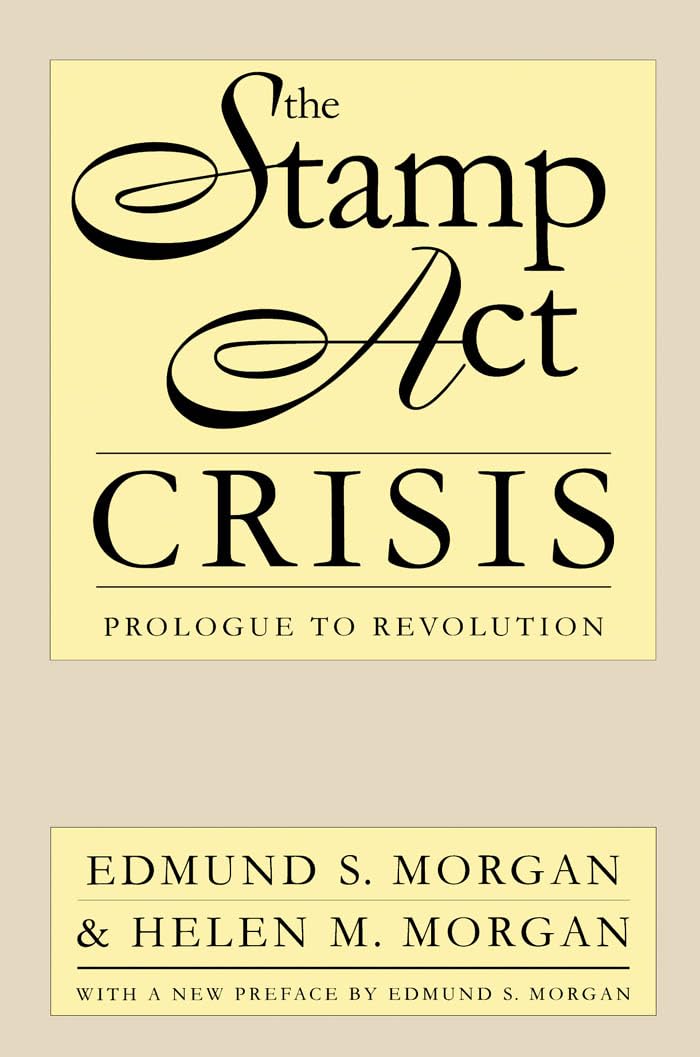
First published over a half century ago, the Morgans’ “The Stamp Act Crisis” is still the most well-rounded and penetrating account of the political upheaval of 1764 to 1766 that essentially put the American Revolution in motion. The authors combine the very best of narrative history, with a strong focus on some of the most prominent participants in the crisis, many now only footnotes in history, figures such as James Otis, Daniel Dulaney and John Hughes, with a deep analytical analysis of the constitutional arguments that turned two relatively minor taxes on molasses and paper into a political cause that shook the world’s most dominating empire to its foundations.
The Sugar Act was intended to help close the gaping hole in the British treasury after the long war with France. By lowering the duty on molasses, but strictly enforcing the new law, the crown hoped to increase desperately needed revenue while not interfering with the flow of colonial trade. Colonial resistance was immediate and vigorous, their opposition to the Act bolstered by the effects of a post-war recession and new restrictive monetary policy introduced by Parliament that prohibited the use of paper money, which crippled the colonial economy that was starved of specie. Pamphlets, such as that by James Otis, “The Rights of the British Colonies Asserted and Proved,” which denied the right of Parliament to tax the colonies, either internally or by duties on trade, unless they granted the colonies direct representation in Parliament, were generated to defend noncompliance with the Act.
The Morgans pay special attention to the work of Maryland lawyer Daniel Dulany, who, in 1765, after reading pamphlets by Soame Jennings, William Knox and especially Thomas Whitley writing for Lord Grenville, authored an essay, “Considerations on the propriety of imposing Taxes in the British Colonies,” which refuted their arguments supporting the rights of Parliament to levy a direct tax on the colonists. Dulany directly challenged the principle of virtual representation the tax proponents in England took as a given. Although such great legal minds as Sydney, Burke and Blackstone supported virtual representation, Dulany argued that it didn’t apply to the colonies, because a tax raised in the colonies would lower the tax burden of Englishmen, so there was no shared interest, which was the intellectual basis for virtual representation. But he was careful not to dismiss all Parliamentary authority over the colonies. In fact, he was a champion of Parliamentary authority in legislation, which was different from taxation. The Morgans explain that Dulany simply sought to define Parliamentary authority within a constitutional framework. Thus, representation was only needed for taxation, not legislation. He acknowledged the colonies subservience in matters of economics and trade, and accepted Parliament’s right to impose duties and regulate trade in its favor.
Ironically, many of the leading British political leaders of the day on both sides of the Atlantic were sympathetic to the intellectual arguments made by the colonists; Pitt even stood up in Parliament and “rejoiced that America resisted.” But British lawmakers also realized that acknowledging their claims put London on a slippery slope that could permanently undermine the sovereignty of Parliament. In the end, the issue wasn’t whether or not the Stamp Act would be repealed — the enormous cost of enforcement and nearly unified resistance of the powerful merchant community in England ensured that the Act would be removed. The issue hinged on the understanding of the colonies claims against taxation, which were fiercely contested. Most agreed that there were some difference between internal taxes (those imposed to raise revenue) and external taxes (those imposed to regulate trade); however, few accepted those made by many colonists, Daniel Dulany especially, that legislation and taxation were two very separate things. The distinction between internal and external taxes limited Parliamentary authority much less than that between taxation and legislation. In his dramatic appearance before Parliament during the crisis, Benjamin Franklin had maintained that the colonists only sought to avoid internal taxes and recognized Parliament’s right to tax in general. Those pushing for repeal had to downplay the colonists’ arguments against general taxation, which created confusion of what really was at issue. In the end, the powerful merchant class movement against the Act on business terms was given credit for its repeal. The Declaratory Act, which repealed the Stamp Act, was based on the 1719 precedent of authority over the Irish and was left deliberately vague on the issue of taxation. It affirmed Parliament’s right to authority over legislation “in all cases whatsoever.” Most assumed that included taxes, but an explicit reference to taxation was deliberately left out, thus ensuring ambiguity and getting the repeal through Parliament.
When Pitt was made head of government in 1766, replacing Rockingham, it was believed that the staunch defender of colonial rights would interpret the Declaratory Act the way that the colonists did and that Parliament would never tax them again. However, a few prescient colonists recognized what Parliament had really done with the Declaratory Act: before they claimed Parliament could tax because the colonists were virtually represented; now they were able to claim that Parliament could tax because they officially declared that they could. The stage was set for the final confrontation, one that would determine the political fate of a continent and, ultimately, an empire.
“The Stamp Act Crisis” is likely one of the dozen best, most enduring books on the colonial period and Revolution written in the past century. Not a light, popular history, it is for more serious students of American history rather than the casual crowd, although I would encourage the book to any thoughtful reader.
 What's Tim Reading Now?
Leave a comment