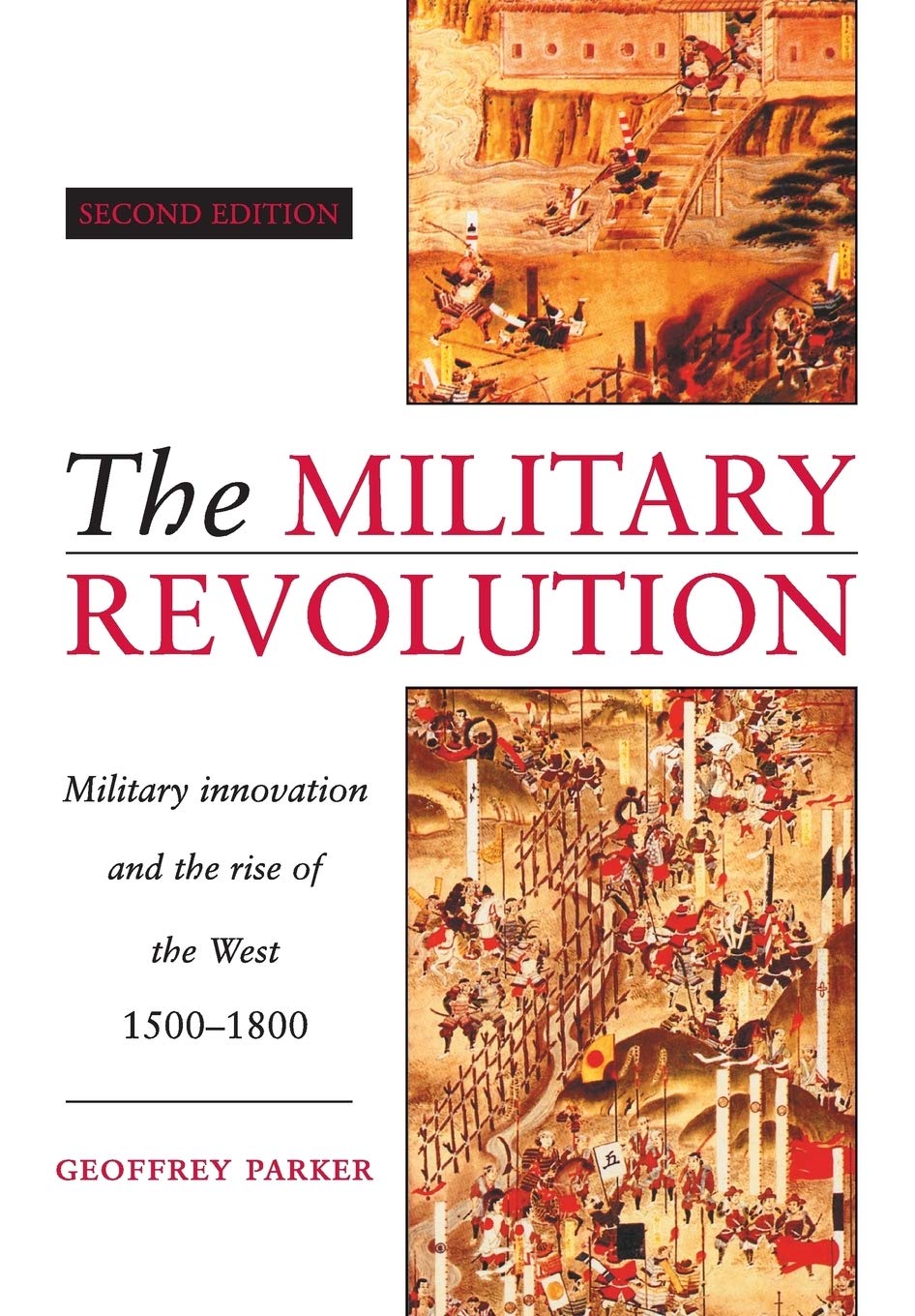
During the 1990s, discussions about a new “military revolution” shaped by advances in the Information Age dominated defense intellectual circles. Yet the concept of a “military revolution” as a transformative historical process actually dates back much further—to a seminal 1955 lecture by British historian Michael Roberts titled The Military Revolution 1560-1660. Building on and revising Roberts’ influential thesis, Geoffrey Parker delivered a series of lectures at Trinity College, Cambridge, in the mid-1980s that culminated in his landmark book, The Military Revolution: Military Innovation and the Rise of the West, 1500-1800. Parker’s work is not merely an academic exercise; it addresses a profound historical puzzle—how Western European states came to dominate the globe long before the Industrial Revolution.
Parker’s fundamental objective is to explain how Western Europe achieved early imperial dominance by the 19th century, controlling roughly 35% of the earth’s surface before industrialization transformed military and economic power. This early expansion cannot be adequately explained by later technological advances, so Parker turns to Roberts’ thesis and expands it to identify a centuries-long military revolution beginning around 1500 and extending into the late 18th century.
While Roberts focused on a relatively short, intense period emphasizing the tactical innovations of infantry drill and the rise of handheld firearms—epitomized by the Swedish innovations under Gustavus Adolphus during the Thirty Years’ War—Parker offers a broader and arguably more nuanced perspective. He argues that the true heart of the military revolution lay not in battlefield maneuvers alone, but in the transformative impact of new fortification technologies, especially the trace italienne, the star-shaped fortress design that revolutionized siege warfare.
According to Parker, Roberts somewhat overstated the decisive nature of tactical infantry reforms that flourished in set-piece battles like Breitenfeld (1631) and Lützen (1632). These battles, fought in regions without modern fortifications, were exceptions rather than the rule. Instead, Parker contends, the overwhelming influence was wielded by the development of modern artillery and the fortresses designed to resist it. The trace italienne fortifications, with their low, thick, angled walls and bastions, effectively neutralized traditional siege tactics and rendered earlier medieval castles obsolete.
This architectural revolution triggered a domino effect in military affairs. First, the maturation and proliferation of gunpowder artillery made older high-walled defenses vulnerable, as spectacularly demonstrated by the French invasion of Italy in 1494. Second, the new fortresses demanded massive manpower for sieges that could last months or even years, shifting the emphasis from swift battles to prolonged campaigns of attrition. Third, raising, equipping, and sustaining these enormous armies required unprecedented logistical and bureaucratic innovation. Parker links this military necessity directly to the emergence of more centralized and absolutist states, as rulers needed efficient tax collection and administration systems to support their armies.
Central to Parker’s thesis is that the combined power of artillery, large standing armies, and impregnable fortresses created a robust military infrastructure that became the engine of Western imperial expansion. This military system enabled European powers to conquer and hold vast territories overseas, laying the foundation for their dominance of one-third of the world’s surface by the dawn of the 19th century. In Parker’s view, the military revolution was not merely a matter of improved tactics or technology but a fundamental shift in how war was waged—economically, administratively, and politically—thereby reshaping the very structure of European states.
Beyond its historical scope, Parker’s analysis sheds light on how military innovation can drive broader societal transformations. The rise of bureaucratic states and absolutism, closely tied to the demands of modern warfare, illustrates the profound interconnection between military needs and governance. Moreover, the evolution of siege warfare and fortification design highlights how technological advances often provoke strategic and organizational responses that ripple through societies.
The Military Revolution is a landmark study for anyone interested in early modern European history, military innovation, or the roots of Western imperialism. Parker’s book is notable not only for its incisive arguments but also for its exceptional use of maps, diagrams, and illustrations, which vividly illuminate complex concepts and historical developments.
In sum, Geoffrey Parker’s work fundamentally enriches our understanding of how military change shaped the trajectory of Western Europe’s rise to global preeminence. His broader, more measured approach refines and expands the original military revolution thesis, making it an indispensable resource for historians, strategists, and readers fascinated by the interplay of warfare, politics, and society.
 What's Tim Reading Now?
Leave a comment