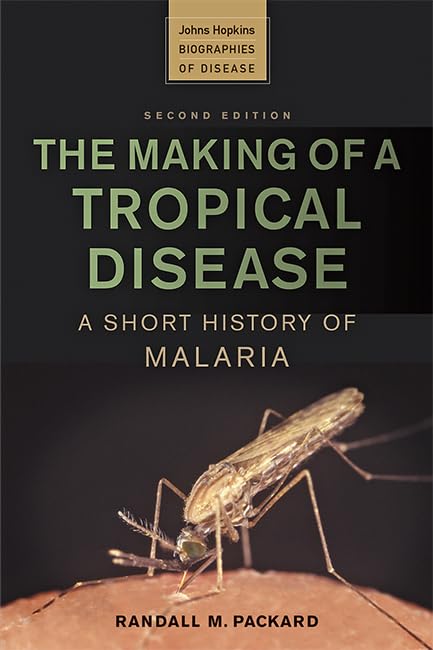
This book isn’t nearly as arcane as one might think. The subject and general theme are far outside my standard reading zone, yet I never once lost interest nor felt lost in the subject matter.
Author Randall Packard’s central message is abundantly clear: malaria is a social disease and only significant economic development and social change can eradicate it. He seeks to demonstrate his point with historical case studies. For instance, malaria once thrived in such places as southeastern England and across the United States as far west as Illinois. Yet, malaria is practically unthinkable in those places today despite the fact that no concerted anti-malaria campaigns were ever undertaken.
So how did malaria disappear from such places in the absence of even elementary knowledge of the disease and its transmission? Simple, Randall argues: the social ecology of those places changed in ways that are not conducive to the propagation of malaria. Namely, it was plantation cash-crop farming that relied on large numbers of indigent, migrant labor residing close to irrigation water sources that allowed malaria to thrive. It was the introduction of inland rice and cotton farming in South Carolina, for instance, as well as the introduction of African slaves who in all likelihood brought the parasite to the US, that brought the disease to this country, and it was the industrialization of the south and the end of sharecropping in the early twentieth century that eliminated it. Again and again, through numerous examples, Packard shows how human action, usually related to farming practices and then industrialization, led to the introduction and/or elimination of the disease.
The fundamental lesson that Packard draws from his work is that only human ecology and economic development can address malaria in any meaningful way. Any effort to destroy the disease either through killing off the vector (female anopheline mosquitoes) or attacking the parasite itself (Plasmodium falciparum, in particular), Packard argues, can at best keep the disease under control, but with no hope to eradicate it. Although he never comes out and says so explicitly, Packard makes it clear that the Gates Foundation’s push for a malaria vaccine is “here we go again” and will ultimately end with disappointing results like previous attempts at malaria eradication by attacking the vector or parasite only.
Needless to say, I learned a lot in this book. One thing that surprised me was just how difficult the transmission of malaria actually is. In order for a person infected with the most serious form of malaria (Plasmodium filciparum) to pass the disease on via the mosquito to another host a string of statistically unlikely events need to occur. First, the malaria parasite needs to be at a phase in its life when it is producing a sufficient number of gametocytes, which are required for sexual reproduction in the gut of a female anopheline mosquito. According to one study cited by Packard, only about 1% of an infected population has a sufficient number of gametocytes in their bloodstream to serve as “infectors.” Second, even if a mosquito bites an “infector” host there is only about a 35% chance that it will actually ingest a gametocyte. Finally, before the parasite can be passed from the mosquito to a new host, the gametocyte needs to reproduce and send sporozoites to the mosquito’s salivary glands, a process that takes 14 days to complete – and the lifespan of a female anopheline mosquito is just 10 to 21 days. Another study cited by Packard suggests that for every 10 gametocytes ingested by a mosquito, only one successfully reproduces and is introduced to a new host to start the lifecycle anew. Thus, the numbers required to keep malaria alive in a population – both infected people and mosquito vectors – is enormous. I did some back-of-the-envelope analysis and determined that it would take over 3,000 people infected with malaria in a mosquito-rich environment to pass the disease on to just a single new host.
In 1957 epidemiologist George Macdonald sought the eradication of malaria by treating the problem as a mathematical challenge that sought to achieve the cross-over point the disease simply could not sustain itself and ultimately vanished from existence. Given the numbers above, I can see why this approach had appeal. The end result of this hypothesis to disease eradication, Packard notes, is that malaria became viewed a vector-borne disease (i.e. efficiently kill the mosquitoes and you will wipe out the disease) rather than what the author argues passionately it is, a social condition. Moreover, the wonder chemical that promised to end malaria once-and-for-all by destroying mosquitoes was DDT.
That anti-malaria effort of the 1960s was actually quite effective in rolling back malaria in many countries, although the disease quickly returned once the aggressive pesticide treatments abated, while no economic development had occurred.
In sum, this is a fascinating book and is highly recommended to anyone with an interest in economic development or simply intrigued by difficult puzzles to solve. Unfortunately, the book is somewhat depressing as Packard maintains that only serious economic development in sub-Saharan Africa and other depressed areas where malaria is endemic will end the disease. And, of course, that is a nut not easily cracked.
 What's Tim Reading Now?
Leave a comment