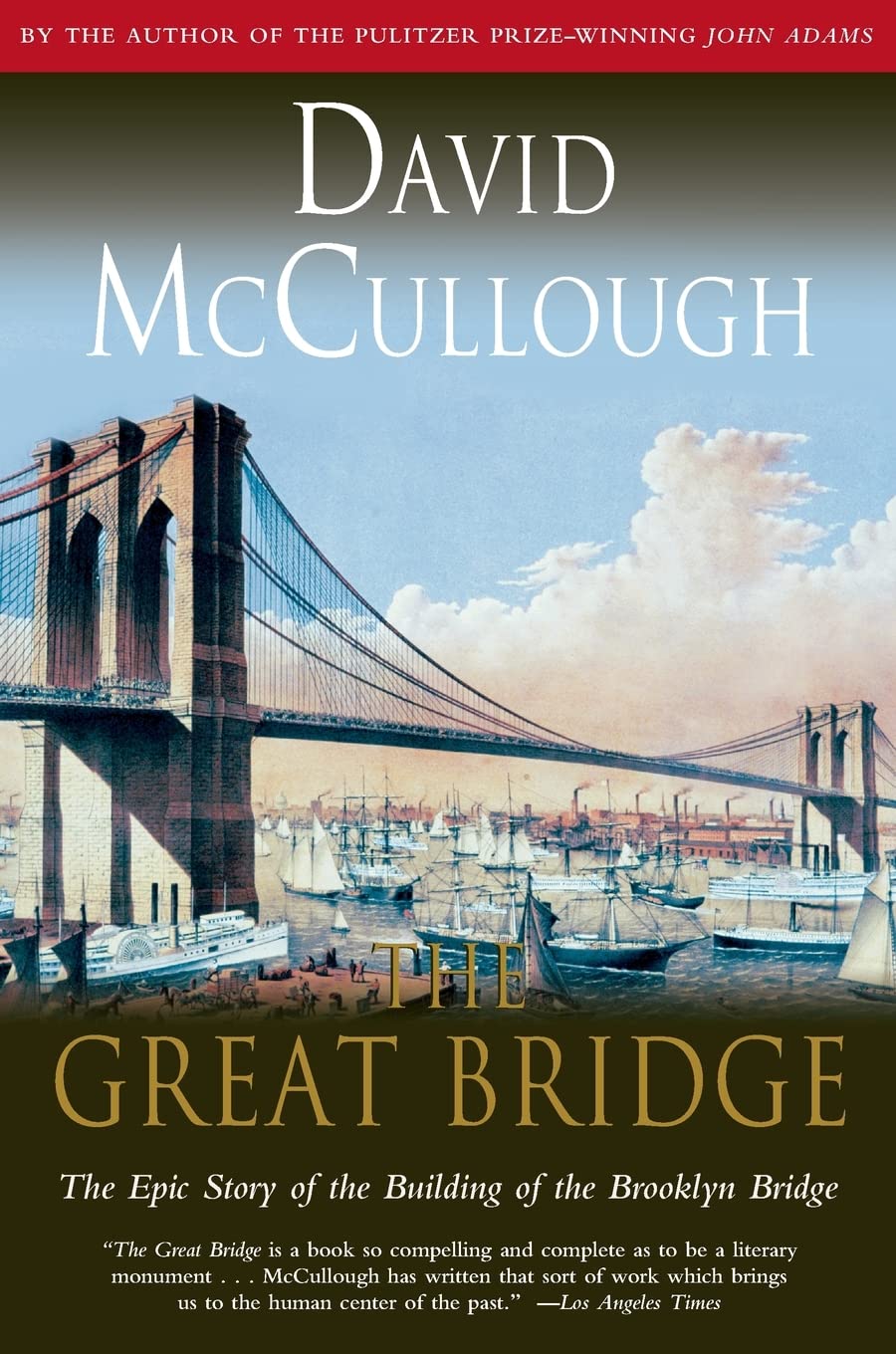
hadn’t read anything by David McCullough in several years and had forgotten just how masterful a storyteller he is. The Great Bridge, published in 1972 as McCullough’s second major historical work, remains a towering achievement in narrative nonfiction and has earned its place at #48 on The Modern Library’s list of the “100 Best Non-Fiction Books.”
Few nonfiction authors can weave as rich and compelling a tapestry as McCullough. The book seamlessly shifts between detailed technical explanations of mid-19th century suspension bridge engineering, gripping biographical portraits of the key figures, vivid portrayals of New York’s political corruption under Boss Tweed, and even accessible medical explanations of decompression sickness—known then as “the bends.” McCullough’s prose is so engrossing that one feels confident he could make the construction of a remote highway stretch as enthralling as the Brooklyn Bridge.
The bridge itself was far from an ordinary feat of engineering. Dubbed the “Eighth Wonder of the World” upon completion, it was the longest suspension bridge ever built and stood as a marvel during an era when such bridges were notorious for catastrophic failures and deadly collapses.
What makes the Brooklyn Bridge truly awe-inspiring is that its design relied solely on the raw intellectual power of its creators, John Augustus Roebling and his son Washington Roebling, working with nothing but pencils, paper, and their prodigious mathematical minds. Lacking any modern computational tools such as CAD or finite element analysis software, the Roeblings performed complex calculations by hand—using advanced calculus, physics, and linear algebra—to predict and ensure the bridge’s ability to withstand wind, weight, and the dynamic forces of the East River below.
Construction began in 1869, with the sinking of two enormous caissons—massive timber and iron boxes—that would serve as the foundations for the bridge’s iconic granite towers. These caissons had to be sunk nearly 80 feet beneath the riverbed to bedrock, all while workers labored in hazardous, cramped, pressurized environments to excavate underwater soil. This was an unprecedented technical challenge. The compressed air inside the caissons prevented water from flooding in, but it exposed workers to the mysterious and then poorly understood risk of decompression sickness. Scores of laborers suffered agonizing pain, paralysis, or even death from the bends, including Washington Roebling himself, who was gravely incapacitated early on and forced to oversee much of the project from his Brooklyn home.
The innovative use of pneumatic caissons represented a milestone in civil engineering, setting standards for future underwater construction. Additionally, the Brooklyn Bridge’s signature steel-wire cables were among the first to be used on such a scale, a testament to the Roeblings’ commitment to pushing the boundaries of material technology.
The bridge’s construction spanned more than a decade, finally opening in 1883. Throughout that time, the Roeblings contended not only with physical and technical challenges but also political intrigue, financial struggles, and public skepticism. New York City was rife with corruption and graft, personified by the infamous Tweed Ring, whose manipulation of public funds and contracts threatened the project’s progress. McCullough paints a vivid picture of this chaotic urban backdrop, making the bridge’s eventual completion all the more miraculous.
The Great Bridge is a profound meditation on human ingenuity, perseverance, and sacrifice. It honors the visionaries who dared to dream big and the thousands of workers who turned that vision into reality under brutal conditions. Through McCullough’s masterful storytelling, the Brooklyn Bridge emerges not only as an engineering landmark but as a symbol of American ambition and resilience.
David McCullough is truly a national treasure, gifted with the rare ability to bring history alive and help us remember the stories that shaped our world.
 What's Tim Reading Now?
Leave a comment