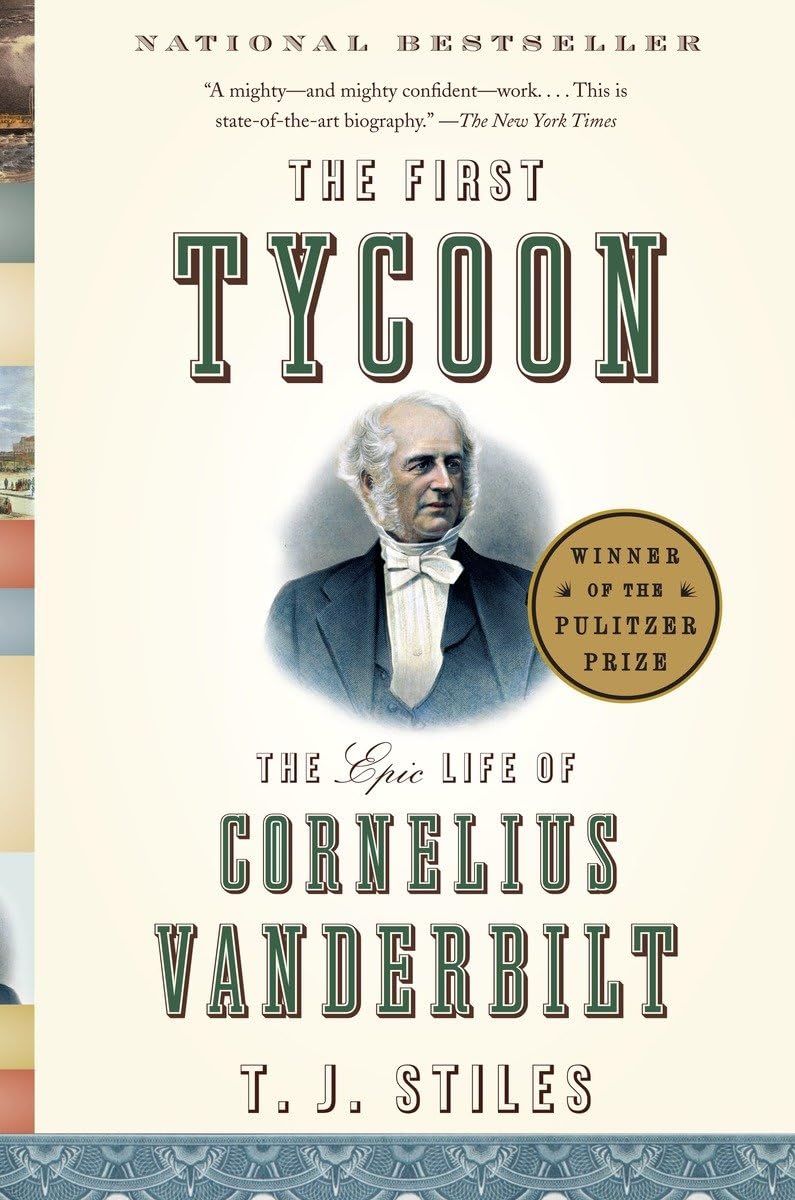
About a decade ago, I undertook a personal project: read the best biography in print on each of the most illustrious (or notorious) Robber Barons. I read Chernow on Rockefeller (brilliant), Wall on Carnegie (very good), Strouse on Morgan (solid), and Klein on Gould (disappointment). I very much wanted to read something on Vanderbilt, but to my shock nothing of worth was available. T.J. Stiles’ “The First Tycoon: The Epic Life of Cornelius Vanderbilt” is the biography I had been longing for. It is, to put it simply, phenomenal; not just the best biography of Vanderbilt ever written, but perhaps one of the best American biographies delivered in many years.
Beautifully written and skillfully crafted, “Tycoon” succeeds mainly by putting Vanderbilt in familiar, human terms, placing him in the context of the national social, political and economic development he did very much to create. Indeed, as Stiles concludes, “Probably no other individual made an equal impact over such an extended period on America’s economy and society [as Vanderbilt].”
What makes “The First Tycoon” truly superlative is that Stiles delivers so well on two fronts: explaining Vanderbilt the man and Vanderbilt the businessman.
First, Cornelius Vanderbilt, the man. He was a coarse, tireless, uneducated boor, who just happened to be a true genius of capitalism. Born and raised on Staten Island, Stiles notes that his life and success were ultimately linked with that of his hometown, New York City. At best the nation’s third city in his childhood, Vanderbilt’s life and affairs would mirror the rise of New York as the principal economic and cultural hub of the new American states. Moreover, Vanderbilt was, from a young age, much like his hometown: aggressive, risk taking, insatiably ambitious – full of what was then called approvingly “to go ahead.” From his role in the landmark Supreme Court decision striking down the steamship monopoly in Gibbons v. Ogden to his campaign of consolidation in creating one of the largest railroad monopolies in the New York Central, Vanderbilt was a fearless trailblazer, ever ready to risk his fortune and frequently his life in a struggle for supremacy. It was a conflict that he ultimately won, just like his native New York City.
But, more surprisingly, Stiles demonstrates that Vanderbilt was also faithfully sober and reflective, self-possessed and often emotionally distant. He saw himself as a man of honor and integrity, and an American patriot who staunchly supported the Union during the Civil War and then devoted himself to national reconciliation in its aftermath (Nashville, Tennessee’s Vanderbilt University is the most enduring monument to that cause). And, according to Stiles, it mattered deeply to Vanderbilt that others saw him that way: a gentleman worthy of dignity and respect. Deliberately apolitical, he espoused a personal philosophy of laissez-faire that, Stiles writes, “morphed from radical to conservative [over the course of his professional life from the 1820s to the 1870s] without him even noticing.”
Vanderbilt’s relationship with his namesake and second son, the dissolute gambling addict Cornelius Jeremiah, forms a key pillar of Stiles’ biography. It adds a painful, human shading to the remarkable story of his business career. His son brought Vanderbilt so much torment and shame, marital strife and personal agony, yet the old man never quite gave up on him, forever holding out hope that Cornelius would change his ways. This father-son sub-story, more than any other, brought Vanderbilt to life for me.
Second, Cornelius Vanderbilt, the businessman. Some men become millionaires simply because they were at the right place at the right time. Few are truly transcendent; business geniuses, who possess a rare combination of intelligence, drive, shrewdness and what Napoleon called “the inner eye” that virtually assured dramatic success, who can perceive the future contours of business life and transactions before any of their rivals. Vanderbilt was clearly such an individual, an extremely competent man of business, who combined technical skills with sagacious operational abilities and a subtle appreciation for the value of new technology, such as steam power or the railroad, and new organizational devices, such as the corporation or common stock (Vanderbilt led the way toward stock price as a value of the future value of a company rather than the total investment capital divided into $100 shares). He was competitive, physically strong and brave, never shrinking from settling matters with his fists, if necessary, who regularly sought out challenges for impromptu horse drawn carriage drag races down Manhattan streets, and who often pushed aside his steamship captains during treacherous seas to take the reins personally. As he entered his eighth decade, Stiles notes, “He had survived fistfights, boiler explosions, a train wreck, heart trouble, Nicaraguan rapids, exposure to tropical disease, Atlantic storms, and wagon smashes.” Imagine a daredevil executive today who personally designed his own aircraft, served as the chief test pilot, who frequently pushed aside his appointed captains to personally pilot the plane through severe weather, and who has an established reputation for racing his custom-made Ferraris in illegal sideshows on the weekend. That was Cornelius Vanderbilt. Richard Branson is the closest contemporary comparison point – and a pale benchmark at that.
Known (and remembered) for his ruthlessness, Stiles demonstrates that Vanderbilt was usually successful because his operations were so much more efficient and cost effective than his competitors, especially the steamships that he personally designed, which often used half the fuel of competitors. And when he moved to railroads, his empire (the New York Central and Hudson Lines, and the Harlem) boasted the flattest, straightest and thus the most fuel efficient lines. In short, his success was no accident or the mere result of price gauging. Vanderbilt always ran the most cost effective and operationally efficient operation, whether it was steamships or railroads, and his wealth grew accordingly. And when he was aggressive and acquisitive, Stiles stresses that Vanderbilt’s motivation was positively Roman: he took over competing (i.e. barbarian) lines only to ensure the safety and health of his core trunk lines leading to his home port of Manhattan.
Mark Twain evidently held a low opinion of the Commodore (likely the result of jealousy): “How I do pity you, Commodore Vanderbilt! You seem to be the idol of only a crawling swarm of small souls, who love to glorify your most flagrant unworthinesses [sic] in print; or praise your vast possessions worshippingly; or sing of your unimportant private habits and sayings and doings, as if your millions give them dignity.” But the author makes clear that there was much about Vanderbilt that was “worthy” and that his “vast possessions” were the fruit of innovation, relentlessness, and an enterprising spirit – the very spirit that has animated the growth and success of the United States of America.
 What's Tim Reading Now?
Leave a comment