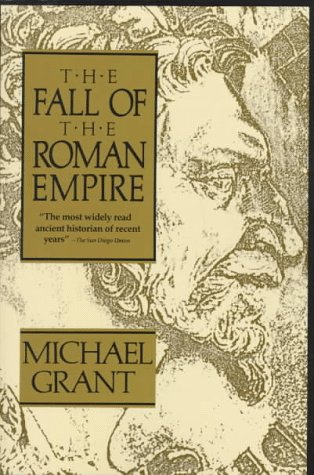
Michael Grant may not be the most revered classical scholar of the late twentieth century, but he just may be the most prolific. Mr. Grant published on an astonishing scale, especially for a man who spent most of his adult life in the diplomatic service of his country, Great Britain.
This piece, underscoring the many reasons contributing to the fall of Rome in the fourth century, is a lucid and broadly accessible analysis of the decline and collapse of the greatest empire in history; a “Gibbon for the common man” one might say, only without the great eighteenth century historian’s reluctance to assign fault and causality.
After reading “The Fall of the Roman Empire” it is difficult to ascertain precisely how or why the imperial state lasted as long as did, precisely the question that Chester Starr examined in his 1982 monograph, “The Roman Empire, 27 BC – AD 476: A Study in Survival.” Grant argues that only the internal flaws can account for the fall of Rome, which really transpired over the course of just a century; barbarian invasion was necessary, but not sufficient to explain the collapse. The author highlights no less than thirteen disunities that he claims undermined the Roman empire and led inexorably to its disintegration. Any one of them, it seems to me, were enough to seriously injure the health of the expansive polity of the Roman empire, a territory so vast, so encompassing that Starr refers to it as an “impossibility” in his piece.
To begin with, Grant highlights the failure of the Roman system to deliver a smooth and legitimate transition of power to the emperor’s throne as a primary source of disunity. Indeed, this structural flaw was cited by both Machiavelli and Montesquieu as the principle reason for Rome’s downfall. With each succession the empire was rocked by civil war and competing claims to the throne backed by parochial armies from the frontier. These internal conflicts resulted in the fracturing that allowed the Barbarians a frequent opening to invasion and conquest.
Moreover, Grant argues, by the end of the empire, the Romans had no real “Roman” army at all. The vast majority of the troops in the legions were conscripted or mercenary Germans — or even Huns from the newly federated lands, autonomous swaths of territory populated and ruled by Barbarians under the ostensible rule of Rome. There were no genuine Romans left to draft, so thoroughly had the agrarian lands been denuded of small landholders, which traditionally provided the backbone of the legionnaires. And these new German legionnaires were poorly assimilated into the social body politic (more on that below).
Next, the author stresses that the Roman state needed money to pay its army, the very army it needed to survive as an empire. Yet, the collection of this revenue did much to destroy the empire by imposing a terrible tax burden (Grant claims that 90% of imperial revenues were derived from land taxes) on the foundation of citizenry, the rural farmer, the same rural farmer that traditionally provided the manpower to the legions. (Note: some recent classical historians, including Starr, have argued that the cost of supporting the imperial army was not that onerous, coming out to the modest sum of 15 sesterces per person per year, at least in the early empire. Unlike those authors, Grant never attempts to define the budget and tax rates, which undermines his argument).
In a theme that resonates today (at least for me), Grant also argues that the elite in later Roman society were far richer, relatively, than their ancestors during the Republic (five times richer, he claims), and worse yet they felt little desire or obligation to serve the state, either in politics or in the army, an undertaking once considered noble, but in the final centuries deemed beneath the highest wrung in society. So, the rich lived their lives of luxury on their estates and deprived the state of desperately needed leadership for generations, while the Emperor himself remained completely detached from his people, living increasingly outside the city of Rome in Milan, on isolated estates at Ravenna or elsewhere, often relying on pithy taglines on the ubiquitous bronze currency trumpeting an imperial glory (e.g. “Unconquered,” “Perpetual”) long since vanished to prop up his image across his empire. Also along this line of detachment from society, Grant describes a growing set of voluntary “drop outs” from the Roman community that further eroded manpower and general civic cohesion, monks and nuns mainly, living in remote convents who were perhaps a bit more like Hippies in the 1960s. However, the author makes no credible argument that their numbers were sufficient to actually damage the fabric or functioning of society any more than the Hippies ultimately did, although they did serve as the ultimate expression of rejecting the conventions of the hallowed past.
Finally, the Romans couldn’t get along among themselves. There was a concerted effort to unify around Christian faith, but that only created deep and passionate schisms in society, resulting in efforts to deny freedom of religion, first against pagans, then against Manichaeans and Jews, and finally against Christian heretics, which Grant argues were some of the most brutal and violent persecutions. Meanwhile, the Romans failed utterly in assimilating the large numbers of Germans — nearly all of whom converted to the Arrian brand of Christianity, a sect ultimately rejected by the mainline Roman church — who became citizens in the later empire as former Barbarian territory was federated into the empire, an inflow of martially inclined manpower that, for a time, propped up the sagging legions.
In closing, this is a solid introduction to the many threads that in part or in concert led to the Fall of Rome, one of the most fascinating and enduring of historical subjects. It is targeted at the lay reader and Roman history novice and serves that audience well.
 What's Tim Reading Now?
Leave a comment