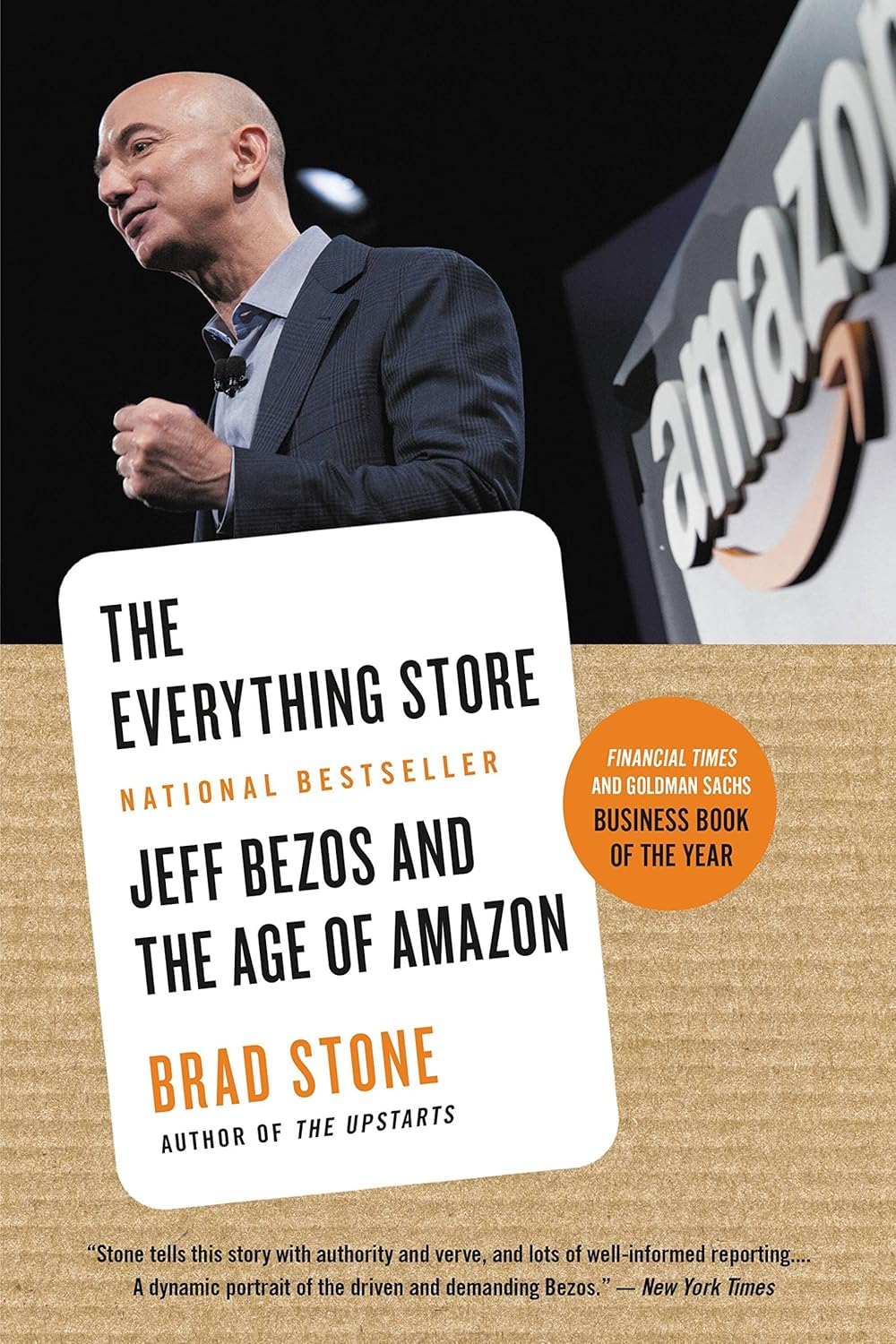
Full disclosure: I’m a big Amazon fan. I’ve been writing reviews on the site for over a decade. I’m a highly satisfied shareholder and avid Prime customer. I also happen to believe that Jeff Bezos is among the most visionary and accomplished entrepreneurs and chief executives of modern times. In “The Everything Store: Jeff Bezos and the Age of Amazon,” veteran business reporter Brad Stone delivers an incisive, balanced, and fast-paced peak inside the secretive and amazingly innovative $150 billion tech behemoth.
As a Silicon Valley technology executive who has long admired what Jeff Bezos has done up in Seattle, this book delivered two critical insights I found especially noteworthy.
First, nothing can compensate for a founder/CEO of genius with a commanding ownership share in the enterprise. The more I live and the more learn, the more I realize that individuals really, really matter, particularly when they are in a position to make sweeping decisions. Like Steve Jobs at Apple or Larry Ellison at Oracle or Henry Ford, truly amazing things happen only when lightning strikes: when visionary entrepreneurs are also strong enough to hold on to their business creations and guide them forward, often pushing the kind of bold gambles and innovative risks that classically trained CEOs beholden to Wall Street analysts simply would never ponder.
Nowhere is this more evident than with Amazon’s improbable rise from the ashes of the Dotcom bubble in the 2000s. The early story of Amazon’s rise in the mid-90s is familiar and, frankly, not terribly interesting in my opinion. A few daring and naïve young men and women in a garage pursuing a crazy dream that nobody thinks can work. It’s been told a thousand times. What makes Amazon so impressive is how the company survived and then thrived in the later years when many in the industry had written the company off for dead or irrelevancy. If Amazon had had a founder like eBay’s Pierre Omyidar, who quickly hired a seasoned executive like Meg Whitman to take over leadership of his highflying startup, I’m quite certain that the Amazon we know today would not exist. In fact, I’m nearly certain it would be gone, gobbled up by Walmart or some other retailer. Amazon Web Services, Kindle, Prime; each of these strategic initiatives were risky multi-billion dollar bets that would takes years to pay off, and yet Bezos bet big on each despite much hand-wringing from his board of directors and top lieutenants. As Stone writes, “Amazon had grown from a beleaguered dot-com survivor battered by the vicissitudes in the stock market into a diversified company whose products and principles had an impact on local communities, national economies, and the marketplace of ideas.” In short, Amazon is the Amazon we know today only because of Jeff Bezos. He has a vision, an irrepressible will, and an iron grip on strategic decision making.
The second key insight has to do with that Bezosian vision, which Stone demonstrates is a relatively simple philosophy. “We don’t have a single big advantage,” Bezos has said, “so we have to weave a rope of many small advantages.” What is so remarkable is how tenaciously Bezos adheres to those principles and makes the most out of those small advantages, even when conventional business school wisdom suggests they are being foolish or reckless. At the core of the philosophy is long-term, customer centric thinking. Here’s how Bezos describes it: “We are genuinely customer-centric, we are genuinely long-term oriented and we genuinely like to invent. Most companies are not those things. They are focused on the competitor, rather than the customer. They want to work on things that will pay dividends in two or three years, and if they don’t work in two or three years they will move on to something else. And they prefer to be close-followers rather than inventors, because it’s safer. So if you want to capture the truth about Amazon, that is why we are different.” Again, only a company with a visionary founder with general management acumen and a commanding ownership stake in the enterprise can ensure that a company sticks to those kinds of principles in the face of mounting losses and withering criticism from Wall Street analysts.
Closely associated to this “long-term-customer-first” mentality is Amazon’s relentless focus on lowering prices. Stone suggests that a 2001 meeting between Bezos and Costco founder Jim Sinegal was pivotal. Sinegal told Bezos: “There are two kinds of retailers: there are those folks who work to figure how to charge more, and there are companies that work to figure how to charge less.” For Bezos it was an epiphany – and a roadmap. Amazon was “going to be the second, full-stop.” The focus on “customer first” and low prices has allowed Amazon to emerge as a world class, truly unique retailer that blends the best of “Walmart AND Nordstrom’s.”
These core values have shaped the culture at Amazon. The first, “frugality,” is starkly different from competitors like Google, famous for their free lunches and massages. “We try not to spend money on things that don’t matter to customers. Frugality breeds resourcefulness, self-sufficiency and invention. There are no extra points for headcount, budget pie or fixed expense.” To this day, senior Amazon executives flight coach and Stone notes that Bezos, one of the richest men in the world, still uses his coffee card at Amazon that allows him to get his 10th drink free. Next, Amazon prides itself on a no-holds-barred approach to getting things done, where teamwork is critical, yet all executives are exhorted to “Have Backbone.” “Disagree and Commit: Leaders are obligated to respectfully challenge decisions when they disagree, even when doing so is uncomfortable or exhausting. Leaders have conviction and are tenacious. They do not compromise for the sake of social cohesion. Once a decision is determined, they commit wholly.” In Bezos’ own words: “The reason we are here is to get stuff done; that is the top priority. That is the DNA of Amazon. If you can’t excel and put everything into it, this might not be the place for you.”
The drive for delivering lower costs has also developed a bare knuckles style of market competition. Stone suggests that Amazon is willing to go to extraordinary lengths to deliver on that low price promise, often throwing its weight around in a way that would even make the flinty executives in Bentonville blush. Once a new and threatening competitor like Zappos was identified, Bezos was prepared to go nuclear to ensure that either Zappos caved and sold out or they would be put out of business. “They have an absolute willingness to torch the landscape around them to emerge the winner,” one vanquished rival is quoted as saying.
The story of Kindle is illustrative as well. Bezos witnessed how quickly Apple destroyed Amazon’s music business with the launch of iPod and iTunes. He was determined not to see the same thing happen to their core books business. His heavy handed approach with the major book publishers was reminiscent of Steve Jobs browbeating the major music labels. Bezos picked an eBook price of $9.99 despite the howls of publishers and the absence of any market research to back up the decision. He picked $9.99 straight from the gut, much as Jobs did with $0.99 per song. The price ensured that Amazon would lose money and generated a near revolt from their publisher partners. Bezos simply didn’t care; he stuck to his guns even in the face of a major lawsuit.
One of the few disappointing aspects of this book for me was how little attention Stone devoted to Bezos’ private life, especially his marriage and family. Bezos married before founding Amazon and his wife, MacKenzie, was an early and important employee. Twenty-five years later they are still married and have four children. Yet none of this is discussed in the book. We learn in the book’s final pages that MacKenzie still often drives Jeff to work in a Honda mini-van after dropping their kids off at school, giving the corporate titan a peck-on-the-cheek before depositing him at the gates of his empire. It’s an intriguing glimpse into the human side of Bezos that the author did not pursue for one reason or another.
In closing, “The Everything Store” is an eye-opening account into an iconic and innovative corporation, which Stone calls “…relentlessly innovative and disruptive, as well as calculating and ruthless.” Indeed, Amazon is something of a Jekyll and Hyde. Or to use Randy Komisar’s terms from his 2001 book “The Monk and the Riddle,” Amazon is both a “missionary” (a company with a mission beyond making money) and a “mercenary” (a company dedicated to competing and winning). “The Everything Store” is a good biography of a company; but only a lukewarm biography of Jeff Bezos the man, even though Amazon is, in many ways, the corporate manifestation of its brilliant founder and chief executive.
 What's Tim Reading Now?
Leave a comment