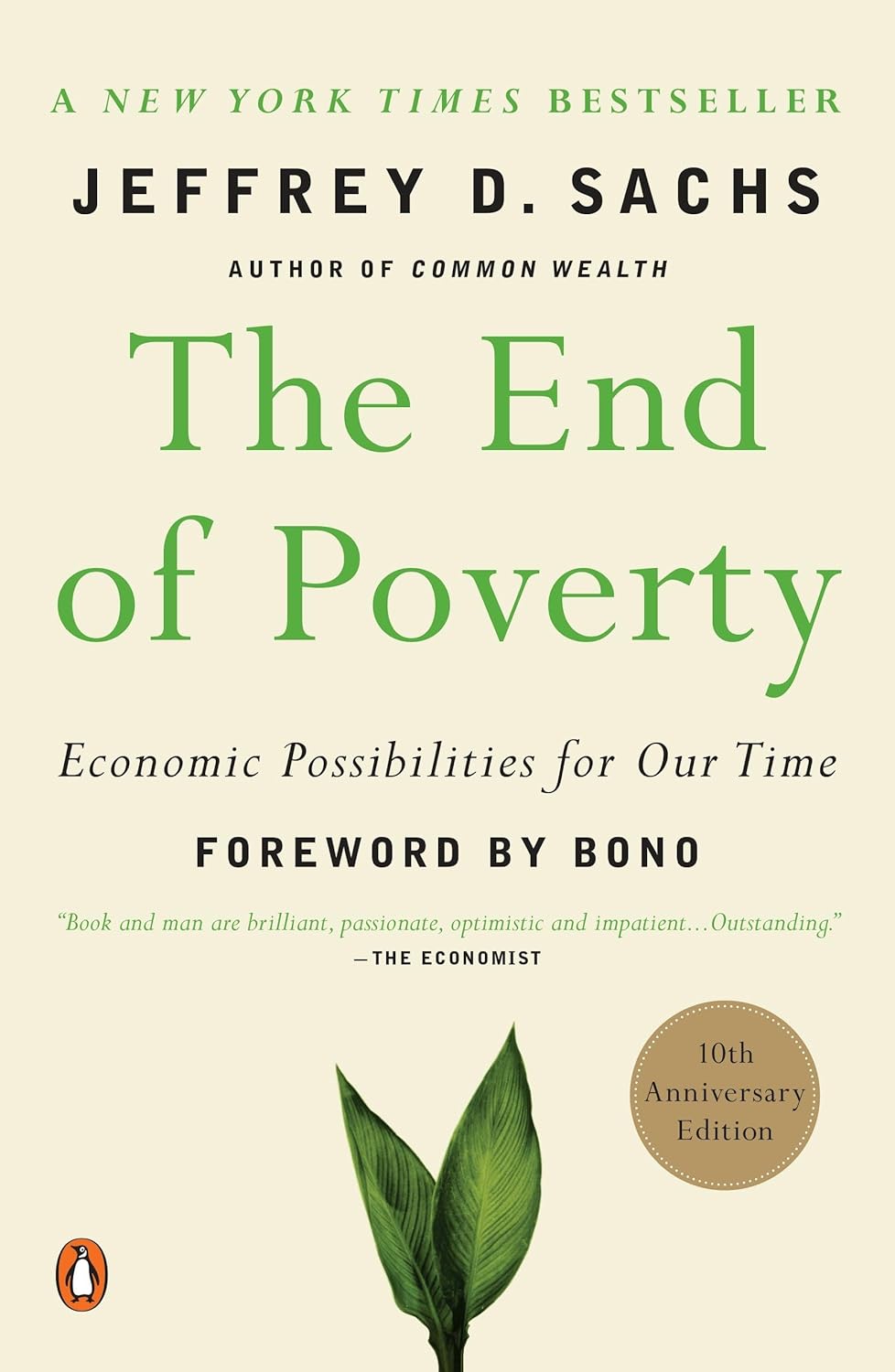
There aren’t any “I’s” in the word “development,” but there are plenty in this 2005 bestselling book on development by “Economist to the Stars” Jeffrey Sachs. The professor presents his personal vision of a grand plan to quickly eradicate extreme poverty, as though indigence was an easily treatable form of small pox. If someone would just give him a check for $1 trillion to spend over the next decade the ill of extreme poverty around the world would be sent to the dustbin of history. He writes: “The wealth of the rich world, the power of today’s vast storehouses of knowledge, and the declining fraction of the world that needs help to escape poverty all make the end of poverty a realistic possibility by the year 2025.”
In the first third of “The End of Poverty: Economic Possibilities for Our Time,” the author introduces his readers to a truly fascinating character, an intrepid man of integrity and unusual brilliance, with the ability to grasp simple and achievable roadmaps for alleviating poverty where others of immense education and experience see nothing but a tangled and unsolvable puzzle. Small wonder that many heads of state and ministers of finance from countries as diverse as Bolivia, Poland and Malawi have come knocking at his door, veritably hat-in-hand and on bended knee, begging him to lend his inimitable genius to the cause of their benighted land. The character’s name is Professor Jeffrey Sachs. And he has a plan to save the world from abject poverty. Consider this exert (and note the use of the first person): “I reject the plaintive cries of the doomsayers who say that ending poverty is impossible. I have identified specific investments that are needed; found ways to plan and implement them; shown that they can be affordable; and addressed the counsels of despair who claim that the poor are condemned by their cultures, values, and personal behaviors.”
In fairness, Sachs isn’t the only hero in his own story. In fact, he’s a big fan of any important person who is a big fan of his. For instance, Sachs writes that collaborators in Poland, Bronislaw Geremek, Jacek Kuron, and Adam Michnik, “are giants in the worldwide struggle for human rights”; his ally Dr. Gro Harlem Brundtland , Director General of the World Health Organization, is “one of the world’s most skilled political leaders”; UN Secretary-General Kofi Annan is “the world’s finest statesman”; while Harvard colleague Paul Farmer is “a saint of global health.” Evidently, the only thing remotely as impressive as being Jeffrey Sachs himself is somehow helping Jeffrey Sachs promote his vision and work.
Snarky comments aside, “The End of Poverty” is absolutely a book of value and importance, even though I don’t necessarily subscribe to the author’s central hypothesis that solving global hunger is a simple, yet expensive trick. And I certainly reject his egocentric approach to the topic, that is often grating — embarrassing actually. In the foreward, written by U2 front man and celebrated humanitarian Bono, the rock star tells a story of being approached by a flight stewardess while traveling with Professor Sachs. Bono humbly commented that the autograph seeker should instead be asking for Sachs’ signature as it will certainly be worth more in time. I can’t help but imagine Professor Sachs shaking his head in agreement with this preposterously flattering statement.
Nevertheless, Sachs makes many valid points and helpful insights in this book. One of the very best is his argument in favor of “clinical economics.” He compares contemporary development economics to physicians in the 18th century, prescribing leeches to bleed the sick, committing much harm and very little good. The professor’s wife is a pediatrician and he’s learned a lot from observing her work. He argues that five principles from medical triage should be applied to development economics: 1) an economy, like the human body, is a complex system where the failure of one system can quickly and easily cascade to others; 2) there is a fundamental importance in differential diagnosis that allows the practitioner to tap into the root cause of a common symptom (e.g. fever/poverty); 3) development, like our health, is a “family affair,” and the economist needs to ask what the industrial world family can do to help the brother sick economy; 4) the economist, like any good doctor, must monitor and evaluate for outcomes, not just inputs (i.e. what’s been done); and 5) the need to develop professional standards and responsibilities for the economist akin to the physician’s Hippocratic oath (i.e. the economist needs to truly understand their “patients” – study their history and culture – and feel ownership for their health and well-being).
Second, Sachs places particular emphasis on the criticality of physical geography. He first gained appreciation for this fact when advising the Bolivian government in the 1980s. I know from my firsthand experience in southern Afghanistan that grand dreams for economic rehabilitation easily founder on the rocky shoals of geographic isolation.
Much like other book on economic development that ostensibly are not about sub-Saharan Africa, but really are all about sub-Saharan Africa (e.g. Paul Collier’s “The Bottom Billion”), Sachs pays special attention to this benighted region, even though his goal is to eradicate extreme poverty globally. So why is Africa so desperate? Sachs quickly rejects two favored explanations from both the political Right and Left: 1) African governments are too corrupt (Sachs: no, many Asian countries, such as India, Indonesia and Bangladesh have been more corrupt and yet have achieved economic growth); and 2) colonial exploitation has devastated Africa (Sachs: no, many countries in Asia suffered just as much, if not worse). So then what plagues Africa? Sachs says it’s the 3 D’s: disease (AIDS and malaria, specifically), drought (unreliable irrigation) and distance (most Africans live in isolated, inland villages without access to navigable rivers).
So is there any hope for poor sub-Saharan Africa? Sachs says, “YES!” But it will require an integrated approach – or “package investments” – backed by major and consistent financial support from the rich countries. He uses the rural, impoverished Kenyan village of Sauri to demonstrate his point. The farmers in Sauri (and just about all the families are farmers) are caught in a classic poverty trap. Their income is so low that they can’t afford to buy critical fertilizers or medical attention. Thus, crops are reduced or fail, while family members are struck down by malaria or worse, forcing families to pull children out of school to help gather water or fuel wood. Economic growth for these families is worse than stagnant; it’s negative. Sachs argues that a “big push” in 5 interconnected development interventions is all that is needed to get these poor communities on the first rung of the development ladder. “If a country trapped beneath the ladder,” he writes, “with the first rung too far off the ground, the climb does not even get started. The main objective of economic development for the poorest countries is to help these countries to gain a foothold on the ladder.” For a mere $70/person per year a village like Sauri can be boosted to the first rung of the ladder with strategic investments in: 1) agriculture (mostly fertilizers and nitrogen rich tree plantings); 2) basic health (village technician); 3) education (primary and functional); 4) power/transport/communication (grid power, roads, cell phones); and 5) sanitation (clean drinking water). Sachs claims that a village like Sauri can be saved for a mere $350K per year. “Foreign assistance is not a welfare handout,” he stressed, “but is actually an investment that breaks the poverty trap once and for all.”
And here lies the rub with this book for me. The professor lays out a clear, albeit ambitious program of packaged, interconnected investments. He also quantifies what it might cost for a very specific village, thus remaining true to his call for “clinical economics” that treats each patient’s case as unique. Yet, this experiment, which is both remarkably cheap (you couldn’t get $5M from the Gates Foundation to prove out the model in Sauri?!) and absolutely critical to his core hypothesis, was evidently not followed up upon. He makes much of his visit to Sauri, the passion and earnestness of its people, the clarity of what needed to be done, the affordability of the needs…but that’s the last we hear of this central test case.
He goes on to chastise the Western World, the United States especially, for a general failure to live up to their financial and political commitments made in support of the Millennial Development Goals. Specifically, the West pledged to devote 0.7% of GNP to official development assistance (ODA), the most flexible and useful form of economic development contribution according to Sachs. For the United States, that would be growing foreign aid from the 2005 range of $15B (0.14% of GNP) to $75B, or roughly 50% more than the annual budget for the entire U.S. State Department.
Sachs argues that helping the extreme poor is absolutely achievable. First, the global population of extreme poor (those caught in negative economic growth) is “only” 1 billion, which he claims is a manageable figure. Second, he is focused only on “extreme” poverty, those unable to provide the basic necessities of a healthy life, not the “relative” poor who can’t afford cable and an iPhone. Third, the situation can be effectively addressed by targeted and achievable projects, mainly roads, power, soil, water and sanitation. Fourth, the new super rich in the western world can afford to pay the bill for these investments almost completely on their own. And, fifth, our available tools, especially technology, are stronger than ever. Despite these qualifications, Sachs’ plan is wildly ambitious. Indeed, rival New York-based economist William Easterly hints in his 2006 counter-thesis “The White Man’s Burden: Why the West’s Efforts to Aid the Rest Have Done So Much Ill and So Little Good” that Sachs has “delusions of grandeur.” He argues that Sachs’ “plan to end world poverty shows all the pretensions of utopian social engineering,” and goes on to negatively cite comparisons of “The End of Poverty” to the writings of discredited nineteenth century utopian Robert Owen.
Sachs estimates that the total investment per person required is roughly $110. He further estimates that even individuals suffering extreme poverty could contribute $10 per year to their own salvation and that their cash strapped governments could reasonably scrounge up another $35 per citizen in the form of taxes to support the program. That leaves $65 per person ($100 – $10 – $35 = $65) to be provided by ODA. Sachs suggests that the total ODA investment would be split roughly 1/3 to health, 1/3 to energy, 1/5 to education, and the rest distributed to sanitation and other needs.
In 2002, gross foreign aid amounted to $76B, but Sachs says that even this number, which he argues is miserly, is misleading, as much of that money was in the form of debt relief ($6B) or import credits or for expensive Western development consultants or for middle income countries he says don’t really deserve the money. Sachs estimates that only $12B of that $76B was true ODA targeting the neediest countries. Rather, according to Sachs, the world needs a whopping $195B in true ODA to the bottom billion by 2015 – or an increase of some 16 fold. Over half of this additional money would have to come from the United States, he writes. And for those who argue that ODA does not take into consideration private and NGO investment, Sachs says that those donations, while important and welcome, only total some $3B per year, or roughly 0.03% of GNP. In other words, a relative drop in the bucket. The author suggests at first that the most wealthy Americans – the top 400 income earners in 2000 who made $69B, or roughly the GDP of four African nations with a population of 161 million – pay the lion share of the required investment. Yet, like in many other examples, he doesn’t present any kind of plan, but rather offers up a 5% additional income tax on those income earners of more than $200,000. The top 400 earn, on average, $172M a year. How he got from that number to $200,000 a year, I have no idea.
He goes on to chastise the United States for spending 30 times more on defense than ODA. That is a reasonable argument to make, I think. Furthermore, he cites a CIA report that shows that there have been 113 cases of state failure from 1957 to 1994, nearly all of which contained the common denominators of high infant mortality, a closed economy, and an authoritarian regime. The vast majority of these events drew U.S. intervention in one form or another, thus arguing for the national security importance of preventing such failures. Or, as Sachs claims, “Eliminating poverty at the global scale is a global responsibility that will have global benefit.” And he cites the Marshall Plan (>1% of GNP from 1948 to 1951), Jubilee 2000 Campaign to end indebtedness and PEPFAR as examples of American generosity. But these examples begged the question for me: Were Jubilee 2000 and PEPFAR successful? If so, how? If not, why not? Again, Sachs is silent on these questions.
In closing, “The End of Poverty” is an important book and if you have half an interest in the subject you owe it to yourself to read it closely. That said, at the very least, supplement your reading of this book with Easterly’s “The White Man’s Burden” and Paul Collier’s “The Bottom Billion.” Sachs deserves to be read with thought and care. But think (or read) twice before you swallow his utopian visions of a world without poverty so close and so easily achievable.
 What's Tim Reading Now?
Leave a comment