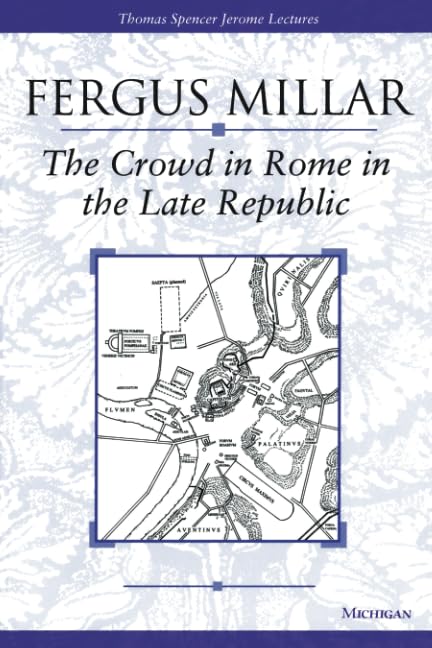
The conventional academic view of Rome during the Republic is that of small, all powerful aristocratic government. Fergus Millar turns that entire argument on its head in “The Crowd in Rome in the Late Republic.” He says that too much focus has been put on the role of the patrician and noble class. Yes, family heritage was clearly an important factor in one’s electability to higher office and the Senate was prestigious. But what about the “facts,” what we truly know about the Republic and not what we have inferred from the writings of its leading statesman? For instance, that birth guaranteed someone nothing and that only the people as expressed in the popular assemblies could legislate. Millar takes issue with the whole paradigm of Rome’s political domination by the web client relationships. He says that these assumptions of clientele and elite control are just that, assumptions. His goal is to deliver an admittedly one sided argument that the Roman people, as expressed by participation in the open spaces in Rome, clearly dominated events. Indeed, he argues that it is one of the few sincere ancient examples of true democracy in action.
Millar hammers home a few themes time and again: all political acts in Rome involved a high degree of public theater, mostly centered on the Forum itself. In other words: “Control the Forum and you controlled Rome.” The author cites Catiline as an early example. Clearly the would-be usurper had strong support outside of Rome, but the urban Romans weren’t with him. Why not? Millar says that Cicero himself noted the great contradiction of the urban political position. Their numbers and position in Rome gave them great political power and they were best positioned to enjoy the fruits of empire (e.g. triumphs, gladiatorial games). If, however, they used that power and money to get for themselves land plots, they would quickly lose that privileged position of power and politics. A real Catch-22.
Concerning the Catiline conspiracy, Millar says that the most remarkable thing was the absence of crowd reaction throughout the whole affair. Why? The Senate and Cicero were able to garner support throughout Italy while Rome remained quiescent. This is important, of course, given Millar’s core theme of control of the Forum as the most potent political weapon.
In addition to publicity is the concept of “public accountability,” Millar says. Just looks at the new laws (62 BCE) that some sort of auditing be done before granting a triumph (e.g. proving that 5,000 enemy perished) and the new requirement of public oaths both before and after taking office. As powerful as the Senate was thought to be, Millar writes, nothing could stop a tribune (or praetor or consul) from calling a contio and then a vote if the Senate denounced a law. Sovereignty truly and fully rested with the people, Millar says. And all of it focused on the Forum itself – the verbal persuasion, the legislative activity, and ultimately the violence. Not only was the Senate powerless to stop legislation it opposed, Millar writes, they were powerless to force through their own preferred bills.
The conventional wisdom of clientele relationship dominating Roman elections is a “modern myth” according to the author. Though it may be true, there is no direct evidence it is so. Speeches and campaigning were essential to political success, he argues. Rome’s fatal weakness was that the system of government was archaic and developed for a nuclear city state, not an imperial nation state. A system of government focused on openness and the centrality of the Forum with ultimate power residing with the people was undermined because the “people” were eventually determined by chance, circumstance or organization. That is, an empire of 1 million citizens and millions of pseudo-subjects would be at the relative mercy of activities taking place hundreds of miles away in a open space the size of American football field that could hold no more than 20,000 – and there was no way to control who exactly those people would be.
Does Millar make a credible argument? Perhaps; it’s certainly unconventional. His focus on the fact that noble birth, in theory, guaranteed nothing and that the Senate had no official power to legislate does say a lot about Roman society or at least how Romans perceived themselves and their government during the Republic. But I’m not convinced by Millar’s hypothesis that in practice the Republic was more of a rough-and-tumble democracy than an aristocratic state controlled by a small circle of noble families with traditions dating back centuries. “The crowd in Rome in the Late Republic” is often thought provoking and will certainly challenge your perspective on well known events from the last generation of the Republic, but only if you have a rather sophisticated understanding of the conventional arguments. No “new reader” to the topic should pick up this book.
 What's Tim Reading Now?
Leave a comment