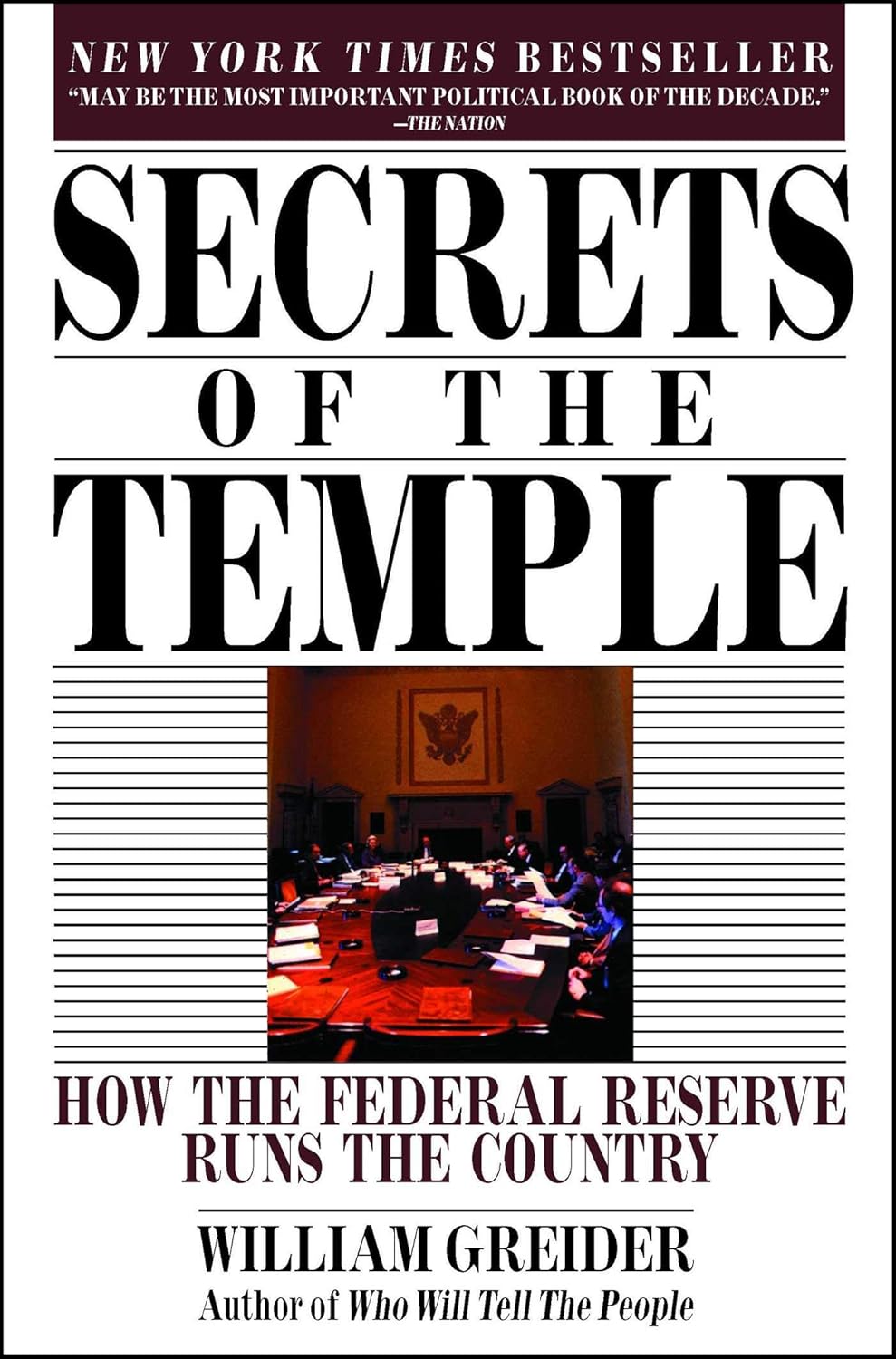
William Greider’s The Secrets of the Temple: How the Federal Reserve Runs the Country stands as a monumental work that demystifies one of the most opaque and consequential institutions in American life—the Federal Reserve. If you’ve ever found yourself baffled by headlines about the Fed “lowering interest rates” or “easing monetary policy,” Greider’s book offers an invaluable, comprehensive, and surprisingly accessible explanation. Stretching over 700 pages, it’s a demanding read, but well worth the investment for anyone seeking to understand how American monetary policy shapes the economy, markets, and ultimately, everyday lives.
Greider’s narrative centers on the era of Federal Reserve Chairman Paul Volcker (1979-1987), whose tenure is widely regarded as a turning point in modern economic history. But the book is far more than a biography or a chronicle of one man’s policy decisions. Greider weaves a rich tapestry of the Federal Reserve’s history, mechanics, and political entanglements, offering timeless insights into how central banking really functions and why it matters so profoundly.
The book’s structure divides into roughly three parts, each contributing to a layered understanding. The first section delves into the inflation crisis of the 1970s—a period marked by stagflation, oil shocks, and eroding confidence in the US economy. Here, Greider vividly portrays the economic malaise and political pressures that forced President Jimmy Carter to appoint Volcker, a somewhat unexpected choice whose radical policy shift would reshape the Fed and the economy. Volcker’s novel and controversial approach was about controlling the quantity of money directly, rather than manipulating the price of money (i.e. interest rates), which was the more common Fed practice before him. Greider carefully explains Volcker’s stunning abandonment of interest rate targeting in favor of controlling the money supply, signaling a decisive break from post-war Keynesian policies toward monetarism, influenced by economists like Milton Friedman. This section not only lays out the economic theory but also the political and institutional challenges of executing such a strategy.
Normally, the Federal Reserve manages the economy by targeting interest rates—specifically, the short-term rate banks charge each other to borrow money. By raising or lowering this rate, the Fed influences borrowing and spending in the economy. This is how the Fed usually “steers” economic activity. Instead of focusing primarily on controlling interest rates, Volcker shifted the Fed’s attention to controlling the overall amount of money circulating in the economy. The idea was that if you control how much money is out there, you can better control inflation (rising prices). Thus, the Fed started setting targets for growth in the money supply rather than setting a target interest rate. They allowed interest rates to fluctuate more freely depending on market conditions, rather than trying to keep them at a specific level. Volcker’s Fed would restrict how much money banks could create in the form of new loads, which often pushed interest rates very high as a side effect. The goal was to reduce inflation by making money “scarcer” and more expensive to borrow, even though this led to painful recessions and high unemployment in the short term.
Greider says that focusing narrowly on the money supply (such as M1 or M2 metrics) as the key lever to control the economy is a reductionist approach, much like believing that if you want to reduce the number of cars, you could simply limit steel production and thereby control the entire car market. He argues that this narrow focus on monetary aggregates often leads to harsh economic dislocations and unintended consequences, much as simply limiting steel production would not automatically or efficiently reduce car numbers without collateral damage to related industries and workers. Greider’s analogy underscores the limitations and risks of over-relying on monetary policy tools in isolation from the rest of the economy.
The middle section, arguably the heart of the book, offers a sweeping historical survey of American central banking. Greider traces the Fed’s origins back to its creation in 1913, exploring how the institution evolved through crises, wars, and changing economic doctrines. This portion serves as a primer on central banking’s complexities—from the Gold Standard and the Great Depression to the Bretton Woods system and beyond. It reveals the Fed not as a technocratic monolith but as a political institution deeply embedded in the interplay between government, finance, and public expectations. Greider’s meticulous research and storytelling bring to life the personalities, conflicts, and ideological battles that shaped American monetary policy over the decades.
The final section returns to Volcker’s aggressive monetary tightening in the early 1980s, a period that inflicted severe recession and hardship but ultimately succeeded in taming inflationary expectations. Greider details the internal and external pressures on Volcker’s Fed as it grappled with the political fallout of high unemployment and the expansionary fiscal policies of the Reagan administration. This era, Greider argues, exposes the inherent tensions within the Fed’s dual mandate and the often-painful trade-offs between fighting inflation and sustaining growth.
A defining strength of Secrets of the Temple lies in Greider’s unflinching critique of the Fed’s claim to independence and benevolence. He argues convincingly that, rather than being an impartial guardian of the economy, the Federal Reserve often acts in the interests of powerful financial institutions—the major money-center banks whose influence shapes policy decisions behind closed doors. Greider highlights the Fed’s traditional prioritization of inflation control as a professional norm, which implicitly favors creditors and the wealthy at the expense of debtors and working Americans. He portrays Volcker’s “war on inflation” as a harsh campaign that, while stabilizing prices, exacted a heavy toll on millions of ordinary people struggling with unemployment, mortgage burdens, and economic insecurity.
Whether readers agree with Greider’s political and economic interpretations or not, the book’s value is undeniable. Its exhaustive research, clear exposition, and narrative drive make it a landmark work in understanding the Federal Reserve’s role in American capitalism. Greider writes with the precision of an economist and the flair of a seasoned journalist, rendering arcane monetary policy accessible without sacrificing depth or nuance.
For economists, historians, policymakers, or curious readers puzzled by the mysterious world of central banking, Secrets of the Temple is both a guide and a cautionary tale—reminding us that the levers of monetary power have enormous consequences, wielded by imperfect institutions and fallible humans. It’s a must-read for anyone seeking to comprehend how the Federal Reserve runs the country.
 What's Tim Reading Now?
Leave a comment