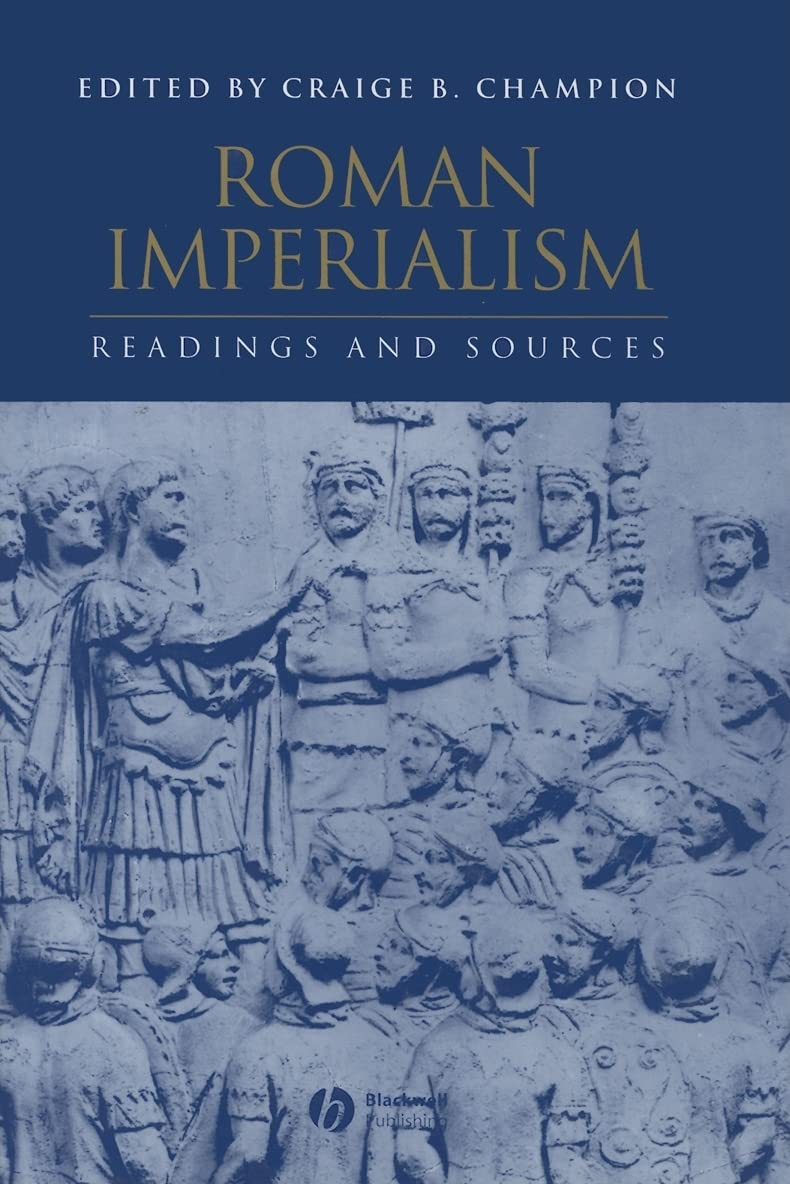
This is a book for a rather serious armchair Roman scholar or upper classman studying the ancient world or international relations more generally. While not a “popular” or narrative history, it succeeds remarkably well for what it is: a compilation of essays by some of the most distinguished Roman scholars in the world on a range of meaty topics related to imperialism in the late Republic and early Empire.
The book is broken up into four parts: 1) the growth of Roman power and imperial motivations; 2) political, economic, and social consequences of empire; 3) ideology and government of empire; and 4) “Romanization.” Each section contains two to four academic monographs from leading classicists on the given subject. These essays are mostly redacted versions of broader volumes and generally present competing perspectives on the topic. The editors have also collected helpful exerts from the writings of Polybius, Livy, Plutarch, Cicero, Caesar, Augustus, Seneca, Tacitus, Vergil, Appian, Sallust, Cassius Dio, Seutonius, Pliny (Elder and Younger), Diodorus , even the Holy Bible, that touch on the subject under review, making this volume a student’s dream.
To begin with, the editor, Craige Champion, notes that “imperialism” is a modern concept focused on the exploitation of advanced industrial, capitalist countries against other states, often tinged all around by racism. He writes that Roman imperialism is something else entirely. The traditional academic view has been shaped by Theodor Mommsen and Tenney Frank a century ago, which argued that Roman imperialism was largely defensive and reactive (i.e. Rome grew by defending itself against serious external threats).
The first section of the book on imperial motivations is the most substantive. The three articles presented by William Harris, Erich Gruen and John Rich present two ends of the spectrum on the impetus behind Roman expansion and the potential middle ground between them both. Harris attacks the traditional defensive imperialism argument of Mommsen and Frank, maintaining that Roman aggression was driven primarily by an economic motive. Not contemporary notions of mercantilism and commercial exploitation, but rather a unique set of circumstances related to public finance and plunder. Gruen argues that while economic benefits of war were clearly welcomed at Rome, it is rather misleading to see a direct, causal relationship between the two. Rather, the economic benefits of plunder had limited impact on the state treasury, while the interests of the ruling senatorial class and the Roman merchants were more often than not at odds with one another. Rome certainly didn’t go to war to benefit the business class, Gruen writes, and the indemnity that the state leveled after victorious campaigns was always set to maximize the political impact, not the economic one. Finally, Rich offers a balanced and rather convincing monograph that argues that Roman imperialism was propelled by a mix of fear, greed and glory. The old “defensive imperialism” and the new economic motivation of Harris are too simplistic, he writes. Rich argues that the wealth and prestige presented by going to war were powerful motivators in Republican Rome. But a fuller examination of Roman war fighting shows that Roman belligerence was actually rather “patchy” with stretches of peace lasting years. Moreover, until the mid-first century most of the major wars were only under taken after senatorial debate and adherence to Roman notions of “just war.” There were also powerful “countervailing” forces at work that Rich says Harris ignores, such as the rivalry between aristocratic families that sought to check and balance the wealth and glory acquired by others. He also notes that Rome did fear its neighbors, however irrational that fear may have been, like “a nervous tiger, disturbed while feeding” to use Paul Brunt’s memorable phrase.
The social consequences of empire is another interesting topic that this book addresses well with two essays from Michael Crawford and Keith Hopkins. Crawford does a great job of synthesizing the inter-connectivity of problems in the late Republic: 1) the need to fight long wars far from Rome required the state to introduce pay for soldiers; 2) state revenue was inadequate to cover these new costs so taxes leveled on the Roman population; 3) this tax was viewed more as a loan that would be repaid if possible; and 4) what better way to secure the repayment then to impose a tribute payment on the enemy. If nothing else, the Romans got the enemy to pay for their conquests. As far as exploitation of the conquered territories is concerned, Crawford maintains that the Romans took primarily three things: art, slaves and land (especially land). Hopkins builds on the importance of land in his essay, focusing on the importance of land in the Roman economy and politics. There were few opportunities for profitable investment in ancient Rome beyond real estate and the production of foodstuffs was perhaps the most important and certainly the largest industry. As the Italian countryside transitioned from subsistence agriculture to large plantations, the productivity grew dramatically so that peasant farms that once produced only modest surpluses were combined and operated with slave power, achieving economy of scale and capable of feeding a million mouths at Rome. Hopkins writes that this revolutionized the Roman economy. By the late Republic the percentage of slaves was as high as 40% (even larger than that of South Carolina at the height of slave labor cotton production). However, Hopkins says it is unclear why large landowners preferred slaves to free labor when you consider the risk of investing in slaves, although it seems to me that the price of slave labor must have dropped dramatically because of Roman conquests. A key theme for Hopkins is that once large urban markets were established, land ownership provided the elite with continuous income, whereas exploitation of the provinces did not. “Land was the main source of wealth, and wealth was a mainspring of political power” he writes. There were certainly other ways to make money in Rome, although none but land offered both prestige and wealth.
I found the final two sections less incisive and compelling. Paul Brunt and Susan Mattern explore rather loosely the ideology of empire. For Brunt, Roman concepts of predestination, glory, clemency and the “just war” were convenient fig leaves that covered rather brutal, naked aggression. Mattern sees the ideology of Roman expansion as akin to “Mafia gangsters, or participants in any society where status and security depend on one’s perceived ability to inflict violence. Image or national `honor’ emerges as the most important policy goal (a classically trained Roman scholar once told me: “if you want to understand the Roman Republic, watch “The Godfather”). The last section on Romanization argues that the dissemination of Roman cultural ways and forms happened rapidly and was much more “pulled” by the conquered elites than “pushed” by a colonizing Rome.
In closing, “Roman Imperialism: Readings and Sources” is a fantastic supplement and is strongly recommended to anyone with more than a superficial interest in the more great questions of Roman history.
 What's Tim Reading Now?
Leave a comment