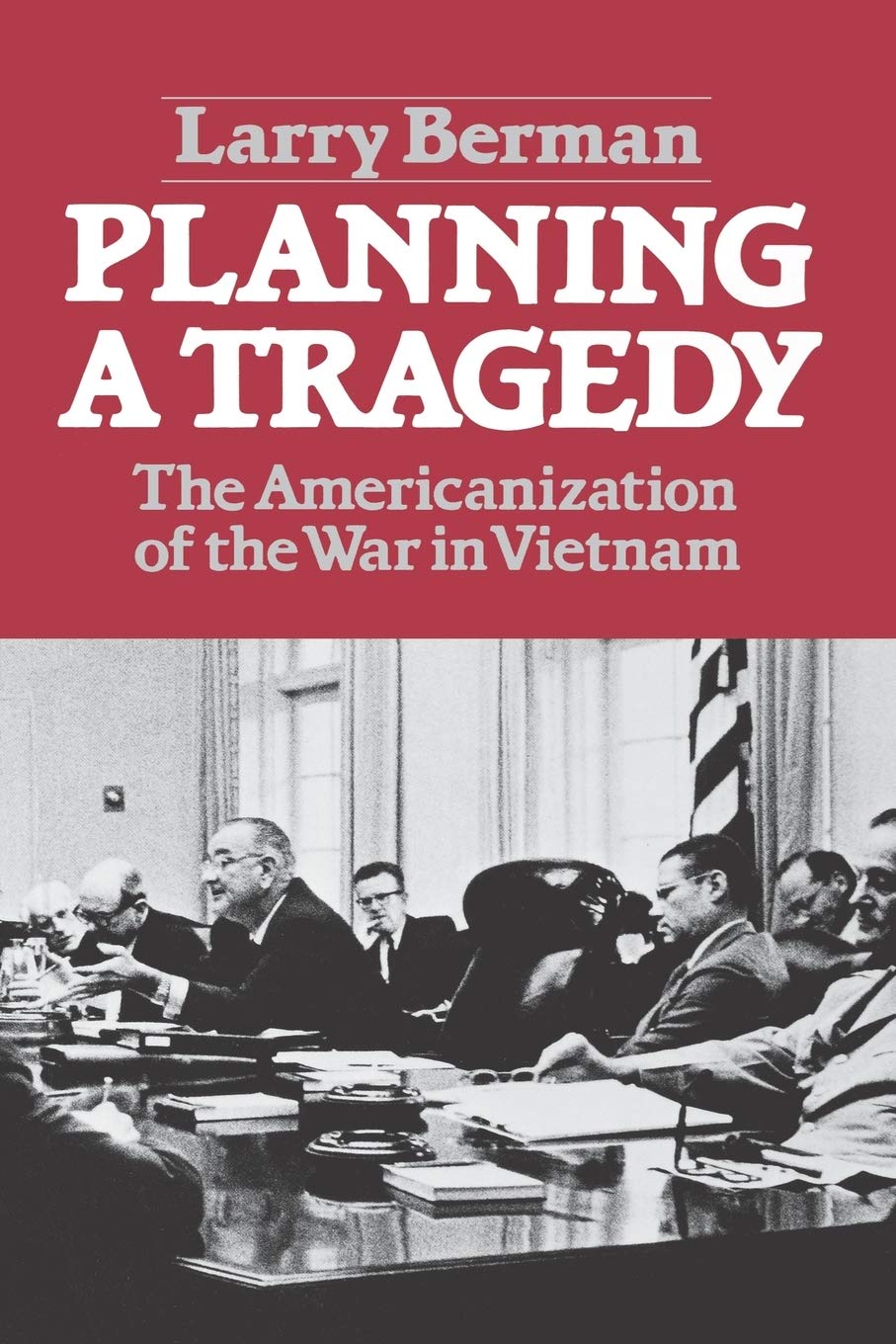
The first in a trio of insightful monographs on key decision points in the US war in Vietnam, “Planning a Tragedy: The Americanization of the War in Vietnam”, which focuses on the Johnson administration’s actions in the fateful year of 1965, may be the best of the three. The material that Larry Berman covers has been addressed elsewhere more thoroughly and possibly more authoritatively, but nowhere has it been delivered more clearly and in such sharp relief.
To begin with, Berman makes it clear that Vietnam may have been a foreign policy mistake, but it was certainly no accident. For president Eisenhower in the 1950s, Laos was always the linchpin of a free southeast Asia. It was imperative that the US convince the communists that the US would fight if necessary to defend that region. Kennedy and his advisors accepted with little resistance the criticality of what Ike started. The Bay of Pigs, Berlin Wall crisis and the Geneva conference bullying by Kruschev made a “win” on the international stage essential, and Vietnam seemed to offer relative advantages over Laos, such as a bigger and better trained army, a perceived greater sense of national unity, and ocean access for supplies, which also made it vulnerable to US airpower from sea. Shortly after being inaugurated and setting up a task force under Roswell Gilpatric to study the issue, the administration took a major step toward intervention with NSAM 52, which explicitly laid out the US objective to “prevent the communist domination of South Vietnam.” Next, the US backed coup in 1963 made Washington morally responsible for successive regimes.
Under Secretary of State George Ball figures prominently and positively in Berman’s narrative. I don’t know how anyone — even with full historical hindsight — could have made as eloquent an argument against escalation as Ball did in the Spring and Fall of 1965. It was as if he had just read Newstadt and May’s “Thinking in Time” and followed the mini-methods to get LBJ and others to reconsider the basis of their policymaking decisions. Ball tried to force a systematic review of the assumptions behind the present policy to cast light on what he perceived as pure folly. It was a valiant but ultimately fruitless effort. Slow and steady escalation may have fit with McNamara’s concept of graduated pressure, which had ostensibly proven itself in the Cuban Missile crisis, but Ball thought it was embraced because it required such little critical thinking about assumptions.
On June 5, 1965 LBJ received a memo from defense secretary McNamara, which was endorsed by Maxwell Taylor, that nearly predicted the imminent defeat of Saigon’s forces. Realizing that the time for decision was fast approaching, Ball made a last ditch effort to influence the president on his decisionmaking about troop deployments. In a June 18, 1965 memo, Ball urged LBJ not to let events get in the saddle and ride mankind. In short, he strongly encouraged the president to keep control of policy and prevent the momentum of events from taking command. In particular, he urged the commander and chief to proceed cautiously during the summer, to use the initial ground troops to feel out the waters and gauge how well US forces would do in South Vietnam. Ball warned against committing large units before the trial period was complete for fear that a major US ground presence would risk rapid escalation and make withdrawal exceedingly difficult. The gist of his counsel was: 1) make it clear that that we are not committing the US to open-ended involvement in a ground war in Asia, where ensuing “events” caused by that action would constrain our options later; but 2) rather commit our troops in a tightly controlled trial period of three months, after which we will re-evaluate our commitment to land war based on real world experience and negotiate with the South Vietnamese if they wanted us to stay; and 3) put the burden of proof on the “escalators” by asking the president to make them draft up plans for military operations, as well as plans for reaching a diplomatic settlement short of achieving all previously stated goals. He finished with a recommendation for intensive study of what “cutting our losses” would really mean, clearly hoping that by forcing a re-evaluation of present policy that rational men in the White House and cabinet would have no choice but to opt for a negotiated settlement, which is precisely what Ball wanted.
Ball was given his final shot to make his case that cutting losses was better than committing the 44 battalions. However, according to the author and others, he was never really given a chance. The meetings were more a “set piece” designed to create the impression that all sides had been fairly considered, according to Berman. Ball was dismissed primarily because he couldn’t offer any acceptable alternatives, he argues. Ball just stressed that the situation was unwinnable; committing US forces was like giving a cobalt treatment to a terminal cancer patient. The best option was to create a situation where the Saigon government asked the US to leave, thus getting out with only a minimal loss of face. But that wasn’t perceived as a legitimate alternative. Nearly all the advisors agreed and Ball failed to shift the burden of proof on those that demand a deeper commitment.
In the end, it was the absence of a stable legitimate government that convinced Ball the war was unwinnable. If there was a serious government to defend, that was a different story. The author argues that LBJ used his advisors to legitimize the option selection process, when all along he knew that he was going to just try to muddle through but wanted give historians and the public the perception that all sides were fairly considered.
Berman faults the advisors, but especially LBJ, for accepting policy hypotheses as “inalienable truths.” Chief among the unanalyzed assumptions was that of containment policy and domino theory. Both of these “rules” also constrained options once the situation took a turn for the worse. While trying to achieve the goal of halting communism in southeast Asia it was never asked “why” the Saigon government should be saved, only “how” it could be saved? The need to contain communism, keep the dominoes upright and preserve US honor and prestige obviated the importance of any legitimate government in Saigon at all. Indeed, Saigon became an impediment rather that the most critical feature of US policy.
For anyone interested in group decisionmaking and the road to war in Vietnam, in particular, there is no better place to turn than Larry Berman’s “Planning a Tragedy.”
 What's Tim Reading Now?
Leave a comment