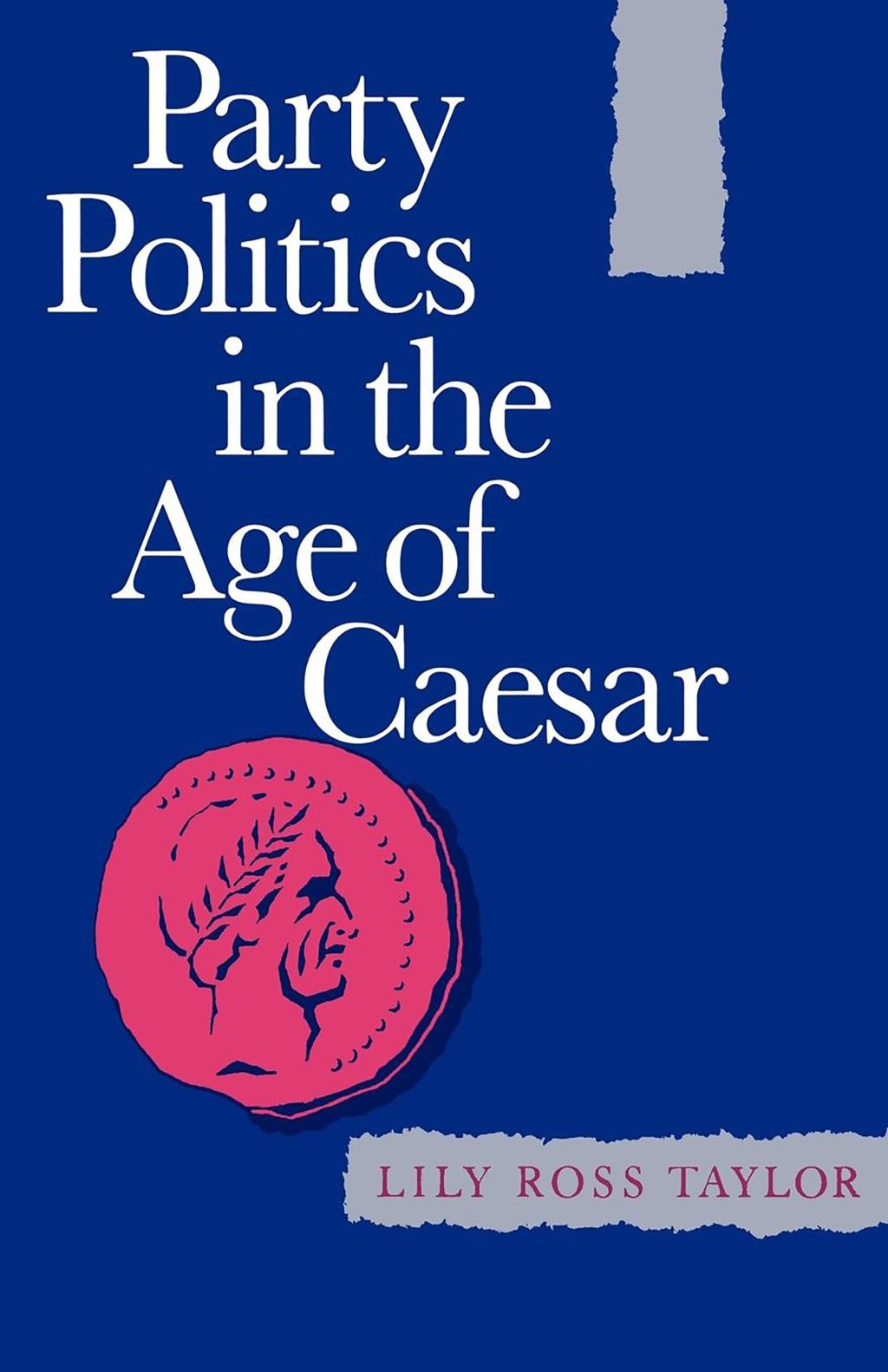
For those looking for a tight, readable introduction on political life in Republican Rome there is no better place to start than Lily Ross Taylor’s 1949 classic, “Party Politics in the Age of Caesar.” She reviews a wide range of institutions and practices — from religion and the law courts to voting assemblies and political campaigning — and does so in a way made especially easy to grasp for contemporary readers, often comparing and contrasting how modern notions of political parties and religion differ from those of ancient Rome.
Taylor stresses that we cannot think of modern political parties when studying the fall of the Republic. The parties were not between the patricians and the plebeians as in the early Republic, she says. Nor was it a struggle between conservative and liberal forces in the polity, although the contest often took on that form for personal reasons. The author argues that the struggles that brought about the parties were over competition between the nobles for political advancement. The resulting “parties” were in actuality alliances based on friendship and family obligations. Taylor emphasizes how personal the entire system was. She compares gaining office in the late Republic to winning an American major political party nomination at a convention (note: Taylor was writing in the 1940s when Democrats and Republicans still picked their presidential candidates in back room wheeling-and-dealing). The world of nineteenth and twentieth century American political “bosses” and “machines” would thus be very familiar to Cicero and his colleagues. As the hunt for securing the spoils of empire intensified, Taylor writes, these alliances of friendship began to harden and take on a semi-permanent nature.
Taylor blames nineteenth century historian Theodor Mommsen with promoting the myth that the struggle between optimates and populares was one pitting a senatorial party against a popular democratic party. She argues that the optimates/populares conflict was an internal struggle in the noble class aimed at their own personal gain and was not at all about any notions of democracy. She maintains that the populares were, on the whole, frustrated lower level nobles who were cut out of the major spoils of empire by the older, more prestigious families. It was at the people’s expense that the populares manipulated the masses to circumvent the powerful grip of a faction of high noble families in command of the powerful Senate. In theory, their differences were based on policy, but in reality, Taylor argues, is was only a difference in political means at achieving identical ends.
The Roman nobility has often been compared to the British ruling class in the way they dominated government. Taylor, however, suggests that by comparison the British were much more open to new blood outside the traditional families than the Romans. Indeed, in the last 150 years of the Republic only 10 “new men” (i.e. men without Senatorial lineage in their family) rose to the consulship, and only one man did it in the last half century (93-48 BC) — and that was Cicero. She writes that the closed political system of Republican Rome is more analogous to the ossified patriarchate of the Republic of Venice than any modern system.
Perhaps the most fascinating and illuminating section of this book, at least for me, is Taylor’s detailed accounting of the step ladder political game that Roman aristocrats competed in. The path to power and success was clear and to a certain extent regimented: early education consisted of history and especially public speaking; then military service began at age 17, often as a military tribune; around 20 years-old he would begin to appear in the Forum to make small speeches for his family; at 30 he would be elected quaestor, which assured membership in the Senate; after the one year term as quaestor, there was a mandatory 9 year break before he could run for praetor, during which time he would likely serve as a legate of a governor in command of some province to gain further military experience and might also run for the optional office aedlie as a way to curry favor with the masses by throwing lavish public festivals and games at personal expense; by age 39 or 40, if all had been going smoothly, he would secure one of the 8 praetorships; after that it was back to the field in a headlong rush for military glory and riches all so that he could achieve the dream of all young nobles, to be elected consul in “his year” (i.e. age 43, the minimum age for holding that office). The stakes were high and the competition intense, especially as there were only two consulships elected every year, one each reserved for noble families from the patricians and plebeians. This political cycle consumed nearly all the energy of the leading families, as they were either in the race themselves or looking to secure advancement for a son or son-in-law. It was literally what life revolved around for the several dozen families that ruled the Republic.
Both sides in the ensuing civil war claimed to be fighting to preserve the old Republic. Caesar was striving to save it from the tyranny of the oligarchy; Cato from the tyranny of the demagogic despot. Despite the high flown rhetoric, Taylor says, both sides were drawn by personal loyalty and interest, not ideology. All would agree that austerity, justice and honor were the guiding principles of the Republic, but no one represented that ideal better than Cato who, both in life and in death, exemplified what all nobles held to be truly Roman.
After the civil war and Caesar’s murder, Augustus ascended to absolute power, instituting a Nazi-like regime, according to Taylor, but carefully cloaked in the spirit and words of his uncle’s archenemy, Cato. The great Republican’s legacy flourished while Caesar’s wilted. He came to represent liberty and virtue, the highest ideals of the Republic. There was never a party of Cato, the author says, but rather a cult of Cato, and it had no opposition.
 What's Tim Reading Now?
Leave a comment