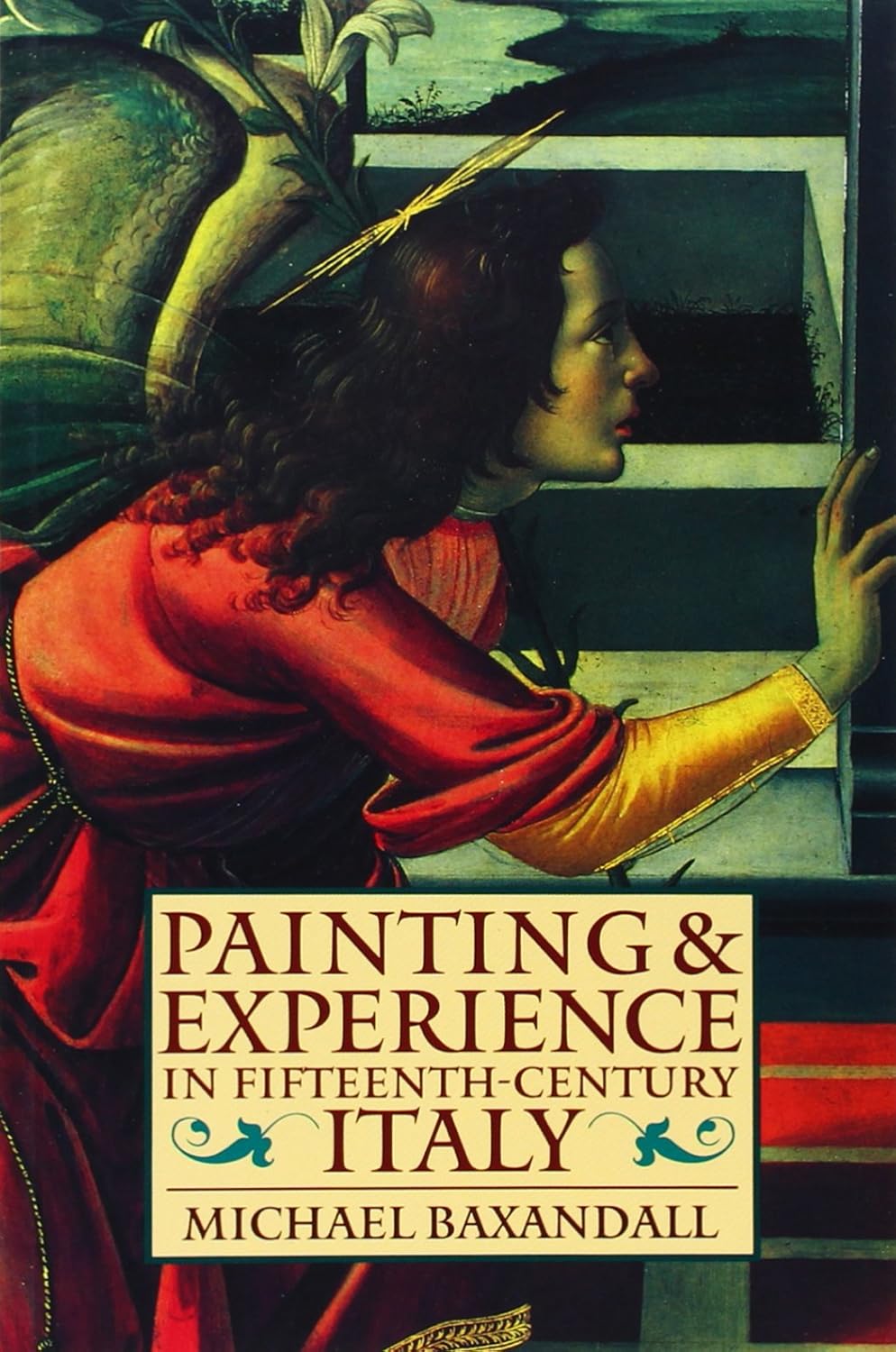
I was fully prepared to love this book. Michael Baxandall’s “Painting & Experience in Fifteenth-Century Italy: A primer in the social history of pictorial style” (1972) is considered a classic in the field and shaped an entire generation of Renaissance scholars in their appreciation and understanding of period art. Unfortunately, this slender little volume lacks a chaste style that would have made it much easier and more enjoyable to read. Instead, it reads like it was written in some foreign language and then poorly translated into English.
A painting is always more than just a painting; it’s a reflection of the society that produced it. The core theme of “Painting & Experience” is that forms and styles of painting respond to social circumstances. The first significant social circumstance that drove the form and style of Renaissance painting was the trade-driven economic growth of the fourteenth century. Baxandall says that money played an outsized role in shaping Quattrocento art. He says that paintings, in fact, are like “fossils of economic life” and that “in the fifteenth century painting was still too important to be left to the painters.”
The contract between client/patron and artist was often very specific. Painters were instructed to use specific colors (contracts were often meticulous about the use of the dark blue hue known as ultramarine), for specific purposes, such as the Madonna’s cloak. By the end of the fifteenth century the focus on the use of gilt splendor like gold and ultramarine diminished and was replaced by a focus on skill. Now the focus was on what specifically the master would be painting and what could be left to his acolytes in his workshop. Baxandall says that the public attitude toward painters shifted dramatically between 1410 and 1490. Savvy client/patrons now became “a conspicuous buyer of skill,” Baxandall says, as there was a perceptible drift away from paying for rare and expensive materials and instead buying a high proportion of a great master’s expensive personal attention.
Next, Baxandall introduces the concept of “The period eye.” In short, he says that fifteenth century Italy possessed certain artistic conventions, techniques, and symbolic elements that would have been obvious to the men and women of the Renaissance, but may not be immediately apparent to modern viewers. He calls this the Quattrocento style. The primary purpose of this book is to enable the modern reader to view Renaissance art from this Quattrocento perspective, to better understand this stereotypical “church-going business man, with a taste for dancing.”
Most fifteenth century paintings are religious in nature, which reflects the omnipresence of the Catholic Church in Quattrocento society. The painter was often a professional visualizer of the holy stories from the Bible. Baxandall says that these works of art were meant to accomplish several tasks: 1) religious instruction of the masses; 2) promotion of the example of the saints; and 3) exciting feelings of devotion. Any viewer brings to the picture “a mass of information and assumptions drawn from general experience,” Baxandall says, which ultimately determines how he or she interprets the painting. The social, political, and religious chasm between fifteenth century and twenty-first century observers is vast. “Fifteenth century pictorial development happened within fifteenth century classes of emotional experiences,” Baxandall writes, and these classes of emotional experiences may be unrecognizable to modern audiences.
This is exemplified by the meaning behind common gestures depicted in Quattrocento art. For instance, holding up one’s hands means the person is speaking on a holy matter, whereas hands on his chest is a sign of humility. A clench fist signals the discussion of a matter of cruelty; a pointed finger suggests a solemn topic. “Even when we already know that the painting represents an encounter,” Baxandall writes, “knowing the gesture helps us to read it more crisply, because the gesture lends itself to different expressive inflections.” Or, to put it more simply: “We miss the point of the picture if we mistake the gesture.”
Color also played an important role in Quattrocento artwork. We have already seen that the dark blue hue of ultramarine signaled the wealth of the patron. There have been earlier attempts to codify the color symbolism found in Renaissance paintings – for instance, purity (white), charity (red), dignity (gold), humility (black) – but Baxandall evidently doesn’t put much stock into it. He cautions his readers that, “There are no secret codes worth knowing about in the painter’s color.”
Proportion, balance, and certain mathematical skill were prized by Quattrocento audiences, Baxandall says. Most period artists used the so-called Rule of Three (also known as the Golden Rule or Merchant’s Key) when dealing with problems of proportion. There were some books available that addressed these topics in some detail, such as Alberti’s “On Painting” in 1435 and the republication of Pliny’s “Natural History” (books 34-36) in 1473.
Baxandall suggests that some of the themes and techniques were more pronounced in certain authors. For instance, Masaccio (1401-1428) excelled at imitating nature, relief, perspective, purity, and ease or facility. Filippo Lippi (1406-1469), a painter very different from Masaccio, was known for his grace, variety, composition, and coloring. Andrea del Castagno (1421-1457), a lesser known artist, was known for his exponent of design, foreshortening (creating the illusion of depth), and his deliberate pursuit of highly challenging work.
In closing, the idea behind “Painting & Experience” is fantastic. Unfortunately, the execution is lackluster and the writing is atrocious. If only someone like Walter Isaacson – a skilled writer with a layman’s expertise in Renaissance art – wrote a book like this, I think it could be epic.
 What's Tim Reading Now?
Leave a comment