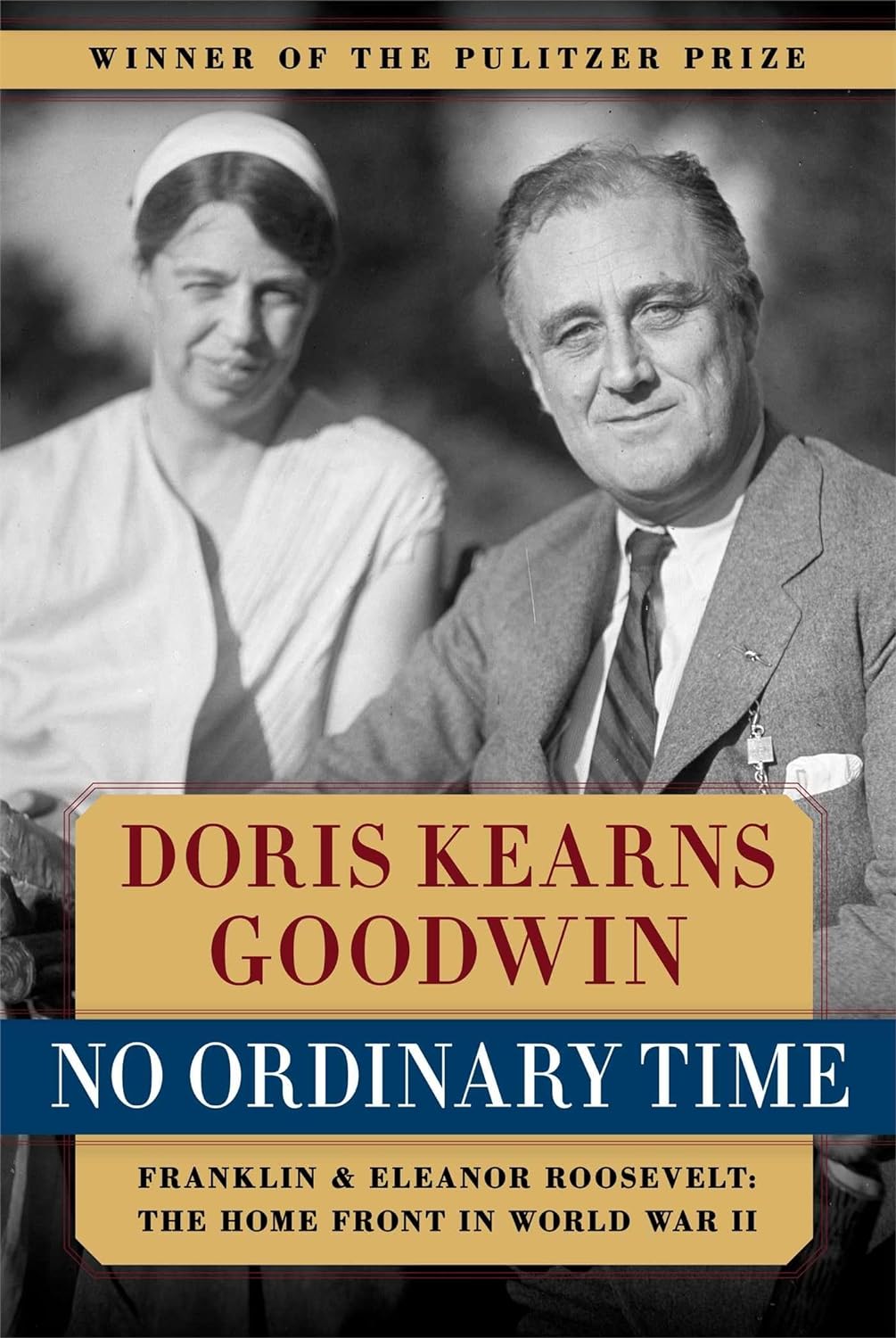
Doris Kearns Goodwin’s “No Ordinary Time, Franklin & Eleanor Roosevelt: The Home Front in World War II” is a slow, methodical, chronological but undeniably brilliant narrative of the most momentous half-decade in American history since 1860-1865. Even if you’ve read a lot about the Second World War and FDR, you’ll likely learn something from this Pulitzer Prize-winning book. At the very least you’ll get an insider’s view of the Roosevelt White House like none other.
The war years may have indeed been “no ordinary time,” but by the time I put this book down I couldn’t help but feel that the Roosevelts had a rather ordinary and depressing marriage, although the author clearly doesn’t see it that way.
The first half of the book focuses on the 18 month run up from the German invasion of France in May 1940 to Pearl Harbor in December 1941. Indeed, it’s not until page 283 that the “day of infamy” arrives. Goodwin highlights FDR’s efforts to make advances in defense preparedness and support for the imperiled Allies, often against sizable, hostile domestic opposition, all while Eleanor importuned him to ensure that the social advances of the New Deal – especially advancement for women, blacks, and labor – were promoted by the unprecedented changes wrought by national mobilization, efforts that the president often found irritating according to the author.
What surprised me most here was that many of the president’s leading advisors, including his closest personal friends and confidents, often despaired at his lack of leadership during this period. Far from being the Olympian leader he is now remembered as, FDR is portrayed as weak and diffident, virtually incapable of making tough decisions, particularly if it required a direct, unpleasant confrontation with a subordinate who happened to be a personal friend and political ally. For instance, the president simply refused to relieve his secretary of war, Harry Woodring, even though that he vocally opposed the administration’s policy of defense build up in the critical months after the invasion of France.
Once war came, however, FDR seemed to find his voice (and managerial chutzpah), even though it marked his unprecedented third term in office. His relationship with Eleanor, or lack thereof, comes into sharper focus during the war years, I found; and it is a rather depressing story. The author describes the president as irrepressibly convivial, the most skilled and natural storyteller to live in the White House since Abraham Lincoln, who desperately needed the company of close friends to recharge his energy and soul after enduring another crushing day of awe-inspiring authority and weighty decisions. What was most clear to me was that Eleanor, his wife and partner of over three decades, was not one of those he wanted and needed around him. Rather, it was Harry Hopkins, his political soul mate, and perhaps the only man in worse physical health than the president for much of the story.
But it was especially women who filled the critical lacuna. The company of women was important to FDR. He described it this way himself: “Nothing is more pleasing to the eye than a good-looking lady, nothing more refreshing to the spirit than the company of one, nothing more flattering to the ego than the affection of one.”
The women who “pleased…refreshed…and flattered” FDR most included his longtime assistant, Missy LeHand, who was undoubtedly madly in love with the president – and very likely his lover before a stroke removed her from the inner White House circle, much to her mortification. And there was Martha, Queen of Norway; beautiful, urbane, and sophisticated. But most of all, and especially at the end, there was Lucy Mercer Rutherfurd, FDR’s former mistress and clearly the absolute love of his life. That the president was not allowed to divorce Eleanor in 1920 and take the Catholic Lucy, his former housekeeper and nanny, for his wife because of the moral strictures of the day (and the credible threat from his mother that he’d be disinherited and lose Hyde Park) seems almost cruel looking back at it. The one person that the president most certainly did NOT need at his side was his wife, Eleanor, no matter how hard Goodwin works to paint their unusual relationship as a special “partnership.”
For all of his showy warmth, his famous smile and his infectious optimism, many close to the president recognized that this superficial congeniality masked a deeper and darker core, one that held no one in his confidence or unshakeable love. In Eleanor’s words: “All would be surprised at their dispensability. The President uses those who suit his purposes. He makes up his own mind and discards people when they no longer fulfill a purpose of his.” Only the president couldn’t “discard” Eleanor. After reading “No Ordinary Time” one gets the distinct impression that he gladly would of long ago if only he could.
Eleanor’s tough judgment is echoed by another inner circle confident, Harold Ickes, who had this to say about his hero and mentor: “Despite his very pleasant and friendly personality, he is as cold as ice inside. He has conventional family affections for his children and probably for Missy LeHand and Harry Hopkins, but nothing else.” It is notable, I think, that he did not include Eleanor in this list.
By 1944 the president’s health was in precipitous decline. Everyone around him was shaken by the sight of the ashen, tremulous president, sunken and empty. That such little thought was put into choosing his running mate in 1944 is incomprehensible. In the president’s final days, as his life slowly but clearly slipped away, the thing that comforted him most was the company of his one and only true love, Lucy Rutherfurd. Secret, but frequent meetings were arranged by the president’s daughter, Anna, without the knowledge of Eleanor. Indeed, Lucy was one of the last people to see the president alive, having spent the weekend with him at Warm Springs, Georgia at the time of his death.
In closing, I loved this book, even though I don’t see the Franklin & Eleanor relationship through the same warm and inspiring lens as Ms. Goodwin. The author’s ability to craft an engrossing narrative and make historical figures so human, as though you know them personally and are in the room with them sharing cocktails and stories, is what I love and respect.
 What's Tim Reading Now?
Leave a comment