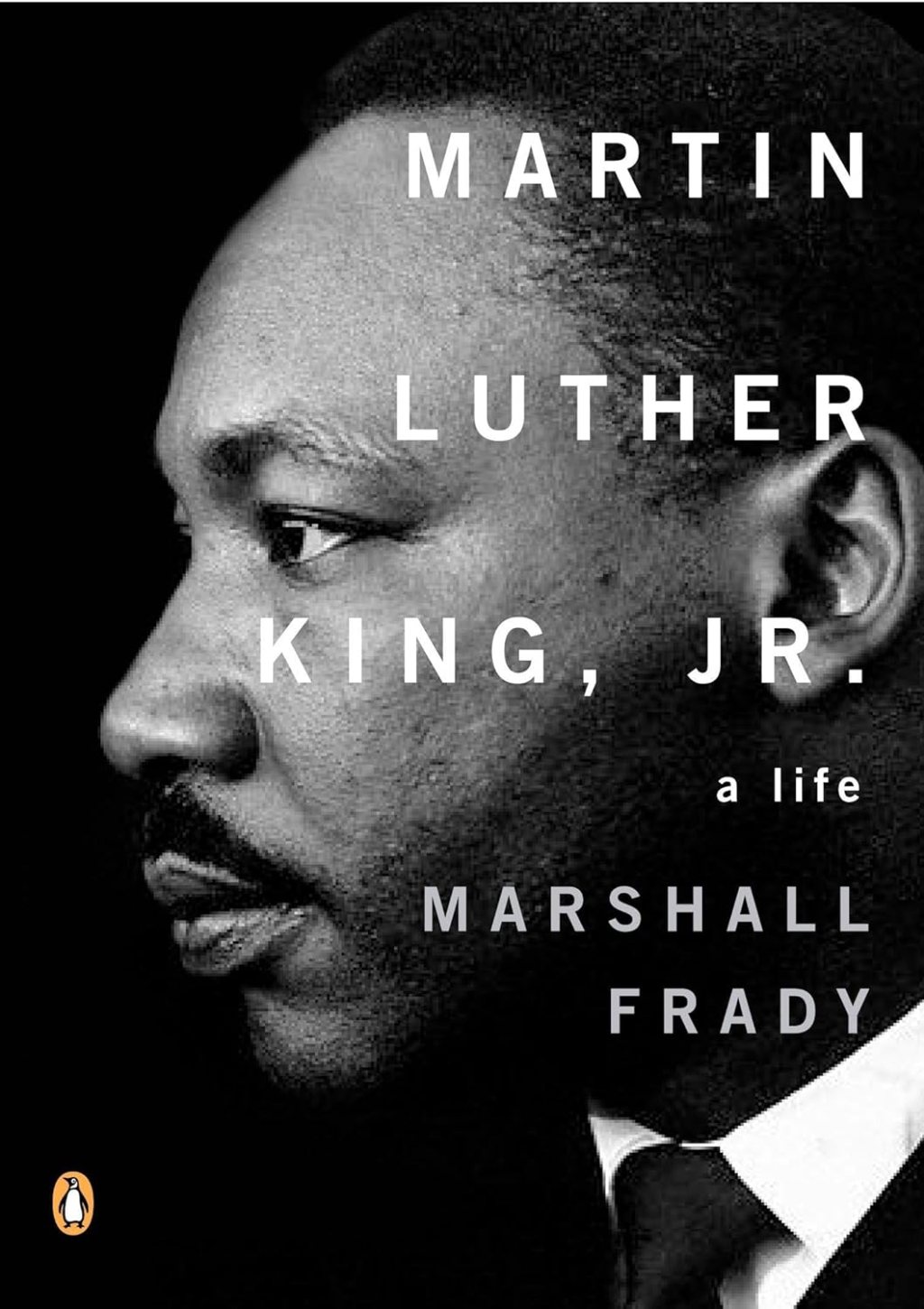
In the introduction “Martin Luther King Jr.: A Life,” Marshall Frady argues that Americans have sought “to remember King by forgetting him,” suggesting that the civil rights leader was never a mere painted icon and that current and future generations actually do him a disservice by remembering him that way. In this trim biography of barely 200 pages, the author presents the full measure of King as a man, his quick intelligence, burning ambition and oratorical genius, alongside his more human, vulnerable dimensions, his frequent self-doubt, his contentious relationship with his father, his often plagiaristic academic affairs, his licentious personal life. The reader gets a sense of both his greatness and his humanity; what made him so special and what made him so ordinary. All of this is delivered beautifully by Frady, with exquisitely constructed prose, capturing the raw emotion of the civil rights era, the vibrancy of the people and the movement, the oppressive, heavy sticky heat of the long, violent summers of the 1960s.
Frady delivers a riveting narrative, beginning with King’s relatively privileged, cosseted youth in Atlanta to his emergence, almost accidentally and with great foreboding, as the leader of the bus boycott in Montgomery at the improbably tender age of 26. The author chronicles King’s career from the unexpected success of Montgomery to the disappointment of Albany, Georgia to his redemption — indeed “apotheosis” according to Frady — in Birmingham and then the March on Washington in 1963 to the lows and highs of St. Augustine and Selma, and finally the frustrations of his lofty aims in Chicago, against the growing war in Vietnam and the revolutionary, pan-racial Poor People’s Campaign.
Several themes run throughout this marvelous work of biographical synthesis. First, King was, for over a decade, haunted by his bête noire, FBI director J. Edgar Hoover, who viewed him as, at best, a fraud and, at worst, an active agent of communist subversion. Frady maintains that King’s priapic thirst was insatiable, regularly bedding multiple women in a single night, including the evening before his assassination in Memphis in April 1968. These assignations were regularly taped by the FBI, complete with King’s allegedly ribald intercourse outbursts, which Hoover and his cronies shared with Washington leaders in a vain hope to crush the civil rights leader’s credibility and cripple his movement. According to Frady, threatened exposure weighed especially heavily on King in Oslo when accepting the Nobel Peace Prize in 1963. Furthermore, Hoover believed that King was under the direct influence of Moscow via his close relationship with Stanley Levison, a known communist and longtime King confidante, although no such ties to Marxist operatives have ever been verified.
A second theme is the central importance of an antagonist in King’s many campaigns for racial desegregation and equality. Without race-baiting Neanderthals like Bull Connor or George Wallace, King’s efforts often petered out, ending in sham negotiated settlements. Nothing hurt the civil rights movement more than superficially congenial whites in power, like Laurie Pritchett in Albany and Richard Daley in Chicago, men who refrained from using force against demonstrators and who were willing to meet in civil discourse, quickly striking bargains that they never intended to fulfill. Tragically, it was the dogs and water cannons and billy clubs — all caught on nightly national television — that propelled the civil rights movement forward in the King years.
Finally, there is the overarching presence of the flesh-and-blood King, short and podgy and chain smoking behind closed doors, living in constant fear of arrest and death, never truly believing in his own abilities or destiny, often swept along by events not entirely of his own making or choosing, without any real plan. By the time of his assassination, Frady argues, King was a spent force, on a steep decline in influence and respectability, out of touch with many black Americans increasingly drawn to the strident nationalism and Black Power movement of Stokely Carmichael and other firebrands, alienating his traditional white liberal base over his early and vigorous opposition to the Vietnam War and splintering his own loose coalition of acolytes in the Southern Christian Leadership Conference (SCLC) over his quixotic Poor People’s Campaign, which was scheduled to kick off just after his fateful trip to Memphis. Indeed, Frady argues that had not King been assassinated in 1968 (like his hero and spiritual idol, Gandhi, in 1948), he likely would have receded to the margins of American history, remembered as a pivotal player in the early civil rights movement, but not the transcendent hero with a national holiday in his honor that he is today.
For those looking for a crisp, sharp, illuminating biography of King, this is the book. Frady writes with rich, florid prose and his vocabulary may be a bit difficult for some (as a few reviewers have commented acidly below), but that’s even more reason to make this the one book you read on King.
 What's Tim Reading Now?
Leave a comment