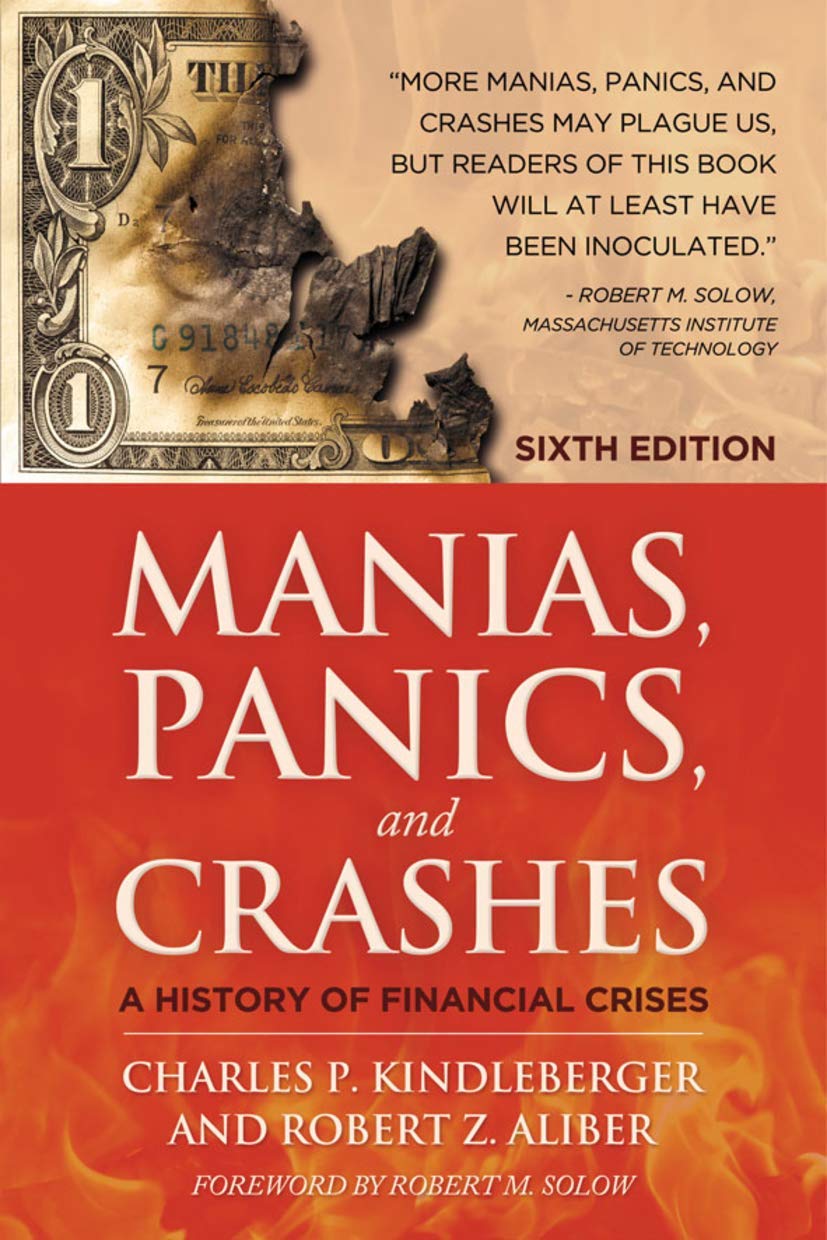
Now in its sixth edition, “Mania, Panics, and Crashes: A History of Financial Crises” was first published by Charles Kindleberger in 1978. How times have changed over those thirty plus years — at least that is the striking conclusion from this latest iteration of the enduring classic, which argues that the world of financial crises began to take a very different shape just as the first volume was being written.
Consider this: according to the latest lead author, Robert Aliber (Kindleberge died in 2003), nearly all of the 10 greatest financial crises of all-time have occurred since 1978; the only ones that fall outside are the Dutch tulipmania of 1640, the South Sea and Mississippi bubbles of 1720, and the Latin American sovereign debt defaults of the 1970s, which fell right on the demarcation line. The original theme of this book was that all financial crises throughout history are the same and that they are a “hardy perennial.” While the basic contours of a crisis (exogenous shock, euphoria, mania, distress, collapse, a pattern first laid out by Hyman Minsky) and the critical enabling element (loose credit) remain the same, the velocity, frequency and magnitude of these events is increasing. Reading this book in 2012 is the financial equivalent to watching “An Inconvenient Truth” – with the frightening overhang that the worse is likely yet to come.
The authors argue that things really began to change in the late 1960s and early 1970s. First, the US began to experience a sustained high rate of inflation (6% plus) for the first time ever in peacetime. Next came the breakdown of the Bretton Woods system, when the dollar went off the gold standard and free floating exchange rates were introduced, which dramatically increased the spread and volatility of world currencies. Then, large and persistent budget and trade deficits, especially that of the United States, along with dramatic economic growth and oil wealth in Asia and the Middle East, led to payments imbalances that created an enormous mountain of money looking for a higher rate of return. Finally, the liberalization of the world’s capital market and the opening of off-shore banks made the international transfer of money fast and easy. In my mind, I see this huge and easily moveable pile of capital as an enormous tidal wave that is drawn, as if by the gravitational pull of higher returns, to the most attractive opportunity of the moment. Aliber writes that over the past 30 years there have been four major cycles of opportunity, over investment, collapse, and then flight to the next future boom and collapse.
The first was Mexico (and Latin America in general) in the 1970s. External money was attracted by the high GDP growth rates, high demand for capital, and the belief that “countries don’t go bankrupt.” When Paul Volker made the decision to squeeze inflation out of the US economy it was the growth economies in Latin America that were really crushed, as the ability of these countries to finance trade and current account deficits declined sharply. The money that had been invested in Mexico and elsewhere needed a place to go – and it moved rapidly across the Pacific to Tokyo.
Japan had been growing at a breakneck rate for decades, mainly fueled by export focused industries, such as automotives and high tech/electronics. As the surge of profit seeking dollars flooded into Japan central banking authorities were faced with a challenge. The success of the Japanese economy depended on exports. The success of exports depended on a relatively weak yen in the international currency market. The rapid inflow of international investment dollars would appreciate the yen. The Bank of Japan made the decision to prevent the yen from appreciating, which meant buying US treasuries to appreciate the dollar. The end state was that Japanese banks held the enormous investment surge and had to find an outlet that wouldn’t appreciate the yen. The answer was loosening the regulations around investment in domestic real estate – which resulted in a skyrocketing of Japanese real estate that makes the recent US experience look like child’s play. The Japanese real estate and stock markets (Nikkei) rose to dizzying heights in what the authors call a “financial perpetual motion machine”: 1) increases in real estate prices led to an increase in stock prices; 2) increases in both led to increases in bank capital; 3) as bank capital increased they were able to lend more; and 4) because those that invested in real estate were making great profits, they took on as much loans as they could get.
So how did it end? Like every other bubble, according to Kindleberger and Aliber. Once the bubble was punctured – in Japan’s case by the seemingly benign policy pronouncement by the incoming head of the Bank of Japan in 1989 that future real estate loans should grow no faster than other loans – those that were most aggressive were caught with their pants down. They had been paying their interest payments with new extensions of credit, which suddenly weren’t coming, so they desperately needed to sell, which caused the perpetual motion machine to sputter, then stall, and then nose dive, as high risk investors became distressed sellers and the prices collapsed. In 1989 the Nikkei was at 40,000. A full generation later, in 2012, it stands at 9,700. One word: WOW.
The tidal surge of global capital quickly receded from Japan and flooded into the emerging economies next door in Asia, the so-called dragons that were the darling of the development community in the early 1990s, countries like Thailand, South Korea, and Indonesia, which offered a compelling combination of high growth, low labor costs, and market oriented monetary policies. Once again the familiar pattern reappeared: foreign capital raced in, much of it into real estate; the local currency appreciated, pushing up the book value of the original investments; allowing local banks to make new and riskier loans; real estate and equity prices skyrocketed as investors flipped properties and poured money into the new and popular “emerging market asset class” of equities; that is, until a few hyper-aggressive and/or risky debtors defaulted, and then the whole house of cards suddenly collapsed, with many countries experiencing a currency devaluation of up to 50%. Fortunes recently and quickly won were just as quickly and easily lost. The speculative money gathered itself up with due haste and bolted back across the Pacific to the next best bet for a quick buck: American mortgages.
The hypothesis that drove the US (and Irish, South African, Spanish, etc.) real estate boom of the early 2000s was that the securitization of mortgages made them more liquid and thus less risky. Global money couldn’t get enough of American mortgages fast enough. When the bubble burst US investment banks had a six month backlog of mortgage securities awaiting actual mortgages to fill them with.
The central hypothesis of this sixth edition makes a lot of sense and it’s sobering. In a global capital market that facilitates “hot money” flowing rapidly and nearly without obstruction to the greatest opportunity for return, where that flow feeds a feedback loop that encourages further and often reckless investment, usually driven as much by currency appreciation and the real estate/equity market link rather than any rational driver of growth, these markets are almost guaranteed to experience a tragic storyline of surreal expansion followed by horrifying collapse.
All of this raises the obvious question: where has the tidal surge of money fled after the US subprime collapse? Unfortunately, disappointingly, almost shockingly, Aliber says nothing at on this critical point, although my sense is that China, and to a lesser extent India, must be absorbing the lion’s share of those assets.
In closing, this is a good book, but by no means a great or essential one, despite its “classic” mantle. I can’t help but feel that the latest iteration is somehow hampered by being tethered to the original. If things have really changed that much so fast, then perhaps the authors need to wipe the slate clean and write something new.
 What's Tim Reading Now?
Leave a comment