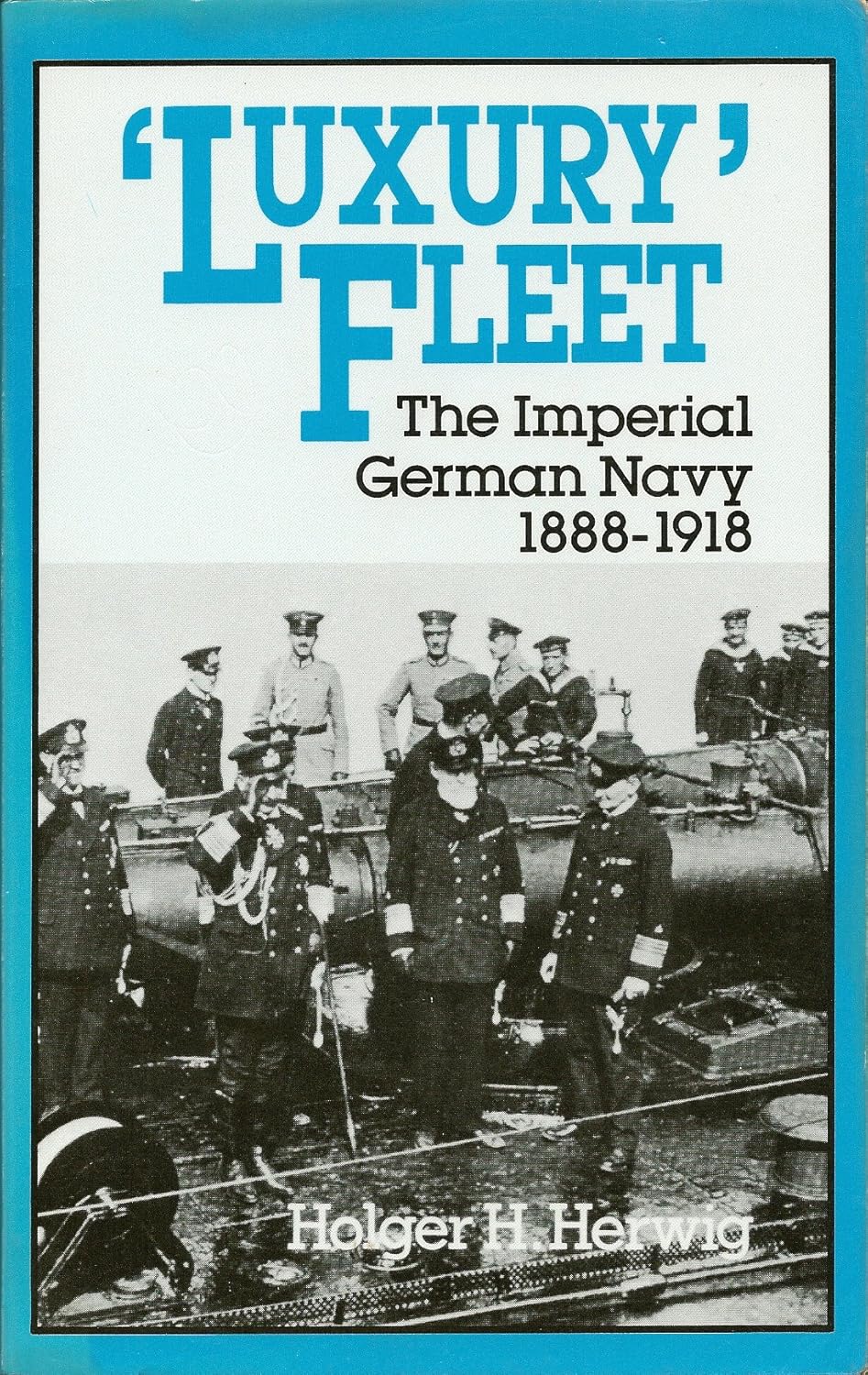
In 483 BC, the statesmen Themistocles led the construction of the Athenian fleet, stating, “I cannot tune a harp or play a lyre, but I know how to make a small city great.” Some 2,500 years later, Kaiser Wilhelm II and Admiral Alfred von Tirpitz attempted a similar path for the upstart German nation, like Themistocles building a great empire on the back of a great battle fleet. In “Luxury Fleet,” Holger Herwig tells that story.
The book is broken up into three parts. The first chronicles the birth of the German navy and Tirpitz’s master plan for creating a modern fleet that could challenge the undisputed king of the world’s oceans, the British Royal Navy. Wilhelm became Kaiser in 1888; Tirpitz head of the navy in 1897, the same year as the famous British display of seapower at the Diamond Jubilee at Spithead. It was also the year that Germany, growing at breakneck speed, embarked on building its new navy, an instrument of global power, according to historian Paul Kennedy, “in the form of a sharp knife, held gleaming and ready only a few inches away from the jugular vein of Germany’s most likely enemy.”
Wilhelm was the driving force behind the creation of the fleet, determined to do for the navy what his grandfather had done for the army. He was deeply influenced by the writings of Alfred Thayer Mahan and fully expected that a re-apportionment of the world’s colonial possessions was coming. A powerful navy would allow Germany to rise from a European power to a global power, from a grossmacht to a weltmacht. “Tirpitz came to the Navy Office with a well thought out, comprehensive naval construction programme,” Herwig says, ‘the creation of a mammoth battle fleet would provide the power basis for a great overseas policy.” Tirpitz was “a clever politician, public relations expert and forerunner of the modern professional manager,” according to the author, a “ruthless, clever, domineering, patriotic, indefatigable, aggressive yet conciliatory, pressing yet patient.” Herwig writes that Tirpitz’s greatest contribution of all may have been his efforts in promoting the idea of the new German navy to the masses.
The two Navy Bills of 1898 and 1900 were “tantamount to a unilateral German declaration of ‘cold war’ against Britannia,” a country the Kaiser arrogantly dismissed as a “hateful, mendacious, unscrupulous nation of shopkeepers.” The British reaction, under First Sea Lord Sir Jackie Fisher (1904-1909) was swift and dramatic. Or in Fisher’s own words, “Napoleonic in its audacity and Cromwellian in its thoroughness.” Hundreds of older vessels were scrapped and the sprawling Royal Navy consolidated into four fleets: Eastern (Singapore), Channel (Dover), Atlantic (Gibraltar), and Mediterranean (Malta). Moreover, a new capital ship was developed, the Dreadnought.
Herwig refutes the popular claim that the Dreadnought at one swoop erased the Royal Navy’s advantage be obsolescing all other existing battleships and also concurs with historian Arthur Marder’s assessment that the Dreadnought was not aimed at deterring the Germans. Rather, the “all big gun one caliber” ship was the clear lesson from the Battle of Tsushima and was being pursued by all major navies the world over when the Dreadnought was launched in 1906. It did, however, require a dramatic increase to the German Second Navy Bill and made it no longer possible to hide the fact that the fleet was aimed at challenging the British in the North Sea. The Anglo-German naval race became “fiery white,” the costs “horrendous,” according to Herwig. Nearly one-quarter of the Reich’s total budget was devoted to naval programs, both ship construction and infrastructure improvements, such as canal and dock expansions. Tirpitz’s carefully constructed grand naval plan was “coming apart at the seams.”
According to Herwig, “The state secretary [Tirpitz] had argued that the building of a mammoth fleet would unite the German political parties against the Social Democrats, rally German workers around the Empire with steady work and higher wages, unite various particularist states through one great German armed force, raise the image of the crown at home and abroad, remove the ‘disturbing influence’ of the Reichstag upon the Kaiser’s policies, make Germany more attractive as an ally to minor naval powers, and wring colonial concessions from London by threatening Britain’s European security with a massive battle fleet concentrated on her Eastern shore.” In fact, the Social Democrats had become the largest party by 1912; the Navy was no longer “the darling of the nation”; the Reichstag held the purse strings tighter than ever; not a single nation sought an alliance with the Germans; no colonies were volunteered by the British or any of the dying empires of Europe. The Reich stood isolated in Europe while the British reacted with vigor to the naval challenge, refusing to accept the German ratio of 2:3 in capital ships.
In 1912, First Lord of the Admiralty Winston Churchill pronounced “from some points of view the German Navy is to them more in the nature of a luxury.” It was a luxury whose price had ballooned to twice the already aggressive outlays of the first two Navy Bills. In 1913, Germany was spending 90% of its income on defense. The national debt had more than double from 1898 to 5 billion goldmarks. The Germans had stretched themselves beyond their financial limits and had little to show for it, except perhaps for overcoming the threat of being “Copenhagened” by the British (a reference Herwig makes frequently to Admiral James Gramier’s seizure of the neutral Danish fleet in 1807 in order to prevent it from joining the French, either willingly or involuntarily).
Part two focuses on the development and management of the German empire for which the new fleet was, in part, to serve. Indeed, a core part of Germany’s goal of weltmacht was overseas colonies. By 1914, she possessed roughly a million square miles and 15 million subjects strewn across a territory ranging from southwest Africa to Polynesia. According to Herwig, Germany placed some 10% of her national wealth overseas and received a return on investment of a mere 2% of national income. The colonies represented just 0.5% of the German global trade. The colonies failed to provide any meaningful raw materials, attract foreign direct investment, nor siphon off any of Germany’s excess population (90% of emigres headed to the United States while just 5,495 Germans moved to the colonies). “The aggregate gross value of Berlin’s commerce with its colonies between 1894 and 1913 remained less than what was spent on them … Clearly, the colonies never laid the proverbial golden egg.” “The simple truth of the matter,” Herwig says, “is that the colonies were regarded mainly as a token of German power and prestige rather than an integral part of her economic or financial life.”
Part three is a narrative history of the First World War at sea from the perspective of the German Navy, which the author claims was woefully unprepared when the war broke out. Herwig stresses that the German naval leadership never resolved the basic dilemma between “grosskrieg” (capital battleship fleet of the Mahan school) and “kleingrieg” (guerre de course more in line with the theories of French Admiral Theophile Aube). “Admiral Scheer realized fully after Jutland that the Grosskrieg could not defeat Britain,” Herwig writes. Yet, Scheer never fully embraced the alternative either. The reasons for which were complicated, not least of which was because such an approach would amount to a “war of ensigns and lieutenants.” The captains and admirals of the fleet would have nothing to do or contribute. In the end, German U-boats sank 6,394 ships while Tirpitz’s glorious High Seas Fleet sunk a total of six. The much vaunted “risk fleet” did tie down the world’s largest fleet in its northern anchorage and theoretically prevented the British from landing troops along the German coast or Flanders.
Der Tag for the High Seas Fleet came not in battle with the Royal Navy in the North Sea, but on November 21, 1918 when the fleet was surrendered and interred as part of the peace settlement. “Never before in the annals of naval history,” Herwig writes, “had such an armada capitulated so ignominiously.” The true end came less than a year later at Scapa Flow when the High Seas Fleet was scuttled at anchor. “It was an unprecedented spectacle in naval history … the fleet had redeemed itself, even if in defeat.” All told, half a million tons of warship estimated at one billion goldmarks in construction slipped beneath the waves.
In closing, “Luxury Fleet” is a fine narrative history borrowing on others’ scholarship. In the introduction, the author states, “This is not first and foremost a work of new research, rather it strives instead to present the general reader with an overview of recent historical investigation…” Herwig succeeds admirably at this goal.
 What's Tim Reading Now?
Leave a comment