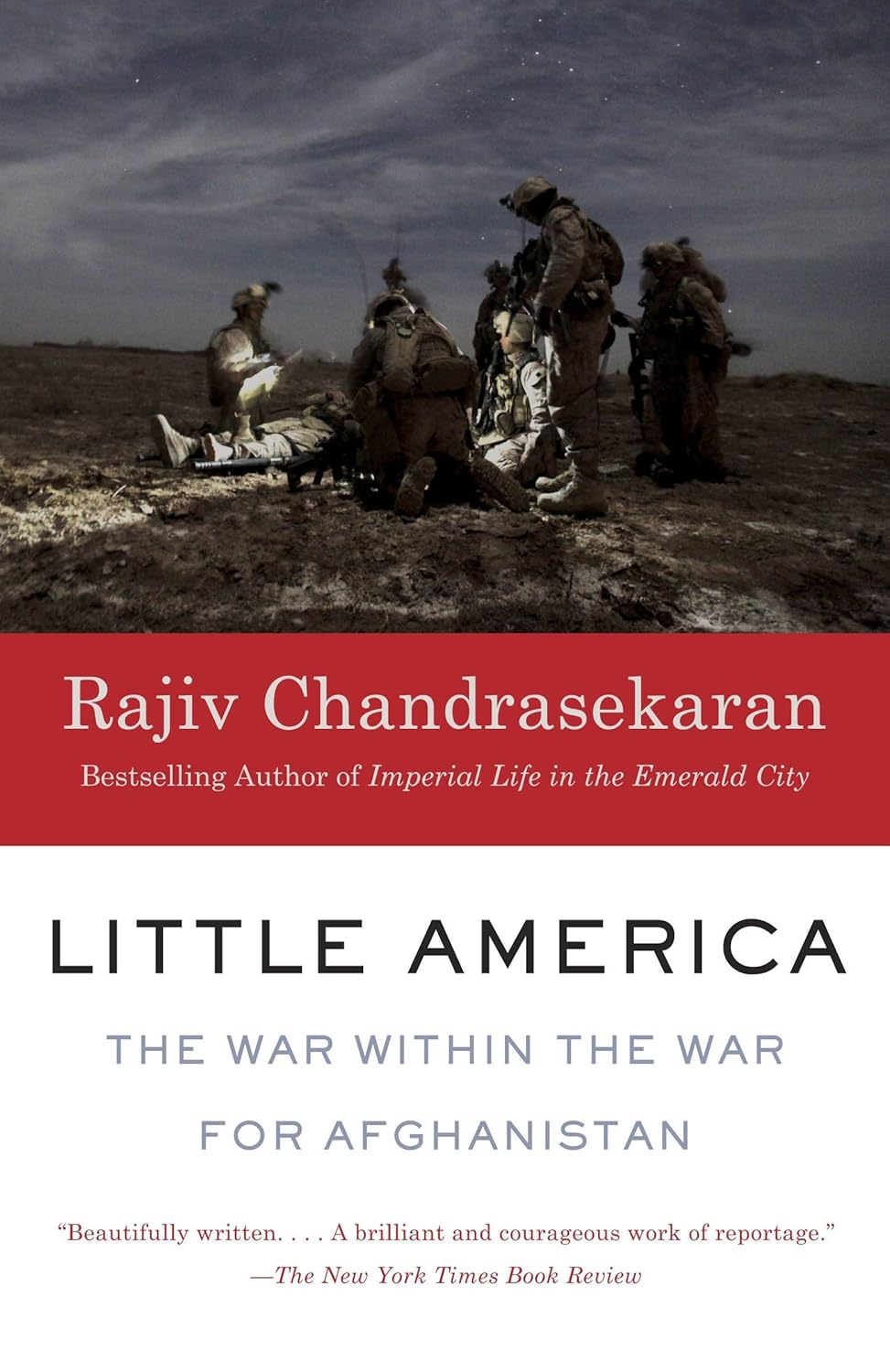
I am a Navy reservist and served as one of the primary economic development officers at NATO’s Regional Command – South headquarters in Kandahar from September 2009 to September 2010. Thus it was with more than passing interest that I read Rajiv Chandrasekaran’s recent journalistic expose, “Little America: The War within the War for Afghanistan,” which chronicles the events and missteps of President Obama’s civilian and military surge into southern Afghanistan beginning in mid-2009. Obviously, I’m not a neutral party; but I’d like to think that I’m fairly objective. Here are my thoughts on the book, along with my personals observations from serving “inside the surge,” often alongside many of the people – American, Afghan and Allied – featured in this book.
The author achieved commercial and critical success with his first book, “Imperial Life in the Emerald City: Inside Iraq’s Green Zone,” a searing indictment of the Bush administration’s Coalition Provisional Authority in the early days after the invasion of Iraq. “Little America” is very similar, yet quite different from that National Book Award winning effort. The similarities are the anecdote-rich, character-driven narrative and the portrayal of a bumbling, embarrassingly incompetent United States government, usually, but not always, focused on bureaucratic civilian agencies and a wide range of feckless senior politically appointed leaders.
The difference is the author’s personal sympathies, both to the war and the primary players in the story, which clearly shine through despite his best efforts to maintain the appearance of journalistic neutrality and integrity. The main characters in “Emerald City” are portrayed as venal, irredeemable creatures, George W. Bush’s small minded janissaries in his illegal and ill-advised war of conquest. The reader is expected to recoil in horror (as I’m sure the author did) from the thought that these people actually represent our flag and nation – and in positions with such consequence in the Arab world and greater Middle East.
The key players in the “Little America” narrative, on the other hand, are noble and principled (and liberal!). Main characters, especially Kael Weston and Marine Brigadier General Larry Nicholson, are portrayed as twenty-first century Galahads: thoughtful, sober, well-educated men with the very best of intentions and single-mindedly pursuing a better life for the benighted people of an unforgiving land, but adrift in a desert of bureaucratic incompetence and political ineptitude. If Iraq in 2003 was the wrong war with the wrong people, both in the national command authority and on the ground, Afghanistan in 2009 was the right war with (mostly) the right people in positions in Washington and in Helmand province, if not Kandahar and Kabul.
In many ways “Little America” reminded me of another relatively recent book on Afghanistan: “Charlie Wilson’s War: The Extraordinary Story of How the Wildest Man in Congress and a Rogue CIA Agent Changed the History of Our Times.” The veteran reporter George Crile produced a ripping good yarn about the CIA’s covert operation to defeat the Soviet Union in Afghanistan, as told virtually exclusively from the perspective of Democratic Texas Congressman Charlie Wilson and his CIA partner, Gust Avrakotos. In that bestselling book – and eventual Tom Hanks / Julia Roberts major motion picture – there were only good guys (Wilson, Avrakotos and those who supported them) and villains (everyone else). In “Little America,” Weston and Nicholson assume the role of Wilson and Avragatos, while the second tier characters in the narrative are placed in their respective camps – good guy or bad guy – depending on how they aligned, directly or indirectly, with the author’s heroes. It makes for a tight narrative. But is it true? Only partially, I’m afraid.
Chandrasekaran may be sympathetic with the main characters he chose to develop for his storyline, but he doesn’t shrink from pointing out the many errors and inconsistencies that have plagued the US and NATO in Afghanistan. Indeed, his laundry list of complaints is tough to synthesize. Here are a mere dozen of his scattershot critiques: 1) Helmand was made a focus of the surge instead of Kandahar not for strategic reasons but because the US Marine Corps wanted a clearly defined area of operations that they could control soup-to-nuts (aka: Marinestan), a heritage born from the second world war’s Pacific theater; 2) cotton should have been the focus of agricultural development strategy in Helmand, but USAID was dead set against that crop for reasons described as short sighted and specious; 3) the heavy focus on developing district level governance was doomed from the start for cultural reasons and led to practically zero progress in improving the image and effectiveness of the central government in the insurgent strongholds of the south; 4) well intentioned USAID support programs, such as AVIPA, had minimal lasting development impact but led to enormous short-term distortions in the local economy where it was introduced; 5) the military implemented a full throttle, classic COIN campaign despite the White House’s clear intent to engage in a more limited counter terrorism and training effort; 6) the human capital of the civilian surge was at best weak and more likely dilutive to the overall war effort; 7) the sole US Army unit available for Kandahar – the Stryker Brigade – happened to be led by a rogue commander who fostered a “Seek and Destroy” mentality rather than a “hearts and minds” approach, which ultimately alienated the local population wherever they served; 8) a criminally incompetent strategic partner in Afghan president Hamid Karzai; 9) various harebrained, big ticket development schemes, such as the rehabilitation of Kajaki hydroelectric dam, that had little chance for success and plenty of opportunity for graft and corruption; 10) sophomoric bureaucratic catfights between some of the most senior members of Obama’s Afghanistan war council (Holbrooke versus Doug Lute and Karl Eikenberry); 11) dubious Afghan allies with ties to the opium trade and a penchant for arbitrary violence, corruption or pedophilia; and 12) a counter narcotics policy that sought to destroy poppy crops in the South despite evidence that the bulk of Taliban financial funding came from wealthy Gulf donors and such actions unambiguously alienated the local farmers from the coalition and their central government.
So what really doomed the Obama Afghanistan surge? Is “fixing” Afghanistan simply an impossible task that never had a chance for success? Was the fundamental strategy behind the surge fatally flawed? Did a lack of civil-military coordination and cooperation undermine the best laid plans? Is the absence of a responsible partner in Afghan leadership the primary cause of our frustration? Could we have succeeded if we had only planted cotton?!
In the end, Chandrasekaran judges Obama’s surge an abject failure; but it was not a failure simply because it was poorly executed (although he claims it was). Rather, it failed, according to the author, because it was a muddled idea from the start and never had a chance for success. “[T]he surge was a big bluff,” Chandrasekaran quotes Weston as saying, but clearing reflecting his own view, “a long odds gamble that the Afghan government, the Taliban, and the Pakistanis would have all behave differently with more American [forces on the ground].”
So how do my experiences align with the author’s critical assessment? Unfortunately, fairly closely. Here are a few relevant anecdotes.
To begin with, Chandrasekaran faults the US forces for not spending enough time in the field, working directly with the Afghans and speaking to them in their own language. That’s a fair critique. However, I can’t stress how difficult it was to move around southern Afghanistan in 2010. As a junior officer in the US military, I constantly struggled to secure transport to the places we needed to go to do our jobs. Rajiv likely never experienced this challenge first hand; he was usually able to zip around the theater in dedicated Blackhawk helicopters (I actually traveled with him around the theater prior to the Marja offensive and remember marveling at the first class treatment, kind of like being a sophomore in high school and befriending a junior with his own car). It took me weeks of effort to conduct simple reconnaissance trips to the industrial park just outside of the Kandahar Airfield (KAF). Things were a bit easier in Kabul, because it was safer, although not nearly as secure as the author suggests in “Little America,” which makes the Afghan capital sound more like Palo Alto on a sunny afternoon.
The author also claims that progress in the South was undermined by a lack of cooperation and mistrust between the US civilians (State, USAID, etc.) and the military, especially during the 2011 time period when the 10th Mountain Division was in charge. Personally, I had a wonderfully productive working relationship with my civilian colleagues in Kandahar, especially my partner from USAID focused on economic growth. The situation at the senior level, however, was definitely a different story. The person in charge of reconstruction and stability during my tour suffered from several “deficiencies” from the American leadership perspective: he was young (late 30s), he was British, and he was a civilian. Moreover, his position carried a broad, ambitious mandate but precious little in the way of tangible power: he held no positional authority (i.e. no one needed his signature or approval to do anything), he had no money to distribute to anyone, and he had few professional resources to contribute (just a dozen or so brains-on-a-stick like me). To make matters worse, he carried with him a certain British public school hauteur that instantly and permanently alienated him from the entire American team, both military and civilian. I was told confidentially on more than one occasion by my American colleagues: “Don’t even mention his name in this building…”
Like Carter Malkasian, I also did my best to learn Pashto during my tour, but it had to be a self-directed exercise: I purchased Rosetta Stone (Pashto) before I deployed and then attempted to learn a new Pashto phrase everyday from our interpreters. (By the time I left Kandahar I was able to make small talk with the locals, but couldn’t conduct business in their native language.) KAF had an impressive array of classes available to troops, from salsa dancing and mixed martial arts lessons to Bible Study groups and guitar jam sessions. Yet there was no Pashto language training available. Seriously. Unbelievable.
More substantively, there was, in my opinion, an irrational obsession with hitting the development equivalent of a walk off, upper deck grand slam, what my boss at RC-South, British Major General Nick Carter, characterized as “a head turning moment.” It led us to pursue ridiculously ambitious projects, such as electric power from Kajaki, which I had a lot to do with and that Chandrasekaran writes about caustically but fairly, or the rehabilitation of the sprawling irrigation canals from the Dala Dam in Kandahar province. These were, in my opinion, “moon shots” that would have been difficult to achieve over a decade even in the most benign, secure environment. Under the parlous conditions of southern Afghanistan in 2010 they were veritably impossible. All we achieved was unrealistic expectations and guaranteed failure.
In my view, we should have been playing “Moneyball” all along, avoiding development vanity metrics and instead simply trying to get as many men on base as quickly and efficiently as possible (that is, small but meaningful and locally sustainable development achievements). I saw the Kandahar International Airport as just such an opportunity and pursued it with single minded intensity, often to the chagrin of my superiors. It was right next to KAF and thus, unlike nearly everywhere else in RC-South, easy to get to on a daily basis. We made tremendous progress (I believe) during my year, including the first unsubsidized export of Kandahar pomegranates to Dubai since the early 1970s. Nevertheless, I was once told by my office director: “Tim, the boss doesn’t want you hanging around the airport all day. You should be back in the office working.” Really? So spending all day with Afghans, speaking Pashto, drinking tea and genuinely turning the airport into a profitable engine of economic growth is wasting time, but staying on base and churning out meaningless PowerPoint slides is “working”? With all due respect, sir, I beg to differ.
On a related note, Chandrasekaran paints a picture of free flowing American largesse, hundreds of millions of dollars thrown around like “Monopoly money.” That may have been true for AVIPA, but not for anything else, at least not in my experience. I was perplexed and frustrated by the absurd bureaucratic hoops I had to jump through for even the most basic funding requests, including the Commanders Emergency Relief Program (CERP), a program supposedly designed to circumvent bureaucratic hoops. There was a litany of development projects I ultimately pursued at the airport and each of them took months of effort and literally hundreds of pages of forms to complete. Before I left Silicon Valley, my company spent $170M to acquire an unprofitable, but strategically important online financial management service. It took a matter of weeks. Yet, in southern Afghanistan, it took a practical act of God (aka: David Petreaus) to get a $1M project approved. This aspect alone of my experience soured me on any career aspirations with the United States Government ever after.
Exacerbating these organizational and strategic challenges were basic intelligence failures. I can’t stress how “blind” we were during my year in southern Afghanistan. Looking back, I still shake my head. There was so much we didn’t know and couldn’t figure out despite strenuous effort. There was a half completed industrial park a few kilometers from KAF. It took us months to figure even where it was, who built it, and what the overall master plan was behind the effort (actually we never received a satisfactory answer on that last piece). The Indians built a well intentioned but inappropriately designed cold storage facility in the area. That, too, took us forever to understand, visit, and assess. I would drop in on the intelligence cell at KAF to speak with the Defense Intelligence Agency (DIA) analysts, who sported impressive sounding titles like “Director, Economic Infrastructure,” only to learn that they knew next to nothing about anything and were hopeful that I could take them to the airport so they could write a report they could send back to Washington. I learned quickly that if you’re not on the ground, working shoulder-to-shoulder with the Afghans, you really knew nothing and were therefore all but worthless.
That leads me to a final gripe. Never in my life have I experienced such an asinine allocation of human resources as I witnessed in southern Afghanistan in 2010. Before I deployed to Afghanistan I was director of strategy and corporate development at a multi-billion dollar Silicon Valley software company. Our team had about 15 highly educated professionals running strategic projects for a company with nearly ten thousand employees. Most employees were focused on the roll-up-your-sleeves type of work necessary for us to succeed in the market: that is, they coded our software and marketed our products. The paradigm in Afghanistan, however, was inexplicably inverted. There were strategists and consultants everywhere; would-be Edward Lansdales and David Galulas with pens-in-hand were forever cycling through our office: congressional delegations, academics with specialties in counter-insurgency or Afghan culture, international journalists, NSC officials, staff officers from ISAF command in Kabul, project leaders from non-governmental organizations, etc. Honestly, for every one guy on the ground in a development role in the districts around Kandahar or Helmand we probably had 25 people writing strategy documents and conjuring up new measure of effectiveness. It was insanity. I felt like I was on a football team with only 7 guys on the field against an 11 man opponent – yet our sidelines were choked with a hundred advisors, clipboards in hand, shouting at us: “I wouldn’t do that if I were you!” Hey, if you really want to help, why don’t you put down the clipboard, put on a helmet, and come out here and play?
A personal experience of mine highlighted just how bad this situation had become. In the spring of 2010 I took a trip to the volatile Arghandab Valley just north of Kandahar city. At that time, Afghanistan was, without doubt, the primary national security and foreign policy objective of the United States government and her closest allies, which account for over half of the world’s GDP. The fate of Afghanistan was held in the south. Success or failure in the south hinged on Kandahar city. And the key to Kandahar city, many have and still argue, is the Arghandab Valley. Yet, when I arrived at the Arghandab district center with a few colleagues from NATO there was just a single civilian development official in the entire valley, a tall, earnest young man in his late twenties. And he rarely left the base. This was the last stop on the Obama Surge Express and it was sobering. If we just had half as many practioneers implementing policy in Afghanistan as we had people writing about it we likely would have achieved stunning success.
In closing, my year in southern Afghanistan was a challenging and frustrating experience, but also the most rewarding of my life. I put my life at risk and abandoned my wife and son and career for a year to serve – and I don’t regret it for a second. Unlike Summer Coish, who Chandrasekaran highlights as an example of squandered human resources, I don’t feel that my time in Kandahar was wasted and genuinely believe that I made a difference, however humble. Nevertheless, I tend to agree with the author’s doleful concluding assessment: “For years, we dwelled on the limitations of the Afghans. We should have focused on ours.”
 What's Tim Reading Now?
Leave a comment