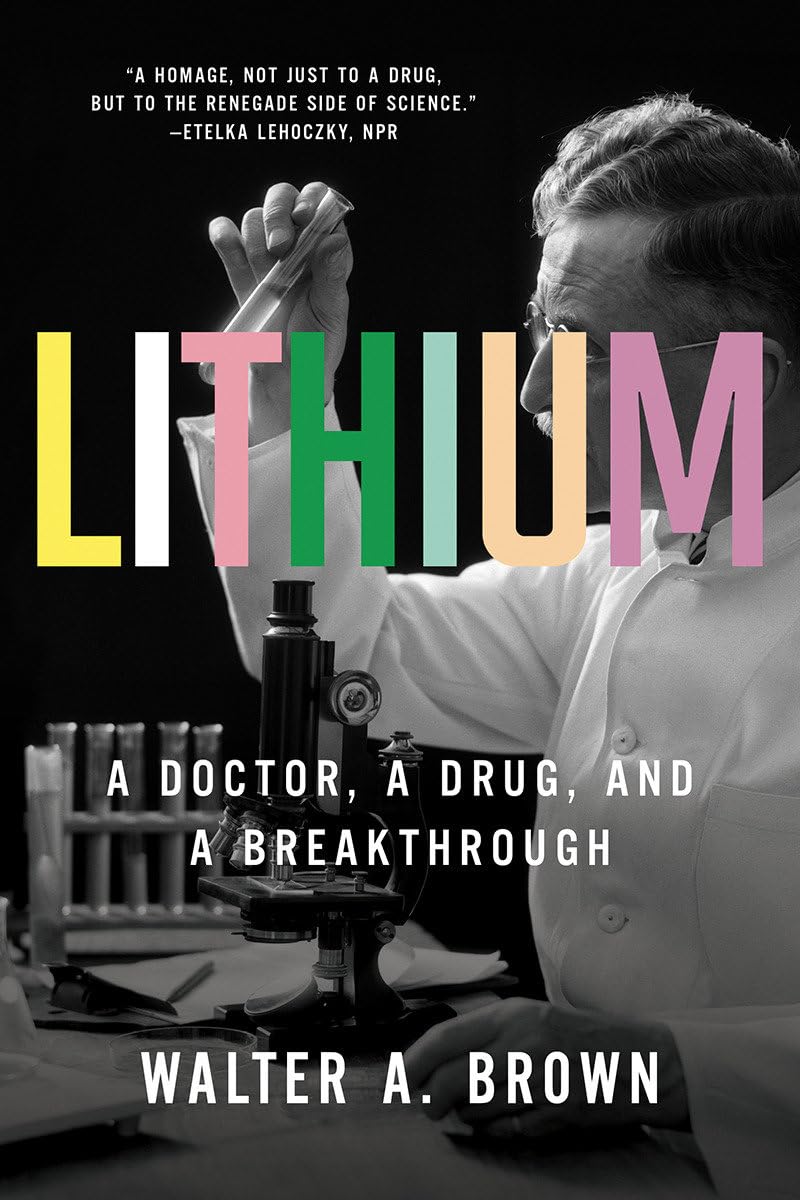
To begin with, let’s start at the end: lithium works. If you suffer from bipolar disorder and/or persistent suicidal ideation, there is no better prophylactic treatment than lithium. It is, as Brown likes to remind his readers, “the gold standard.” It is estimated that lithium has saved the US economy hundreds of billions of dollars since its belated introduction in 1970. Yet, lithium has never been marketed and no single company is financially motivated to promote it. The amazing thing is that this natural element has far out-performed the best that modern pharmacology can design.
Lithium wasn’t discovered until 1817. Its name comes from lithos, the Greek word for stone. In the nineteenth century it was used to address a wide variety of diseases associated with uric acid build up, such as gout. When it was discovered that uric acid was not the cause of many diseases, including mental illness, which many people then believed, lithium’s reputation as a universal remedy quickly faded. Nevertheless, well into the 1930s the public continued to believe that lithium provided health benefits (lithium citrate was once one of the seven ingredients in the soft drink 7-Up, first marketed in 1929). Lithium was also used liberally and irresponsibly as a salt substitute in the mid-twentieth century, which led to an alarming number of deaths from lithium toxicity, an outcome that undermined the adoption of lithium for mental illness purposes for many decades.
The hero of Brown’s story is Australian psychiatrist and former world war two POW John Cade (1912 – 1980). However, after reading “Lithium” it’s hard not to see Cade as an ernest, eccentric, and, above all, incredibly lucky physician. His lithium breakthrough came in 1949. It was the result of an unlikely concatenation of mistakes, misdiagnoses, and blind luck. Or as Brown charitably characterizes it: “Cade’s penchant for informed speculation, for inductive leaps – indeed, for fantasy – allowed him to make his lithium discovery.”
To begin with, Cade erroneously believed that mental illness was directly caused by some organ producing too much or too little of something. He began looking for clues in urine samples from bipolar patients at the mental hospital where he worked in Melbourne. He began injecting the urine samples into guinea pigs and found that urine from bipolar patients was significantly more toxic than the samples from the control group. Cade – without much solid evidence, according to Brown – focused on uric acid as the possible culprit, which led him to experiment with lithium. He injected the guinea pigs with high levels of lithium and observed a dramatic sedative effect. In fact, Brown writes, Cade had unwittingly drugged the animals to the verge of lethal comatose. “Those guinea pigs probably did not just show altered behavior,” Brown writes, “they were presumably quite ill.” Cade was thus observing lithium toxicity and not the therapeutic effect he is ultimately credited with discovering. Next, Cade jumped immediately from the preliminary observations from his home laboratory straight to a human trial among the patients at his mental hospital, a move Brown says “defies scientific logic.” One suspects that it would also likely defy many laws today. Finally, in one last and improbable lucky stroke, Cade prescribed his test patients the almost perfect therapeutic dose of lithium during the trial: 1200 mg per day. Cade, at age 37, released his report on the lithium trial in manic patients in the September 1949 issue of the Medical Journal of Australia. He strenuously objected to the idea that serendipity played a crucial role in his discovery. He never again conducted any further research on lithium.
In looking back on his experiments that led to the discovery of lithium’s therapeutic effects on manic patients, Brown says that “Cade’s oversights or selective forgetting run the gamut.” Nevertheless, the author says, “Cade’s discovery launched psychiatry’s pharmacological revolution – the use of drugs to treat the mentally ill.”
Lithium experienced a slow, almost tortured path to widespread adoption. It took two decades before the FDA approved the drug in the United States. Brown says there were two primary reasons for lithium’s delayed adoption. First, drug companies couldn’t patent lithium and they had new psychiatric drugs coming online that competed with it, such as chlorpromazine. Thus, they devoted their time and resources to promoting their new profit-making drugs over lithium. Second, Brown suggests that the dangerous reputation that lithium earned because of the ill-advised salt substitute program, where participants were daily ingesting eight times the therapeutic dose, cannot be overstated. For decades lithium was associated with deadly toxicity. Even John Cade banned the use of lithium at his hospital in Melbourne in 1952. Third, in the mid-twentieth century many psychiatrists considered any drug treatment at best secondary to psychotherapy, further diminishing the attraction lithium may have had for mental health practitioners.
According to Brown, the second most important figure after John Cade in the development and adoption of lithium for the treatment of bipolar disorder and the prevention of depressive episodes is the Danish psychiatrist Mogens Schou. He conducted a double-blind, randomized controlled trial (RCT) in the hopes of providing definitive proof of lithium’s effectiveness in the treatment of mania. Brown calls Schou’s RCT “a turning point for lithium and psychiatry,” even though the global psychiatric community largely continued to ignore lithium well into the 1960s.
Reception to the drug took a turn in 1963 when it was reported for the first time that lithium also acted as a prophylaxis against mania and depression. That is, lithium could actually prevent signs of mental illness, a claim that was “totally unexpected, if not outlandish,” according to Brown. The dramatic prophylactic claim, which was based on less than stellar research design, “became one of the most rancorous disputes in the history of psychiatric research,” Brown says. Lithium stubbornly remained “the Cinderella of psychiatric drugs.” In 1970, the United States became the fiftieth country in the world to approve lithium. By the end of the decade, the author says, “it had transformed the treatment of manic-depressive illness and drastically improved its prognosis.”
Incredibly, even after three-quarters of a century of observation and research, modern science still has no idea how or why lithium works. According to Brown, “we simply don’t know which of lithium’s innumerable biological effects account for its ability to prevent episodes of mania or depression.” It doesn’t help that we still don’t know what causes bipolar disorder in the first place. The presence of bipolar disorder is extraordinarily high in people in creative professions: writers, composers, poets, and artists. It is unclear why, but the root cause of the disease may eventually be unraveled by researching that clear connection.
Today, alone among the agents, like chlorpromazine, introduced nearly 75 years ago in the first wave of psychiatric drugs, “lithium is still widely used and remains the gold standard for the treatment of manic-depressive illness,” Brown says. It is estimated that 250,000 Americans are taking lithium today. In addition to alleviating debilitating manic and depressive episodes, it is estimated that lithium has reduced the suicide rate of bipolar patients by 90 percent. Yet, lithium is not without its limitations and drawbacks. It is estimated that lithium does not work on roughly thirty percent of people with bipolar disorder, and those that take the drug over long periods frequently experience thyroid and kidney problems.
 What's Tim Reading Now?
Leave a comment