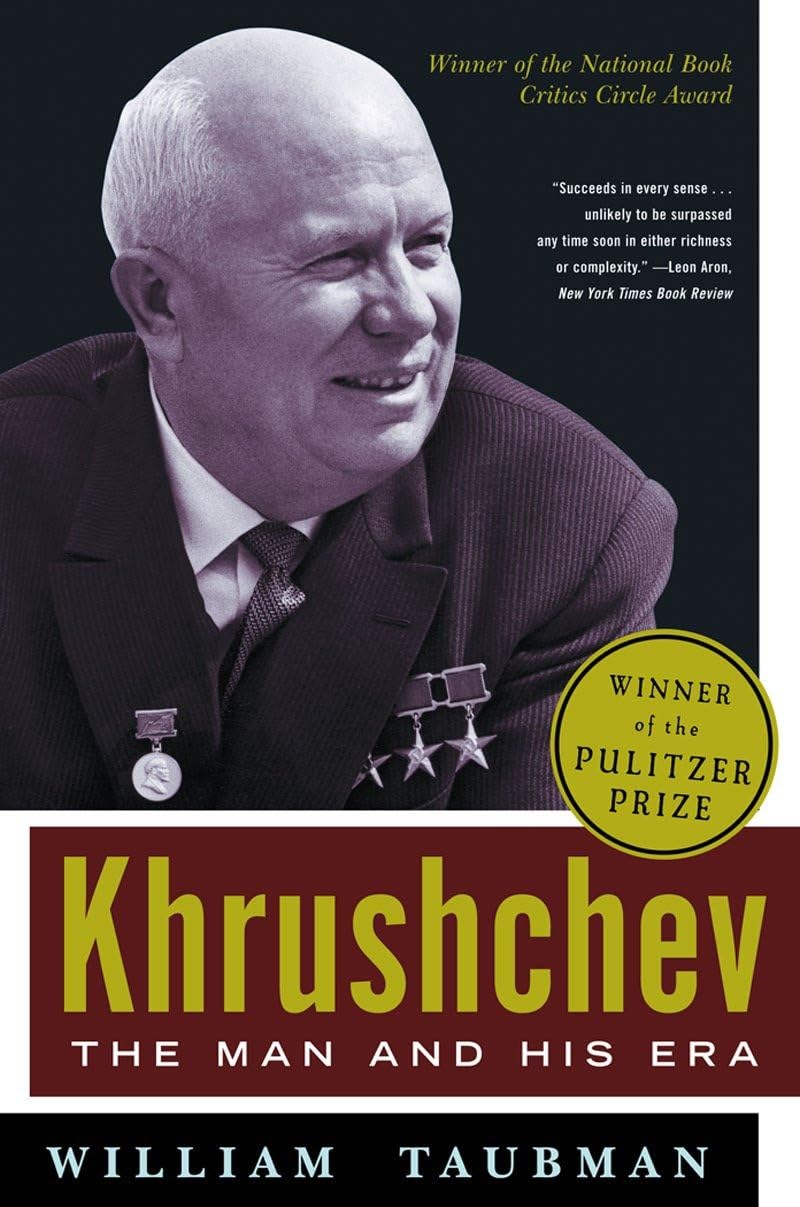
Nikita Khushchev was an unlikely giant of the twentieth century. His improbable decades-long march to supreme leadership of a world girdling communist empire was matched only by his improbably well-orchestrated fall from power in 1964.
The riddle that Tubman seeks to unwrap in this excellent single-volume biography is: How exactly did someone like Khrushchev, this “crude and limited man” as the author describes him, rise so far in the cut-throat Soviet communist party, besting men far more talented and ruthless, and then retain sole command of a global superpower, and for so long? Or as British Prime Minister Harold Macmillan asked himself in his diary after meeting with Khrushchev in Vienna in the mid-1950s: “How can this fat, vulgar man, with his pig eyes and his ceaseless flow of talk, really be the head – the aspirant Tsar – of all these millions of people and this vast country?”
It’s a great question – and Tubman stresses several points in trying to answer it.
First, the author makes clear that Khrushchev was, in many ways, the embodiment of the revolutionary state that he eventually led. Of humble birth in a remote village in the southern Russian region of the Donbas, Khrushchev had impeccable worker credentials that served his career well: virtually uneducated, a shepherd in his youth and then a miner and metal worker at foreign owned firms in young adulthood, he advanced in life mainly, if not exclusively, by hard work and an indefatigable desire to impress his Bolshevik authorities. He lacked education, manners and culture. His grammar and spelling were atrocious. He stood just 5’1″ and was overweight since his early twenties. He knew almost nothing of life outside of Russia for the majority of his life. But he knew what it meant to work hard for a living in terrible conditions and for a foreign or aristocratic overlord. For many Russians, including many in leadership in the communist party, someone like Khrushchev was an authentic as they came – and they rewarded him accordingly.
Second, as is true in almost all walks of life – capitalist, communist, or otherwise – Khrushchev benefited enormously from the help rendered by powerful mentors and patrons early in his long climb to the top. His boss in the Ukraine, Lazar Kaganovich, was the most central and important (and Khrushchev would later reward that favor by exiling his former mentor). Perhaps as important was Nadezhda Alliluyeva, Stalin’s influential second wife, who was a student colleague of Khrushchev’s in the early 1930s at the Industrial Academy in Moscow. The positive, private words she relayed to the vozhd in those years not only set up the dumpy little Khrushchev for future success, it likely saved his life during the terror Stalin unleashed after his wife’s suicide in 1932.
Third, Khrushchev’s relationship with Stalin was, as described by Tubman, both critical to his future success and morbidly fascinating to read about. The author memorably characterizes Stalin as Khrushchev’s “mentor and tormentor.” Khrushchev deeply and sincerely admired Stalin – at first, that is. Stalin, in turn, clearly saw something in Khrushchev – and genuinely liked him. Perhaps it was his perceived lack of natural talent that made him so congenial and thus less threatening to the paranoid Stalin. Whatever the case, Khrushchev could never have been in position to jockey for ultimate leadership after Stalin had not Stalin nurtured and supported him into that position. And it was a position that Khrushchev earned the hard way over the years, enduring Stalin’s withering insults and criticisms, for years anticipating a knock on the door at 3 a.m. that would end his life and destroy his extended family. Tubman describes cringe-worthy stories of public humiliation inflicted upon Khrushchev by Stalin (e.g. Stalin once tapped on Khrushchev’s forehead with his pipe in front of the collected Soviet leadership and then remarked with a smile: “hollow!”).
Finally, like Stalin, Khrushchev built his power within the organizational framework of the sprawling Communist Party of the Soviet Union (CPSU). More sophisticated, more talented, more experienced rivals – men like Malenkov, Beria, Molotov and Kaganovich – built reputations within the Kremlin while Khrushchev slowly and steadily built a patronage network within the CPSU, but beneath the radar and outside of the capital, just as Stalin did in the 1920s. One can’t help but think that these other potential heirs to the throne all too easily dismissed the humble, bumbling, insecure Khrushchev. Tubman frequently paints a picture of a “radiant” Khrushchev, energetic and garrulous with brilliant, piercing eyes, but plagued by self-doubts, harboring an acute inferiority complex. Eventually, like Stalin again, he craved flattery and toadying while insisting that he hated it.
Khrushchev’s near decade as leader of the Soviet Union (in his capacity as the First Secretary of the Communist Party, not head of state) witnessed some of his country’s greatest technical achievements (hydrogen bomb, sputnik, Yuri Gregarin’s space flight), which he took great personal pride in, and extremely daring, if not reckless, foreign policy actions (Hungary, downing of Francis Gary Powers, construction of the Berlin Wall, the Cuban Missile Crisis). Tubman describes a leader who operated almost exclusively from the gut. “Not thinking things through was typical Khrushchev…” according to the author, whether it was the attempt to surreptitiously place missiles in Cuba or mandating the transition to corn farming across his continent-sized nation.
In the end, Tubman argues, Khrushchev lost one too many internal constituencies. He lost the army with his single-minded focus on the nuclear-tipped missiles at the expense of conventional forces. He lost the intelligentsia with his uncouth behavior and embarrassing verbal attacks (in one memorable scene described by Tubman, Khrushchev publicly dressed down sculptor Ernst Neizvestny at a 1963 art exhibition: “If that’s supposed to be a woman than you’re a [homosexual]. And the sentence for that is ten years in prison”). And, most importantly, his domineering style ultimately lost the support of his protégés within the communist party, including his eventual successor Leonid Brezhnev.
In closing, Tubman brilliantly succeeds in bringing Khrushchev to life. You feel like you know him, that “rumbustious, impetuous, loquacious, free-wheeling” Russian hillbilly, as British ambassador Hayter once described him; a mercurial, ambitious man who overcompensated for his lack of ability with single minded determination and the Olympian humility to suffer cruel abuse from his superiors without wavering in his commitment to the cause and the state. Khrushchev’s story of achievement against such long odds is inspiring and, in a way, almost American, which helps to explain how he and millions of others could have kept such faith in the future of the Soviet state in the face of such suffering and mindless cruelty. He was, as Tubman concludes, “…Both true believer and cold-eyed realist, opportunistic yet principled in his own way, fearful of war while all too prone to risk it, the most unpretentious of men even as he pretended to power and glory exceeding his grasp, complicit in great evil yet also the author of much good.”
 What's Tim Reading Now?
Leave a comment