John Maynard Keynes once famously quipped: “Practical men, who believe themselves to be quite exempt from any intellectual influence, are usually the slaves of some defunct economist.”
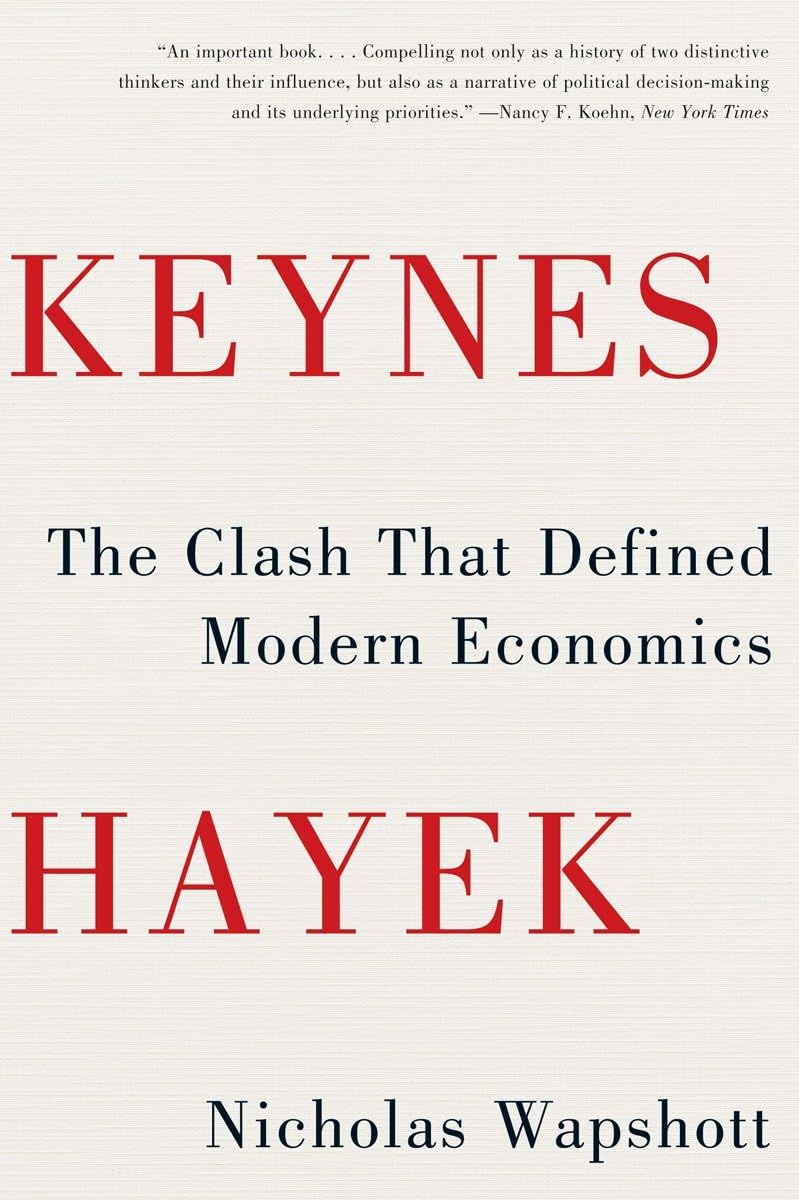
The underlying question in Nicholas Wapshott’s” Keynes Hayek: The Clash that Defined Modern Economics” is whether or not Keynes himself is now one of those defunct economists. And, if so, has Friedrich Hayek, so long in the great man’s shadow, spurned and ridiculed for most of his life by the professionals in his field, emerged as the leading intellectual force in economics today?
After reading “Keynes Hayek,” I can’t help but think that the subtitle is misleading. There was never much of a “clash” between the two men, besides a short, public and rather pedantic tit-for-tat in 1931 when Hayek wrote a sharply worded critique of Keynes’s “Treatise on Money,” a piece Keynes had already admitted was not full baked and marred with inconsistencies. I found these early chapters of the book difficult to follow and digest. Wapshott quotes extensively from Hayek’s writing, which is turgid and abstruse, and only rarely attempts to put his arguments in simple English. I found myself agreeing with University of Chicago economist Frank Knight’s contemporary complaint: “I wish [Hayek] or someone would try to tell me in a plain grammatical sentence what the controversy…is about. I haven’t been able to find anyone on this side [of the Atlantic] who has the least idea.”
Beyond that brief contretemps, which centered mainly on the uninspiring topic of how basic economic terms like investment were being defined, Keynes simply ignored Hayek, because he could. After all, by the early 1930s Keynes was an international celebrity; Hayek was merely a young and largely unknown lecturer at the London School of Economics with a thick Austrian accent. If Hayek sought to pick a fight with the legendary Keynes , Keynes’s strategy was to avoid anymore tiresome direct exchanges with his pygmy rivals and instead bury them under the intellectual weight and rigor of his magnum opus, “The General Theory of Employment, Interest and Money,” which first appeared in 1936.
After years of trying to influence economic policy by directly influencing the policymakers, Keynes gave up in frustration and instead sought to achieve change by winning over an entire generation of young economists to his theory that during a crisis full employment could only be achieved by government intervention, such as public works projects, that increased aggregate demand. He was successful beyond even his own lofty and confident expectations. He had set off a revolution – and he knew it. Hayek wasn’t even able to muster a response.
The two men, Keynes/Hayek, simply do not measure up as great rivals like Edison/Tesla or Ali/Frazier. Keynes was a brilliant man – and brilliant in many ways. Hayek was shy, inarticulate, and uncomfortable in the spotlight and outside the world of theory. Wapshott recognizes that and notes “It is worth speculating how the battle with Keynesian ideas would have turned out had Hayek been more of a showman…Had [he] possessed Keynes’s self confidence, commercial nous, and his love of performance, he might have been able to persuade that managing an economy was not desirable.”
But not only was Hayek no showman, with little feel for public relations or how to win over a crowd, he also offered no solutions. The painful reality, he claimed, was that we had to allow the market to naturally find its equilibrium, which could take years and would certainly have punishing effects on workers in the meantime. Any government intervention would only make things worse and delay the arrival of equilibrium and full employment. Wapshott writes: “Hayek was a doubter and pessimist: those who strived to make the world better would likely end up inviting unintended consequences. The free market worked best according to rational decisions based on self-interest and failed to work when tempered by idealism.”
Keynes, on the other hand, “offered a hopeful view of the future, with everyone employed based on an optimistic view of human nature.” It was certainly an easier product to sell. Or, as Milton Friedman once sarcastically put it, “What a wonderful prescription: for consumers, spend more out of your income, and your income will rise; for governments, spend more and aggregate income will rise by a multiple of your additional spending; tax less, and consumers will spend more with the same result.”
The upshot was that the post-War free world was decidedly Keynesian. Or at least it was Keynesian in that the economic policies were driven by Keynse’s legion of bright-eyed and motivated followers who adopted his prescriptions with near religious intensity and devotion. Alan Peacock of LSE argued that Keynes, who died suddenly at the age of 62 in 1946, was the “Kerensky of the Keynesian Revolution.” That is, a moderate who got the revolution moving, but who was quickly kicked to the curb by the wide-eyed true believers. Indeed, it is worth noting that the vast majority of students have learned Keynesian concepts not from reading the master directly in “The General Theory,” but rather from his American acolyte, Paul Samuelson, whose “Economics: An Introductory Analysis” has been printed in forty languages and has sold 40 million copies over the past half century. As Samuelson once arrogantly put it: “I don’t care who writes a nation’s laws if I can write its economics textbooks.”
Once politicians discovered the electoral power of Keynesian economics, the revolution really took off as presidents of both parties aggressively used fiscal policy to prime the economy in tune with the electoral cycle. By 1965, the United States and the western world had never had it so good. Everyone was enthralled with Keynesian prescriptions they believed had delivered two decades of strong economic growth, low employment and low inflation. John Maynard Keynes was named Time’s Man of the Year – nearly twenty years after his death.
But that honor may have been the high water mark for Keynes, as the 1970s introduced something that Keynesian economists thought impossible: sustained high inflation and high unemployment (stagflation). Wapshott likens Keynesian polices by the 1970s to a wonder drug that after awhile starts to lose its potency. By the time of the Reagan 80s and the collapse of the Berlin Wall and the general loss of faith in socialism, Hayek and his followers, Milton Friedman foremost among them, suddenly and surprisingly came into fashion. Hayek, who received the Noble prize in 1974 and died in 1992 at age 92, had lived long enough to confidently say, “I told you so.” By the 1990s, Democratic president Bill Clinton was committed to balanced budgets and free market economists had taken over the international institutions created by Keynes at Bretton Woods, the World Bank and International Monetary Fund. In the long run, so it seemed, Keynes was dead.
And then the worst economic crisis since the Depression hit in 2007 and the immediate response from the conservative Republican administration of George W. Bush was a stimulus and bailout package along almost pure Keynesian line. Evidently, “everyone is a Keynesian in a foxhole.”
So is Keynes “defunct”? Not by a long shot, Wapshott concludes. The cult-like conviction of his adherents in academia and government may have tempered since the stagflation of the 1970s, but Keynes fundamentally altered how we think about the economy and society’s relationship with it. Today, Keynes’s approach to understanding an economy from the top down (macroeconomics) rather than from the bottom up (microeconomics), as Hayek did, has become standard. The macroeconomic metrics that Keynes pioneered, such as Gross Domestic Product (GDP), remain the essential yard sticks for measuring the health of an economy. Finally, Keynes’s general point that the economy can and should be managed by the government has become an established fact, although those who claim Hayek as their intellectual godfather prefer to see the economy managed by the government’s influence on the money supply through interest rates (monetary policy) rather than through tax cuts and public spending programs (fiscal policy). Many politicians, particularly those of a conservative stripe, may preach Hayek on the campaign stump, but once in office, and especially in the midst of economic crisis, they unabashedly embrace Keynesian solutions, either because they work or simply because they are politically expedient.
Milton Friedman was certainly ahead of his time when, in 1966, he noted with his usual ironical wit: “In one sense, we’re all Keynesians now; in another, nobody is any longer a Keynesian.”
 What's Tim Reading Now?
Leave a comment