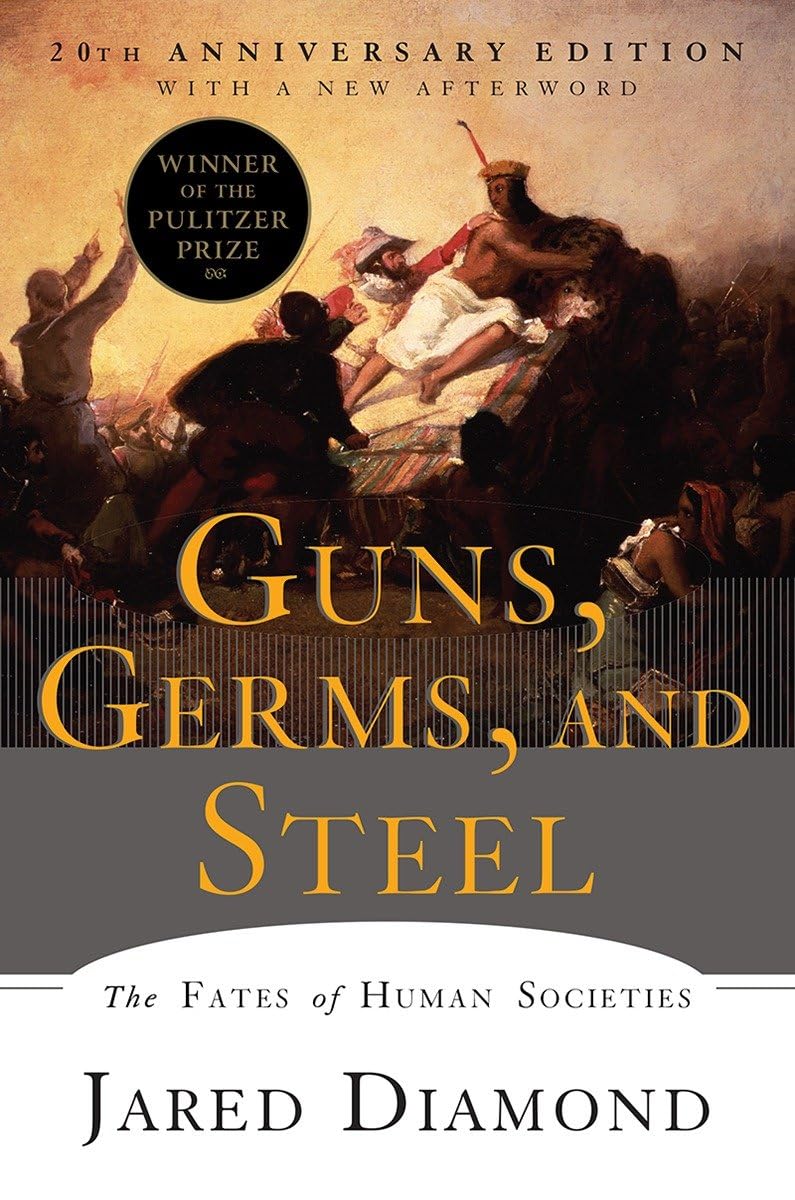
As an avid reader with no prior background in anthropology or historical geography, I found Jared Diamond’s Guns, Germs, and Steel to be truly mesmerizing—a sweeping synthesis that tackles one of the most profound questions in human history: Why did some societies conquer others rather than the reverse? Since its publication, the book has achieved remarkable acclaim, including becoming a national bestseller and winning the Pulitzer Prize, yet it has also attracted strident and sometimes venomous criticism from scholars across multiple disciplines.
Diamond’s central and most original thesis is a bold challenge to traditional, ethnocentric explanations of Western dominance. He argues that the West’s global conquest was not due to any inherent superiority of its people but rather a contingent product of geography and environment—a “fluke of nature.” According to Diamond, Eurasia’s unique combination of domesticable plants and animals gave it an early advantage in food production. This agricultural bounty led to a cascade of transformative consequences, which Diamond categorizes as the “ultimate” and “proximate” causes of Western ascendancy.
At the root, the availability of crops like wheat and barley and animals such as horses, cattle, and goats allowed for dense, sedentary populations supported by surplus food. This surplus, Diamond explains, enabled the development of complex societies with specialized classes, including bureaucrats, artisans, and soldiers—groups necessary for technological innovation, organized warfare, and empire-building. Furthermore, close living quarters with domesticated animals led to the evolution of deadly germs, to which Eurasian populations eventually developed immunities, devastating populations in less-exposed continents during European conquests.
One of Diamond’s most compelling and original insights lies in the importance of Eurasia’s east-west axis, which facilitated the diffusion of crops, animals, and technologies across similar climates and latitudes. This geographic factor, combined with the absence of major geographic barriers, allowed ideas and innovations to spread relatively easily, fueling competition among many societies and accelerating technological progress.
While Diamond’s thesis is persuasive and elegantly presented, it is not without its critics and limitations. The final chapter, which attempts to explain why Europe, rather than other Eurasian powers such as the Middle East, India, or China, ultimately dominated the world, is notably less convincing. Here, Diamond offers a relatively terse explanation, touching briefly on Europe’s political fragmentation and the competitive environment among its states. Many readers and scholars feel this section leaves significant questions unanswered, suggesting that geography alone cannot fully account for Europe’s ascendancy.
This perceived gap has sparked vigorous debate and opened the door for alternative interpretations. For instance, classicist Victor Davis Hanson’s Carnage and Culture explicitly rejects Diamond’s geographic determinism and instead highlights cultural and military factors, particularly the war-making efficiency of Western liberal democracies emerging from the Hellenistic period. Rather than viewing these perspectives as mutually exclusive, it is fruitful to consider them as complementary: Diamond provides the environmental and geographic foundations, while Hanson offers a cultural and political epilogue explaining how Europe capitalized on those advantages.
Diamond’s work remains a landmark introduction to anthropology, environmental history, and the interdisciplinary study of human societies. It offers a cogent and data-driven alternative to traditional Eurocentric narratives by framing the rise of the West as a product of environmental luck rather than racial or cultural superiority. Whether one fully agrees with his conclusions or not, Guns, Germs, and Steel challenges readers to think deeply about the forces shaping human history and to reconsider assumptions about progress and power.
In closing, this book is an essential read for anyone interested in the grand sweep of history and the origins of global inequality. Approach it with an open mind, engage critically with its arguments, and use it as a springboard for your own reflections. Love it or hate it, Jared Diamond’s Guns, Germs, and Steel is a monumental work you owe it to yourself to explore.
 What's Tim Reading Now?
Leave a comment