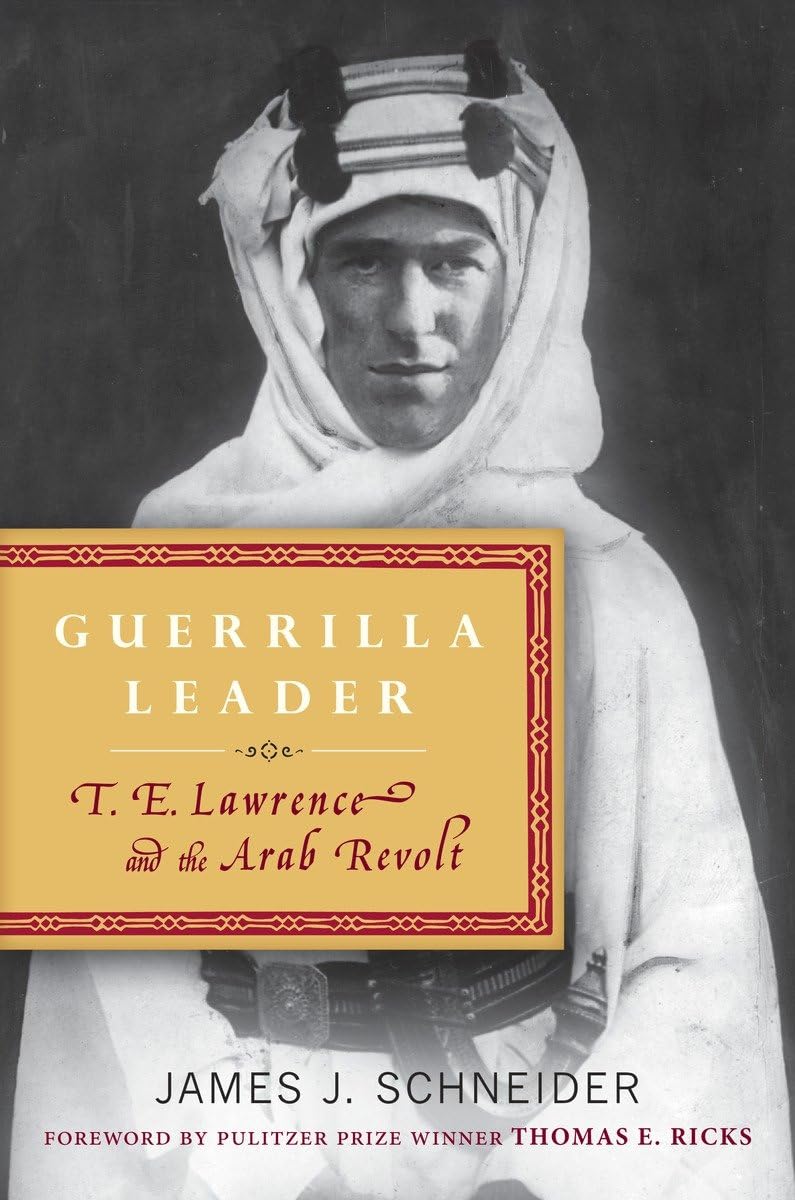
The author, James Schneider, is a professor at the U.S. Army Command and General Staff College. In the Preface and Acknowledgements in the advanced proof of “Guerrilla Leader” he hints that he sees T.E. Lawrence as an exemplar of the type of military officer the U.S. Army needs to cultivate in order to be successful in counter-insurgency struggles like Iraq – intelligent, culturally sensitive, curious, brave, and adaptable – a viewpoint echoed recently, and convincingly, by Mark Moyar in “A Question of Command.”
Presumably “Guerrilla Leader” is meant to be read by junior officers and NCOs, the type of men and women who will continue to play a critical ground-level role in Iraq and Afghanistan and other areas of global instability. If so, I should be the ideal reviewer, as I recently spent a year in southern Afghanistan and devoted my pre-deployment months to reading everything I could on counter-insurgency, including Lawrence’s classic “The Seven Pillars of Wisdom.” I regularly share my “must read” counter-insurgency reading list to fellow JOs in my reserve unit heading down range and, unfortunately, this book will not be on it, primarily because I can’t quite figure out what this book is all about.
“Guerrilla Leader” isn’t a biography. There are many solid biographies of Lawrence worth reading, from the 1976 Pulitzer Prize-winning “A Prince of our Disorder” by John Mack to more recent works, such as Michael Korda’s 2010 release, “Hero.” In the Acknowledgements Schneider claims that he buried himself in the Lawrence archives at Oxford, but little of that effort manifests itself in this book. What is worse, Schneider decided for some reason to not footnote anything other than references to the “Seven Pillars. Thus “Guerrilla Leader” reads quite like the Cliff Notes version of that brilliant, although often dense and overwrought war memoir.
“Guerrilla Leader” isn’t an in-depth assessment of Lawrence’s theory of unconventional warfare. Schneider makes much hay about Lawrence’s “revolutionary heresy” of modern guerrilla warfare, indeed claiming for him the mantle as “the first theorist and practitioner to revolutionize the guerrilla within the broader context of modern industrialized warfare.” Schneider devotes one whole chapter (perhaps the best), titled “A Flash of Genius,” laying out Lawrence’s basic theory of insurgent warfare, emphasizing Lawrence’s three major dimensions of guerrilla warfare: the algebraic (factors fixed in time and place); the biological (those subject to wear and tear – or friction); and the psychological (those related to the mind of the enemy) and then distilling the critical elements of success down to a David Galula-like list of principles (Schneider calls them “Luther-like”): 1) guerrilla forces can and should augment conventional forces; 2) the guerrillas need a sanctuary; 3) the enemy must be technologically advanced but; 4) numerically weak; 5) the guerrilla force must possess at least the passive support of the populace and; 6) be nimble and logistically independent; and 7) armed with modern weaponry, especially explosives capable of destroying the enemy’s material (indeed, the “IED” played a huge part of Lawrence’s success – he set off at least 80 improvised mines along the Turkish rail lines alone). Schneider does a decent job summarizing Lawrence’s arguments, but his original words, found in Chapter XXXIII in “The Seven Pillars,” is just as crisp, more powerfully written and shouldn’t be skipped. Most disappointingly, after laying out Lawrence’s view on guerrilla warfare in chapter three of this book, Schneider never once returns to the themes, showing how the Arab Revolt followed the key principles or how Lawrence crafted strategy based on his readings of the three dimensions of irregular warfare.
“Guerrilla Leader” isn’t a history of the Arab Revolt or the British campaign against the Turks and Germans in the Middle East. I would love to read a rich, textured history of the events described here, blending the best of political backdrop, competing personalities, strategy and tactics, and battle narratives, something like Thomas Pakenham’s “The Boer War.” But, again, this book is mostly just a very average rehash of “The Seven Pillars.”
One final quibble: Schneider’s prose skews toward an embarrassing shade of purple. He seeks to emulate (I guess) the highly evocative style of Lawrence, but if anything the overblown language detracts from the book’s readability. If this book is really directed at junior officers, why would anyone mar the narrative with writing like this: “To a fever-addled mind, time means nothing. All sense of it is lost; there is no temporal duration, only an unendurable pounding in the temporal lobes. Dream’s nighttime domain and reason’s daylight abode trespass each other. Both dance together in an awkward, heated embrace where human reason succumbs to a siren’s dream of past images and remembering. All cast up in a silent fog of ambivalence, hope, and regret: the Lawrence family secret of his bastard birth, the Arab uprising, the death of two beloved brothers in a combat on the western front – and more. For several days, the fevered ballet in Lawrence’s head continued, mere shadows cast by a real struggle in his febrile body.” [My marginalia notes next to this paragraph reads: “Are you kidding me?!”]
In closing, there isn’t much to recommend about “Guerrilla Leader,” unfortunately. I tend not to post negative reviews, but I received this copy via the “Amazon Vine Voice” program and, as per the terms of that program, had to contribute something.
 What's Tim Reading Now?
Leave a comment