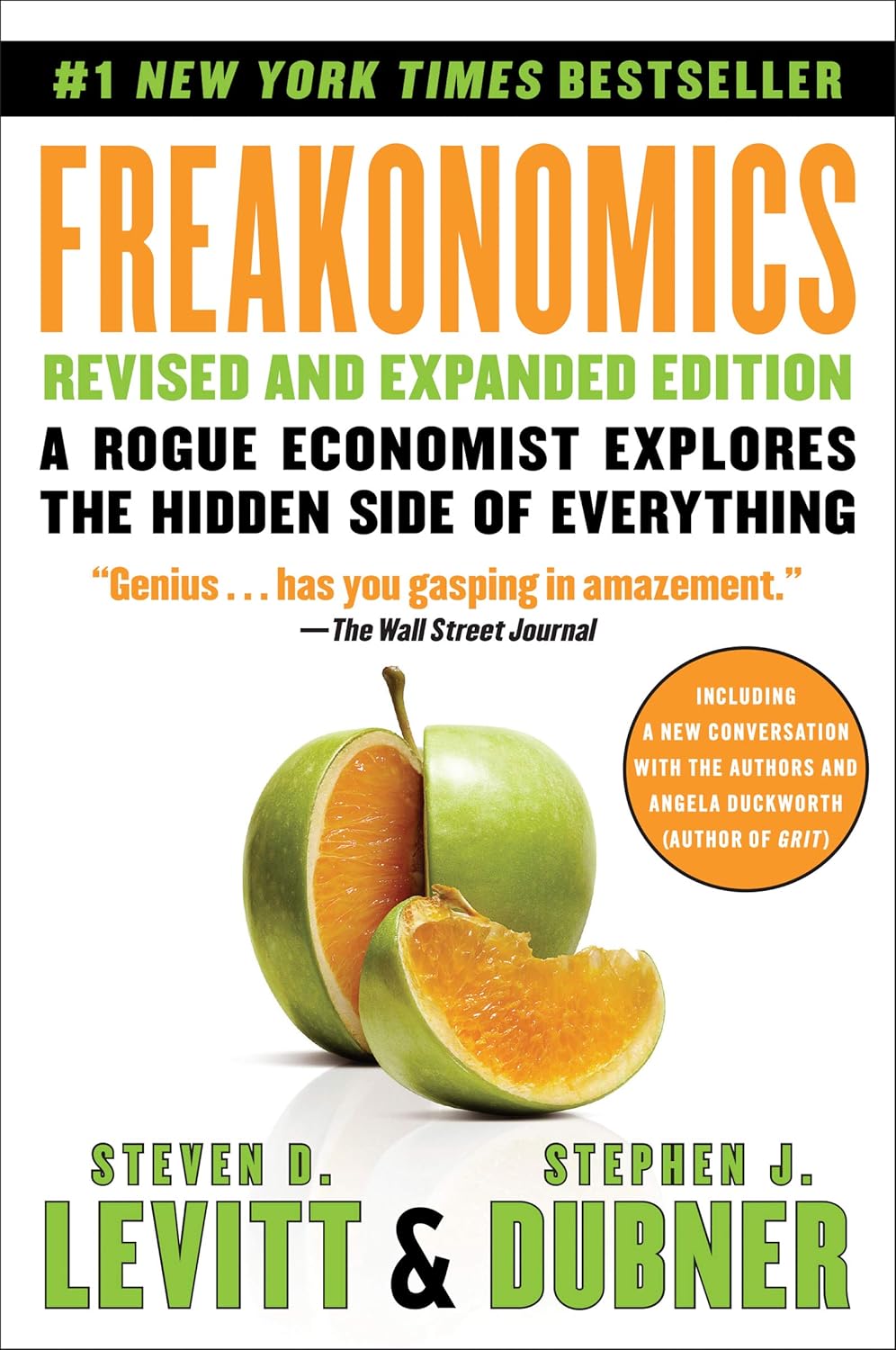
A number of years back I had the privilege of serving as a graduate intern in the Pentagon’s Office of Net Assessment. Two things I took away from that experience working directly for Andy Marshall were: 1) devote most of your energy to discovering the right questions to ask; and 2) once you zero in on a handful of key questions, devote the rest of your energy to discovering the right metrics to apply to those questions.
The lessons imparted by Marshall are at the core of “Freakonomics,” which is nothing more than a serialized collection of the work of the brilliant and unorthodox University of Chicago economist Steven Levitt put into an easily accessible style by veteran New York Times reporter Stephen Dubner.
Levitt concedes that there is “no unifying theme” to Freaknomics, although there are a few leitmotifs. The most dominant theme is what Andy Marshall told me as a young graduate student – “knowing what to measure and how to measure it makes a complicated world much less so.” Several other points and observations run throughout “Freakonomics.” First, the conventional wisdom is often wrong. Second, the conventional wisdom is often wrong because it is propagated by so-called experts who are serving their own agenda. Third, everyone (especially experts) are driven by some form of incentives and understanding the incentive structures of any organization or actor will go a long way to identifying the right metrics and thus better understanding behavior.
There is much in this book that could offend the average reader. For instance, Levitt argues forcibly that the dramatic and unanticipated drop in juvenile violent crime in the 1990s was a direct result of Roe v. Wade, and had little or nothing to do with the booming economy, tougher gun control or innovative policing strategies. That is, an entire generation of would-be criminals – mostly from young, unmarried, uneducated, poor minority women – simply were aborted rather than born in the mid-1970s onward. Levitt’s thesis has been attacked from both the political left and right, and not too surprisingly his arguments have been called racist or in favor of eugenics.
The actual case studies in each chapter really are not all that important, in my opinion. Each one is fascinating and compulsively readable (I read the book in two sittings). The best take-away from Freakonomics is not – or should not be – that abortion is good for society because it prevent children with a high propensity for crime to be born or that African-American children with distinctly “black names” do less well in life (socio-economic standing, etc.) more because what that name says about their parents and upbringing than how they are treated by society, but rather that Levitt encourages one to ask different questions and ruthlessly pursue metrics that may have gone overlooked.
There is no better primer on how and why to challenge the conventional wisdom in any facet of life.
 What's Tim Reading Now?
Leave a comment