I worked with the Pentagon’s Office of Net Assessment in the 1990s. For all the fuss made back then about an emerging Revolution in Military Affairs – long range precision strike capabilities and information dominance – many of us believed that the truly important core competence of the US armed forces was (and would remain) the vastly superior training and professionalism of our troops. Technology is relatively easy to replicate and/or undermine; an army and navy led by highly educated and disciplined but innovative officers and NCOs takes generations to build.
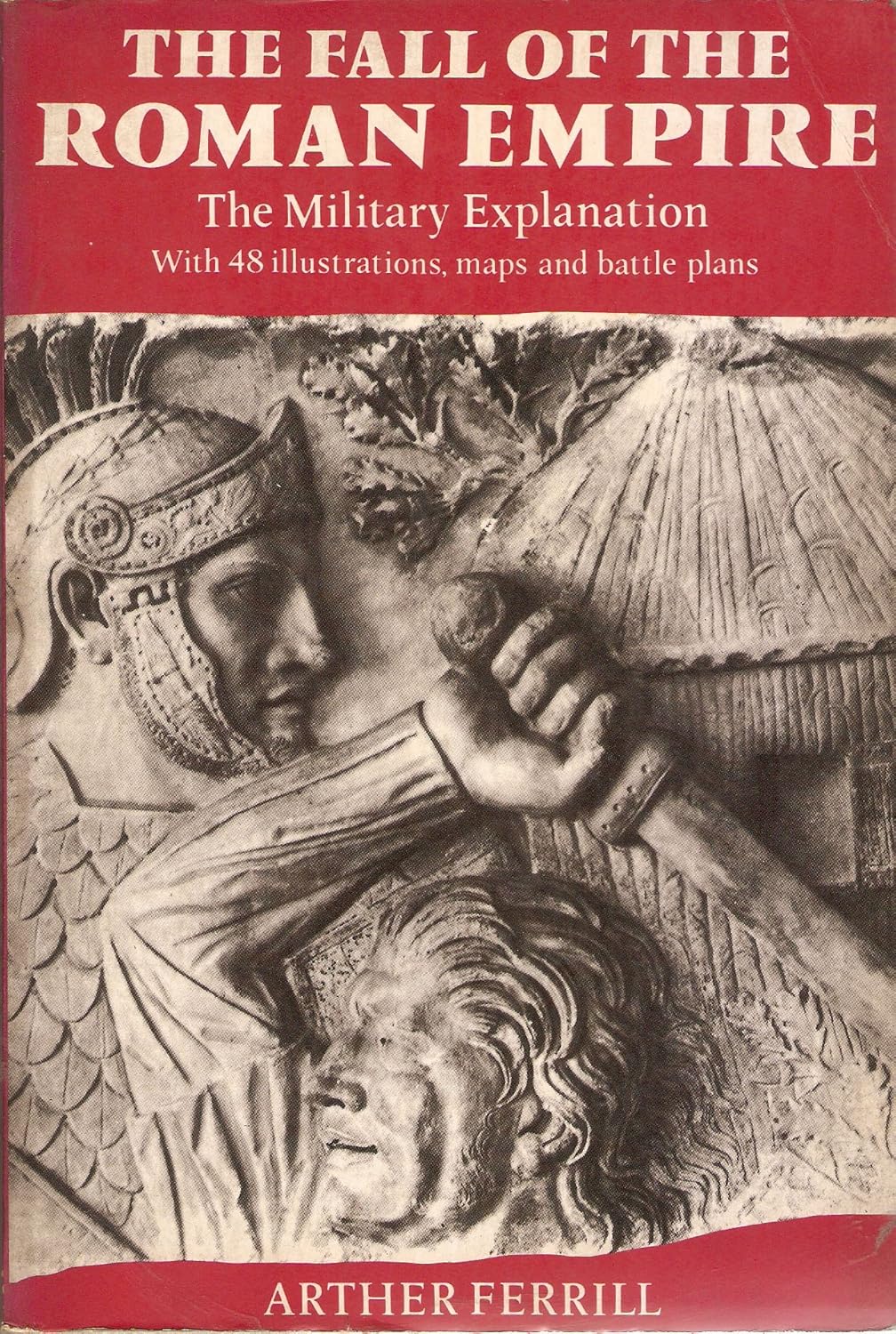
Arther Ferrill makes a similar point in this compact monograph, maintaining that the Roman Empire fell because it was no longer able to consistently defend itself against outside threats once the vaunted Roman legions had lost their edge in infantry battle, which was the outcome of two major strategic decisions that ultimately undermined the training and discipline of frontline troops.
First, Ferrill questions the wisdom of the mobile strategic reserve force, a force of nearly 100,000 that was meant to leverage interior lines and reinforce threatened areas along the frontier. He claims that Theodor Mommsen canonized the view that the mobile reserve created by Constantine in the early fourth century was a much needed innovation and that following generation of scholars accepted that verdict almost without question. However, Ferrill sides with the great British historian, Edward Gibbon, who saw that organizational change as disastrous. The arguments against the mobile force are compelling, Ferrill writes. First, a mobile reserve couldn’t necessarily counter a two front war any better than the preclusive defensive policy of a strong frontier force. Second, it was apt to create a central elite force that inevitably led to the decline in the fighting power of the frontier units that were no longer expected to engage and defeat the enemy. Third, the mobile nature of the central elite force meant that it was dominated by cavalry and that over time the Roman’s prowess at close order infantry, for centuries their core competence, would be steadily eroded. In summary, Ferrill writes that the centralization and militarization of the Roman Empire under Constantine and after took a heavy toll on the military efficiency and morale of the forces along the perimeter, which for generations had held the barbarians at bay. It was the first but not the most consequential crack in the Roman war machine.
The real cause of the Roman army’s downfall, Ferrill says, came a century after the mobile strategic reserve was created. He writes: “The cause of [the] deterioration in Roman arms is almost certainly the ‘barbarization’ of the army resulting from the use of ‘federate’ troops by Theodosius the Great and his successors…Too long and too close an association with barbarian warriors, as allies in the Roman army, had ruined the qualities that made Roman armies great…[thus] the Roman army of AD 440, in the West, had become little more than a barbarian army itself.” But actually it was worse than that, Ferrill goes on to argue. The barbarized Roman army combined the worst features of each style of warfare. “Close formation and indiscipline make a very sad conjunction,” he wryly concludes. Ferrill sees the work of Vegetius, which argued for a return to the old Roman ways of training and discipline, as the best and most obvious evidence of the deleterious influence of barbarians in the legions.
It must be noted that several modern scholars have disputed the “barbarization” argument, including Hugh Elton (“Warfare in Roman Europe, AD 350-425”), who argues that the claim of heavy, negative barbarian influence is widespread but poorly documented. Elton suggests that likely only 25% of the Roman army of the late fourth and early fifth centuries were barbarian and that number probably held steady.
For Ferrill, the years 407 to 410 were decisive. Indeed, he calls them the “Turning Point” and devotes an entire chapter to that brief period. The author claims that historians, both ancient and modern, have been too harsh on the Emperor Honorius (395-423) primarily because he reigned over a critical period of Roman decline, including the sack of Rome by the Visigoths under Alaric in August 410. Ferrill writes that Honorius, while no genius, pursued a reasonable enough garrison strategy in the face of the threat posed by the Visigoths. Ravenna and Rome each had powerful walls and the barbarians were notoriously unable to conduct sieges effectively. Moreover, the emperor had no effective field army left to oppose Alaric and almost certainly would have lost an open battle. The author claims that Honorius strategy very well may have worked, had not someone inside Rome, in an act of treachery unequaled in the city’s long history, opened the Salarian Gate to the barbarians.
Rather it is Stilicho, the Romanized barbarian who served as field general of the western army from 395 to 408, who is singled out by Ferrill as the one man perhaps most culpable for Rome’s demise. It was Stilicho who pursued the Theodosian policy of barbarian appeasement and wholesale incorporation into the Roman army, which doomed their fighting effectiveness and thus led to the collapse of the empire. “Stilicho was wrong,” Ferrill writes, whereas “Honorius was unlucky.”
Overall, I enjoyed “The Fall of the Roman Empire,” although I felt like it was a journal essay that unnaturally stretched itself into a book of some 160 pages. I don’t believe that Ferrill’s arguments are particularly novel, nor is his prose narrative style especially riveting, but as one view point on the ultimate cause of Roman decline and collapse targeting the lay reader, it may be worth your time.
 What's Tim Reading Now?
Leave a comment