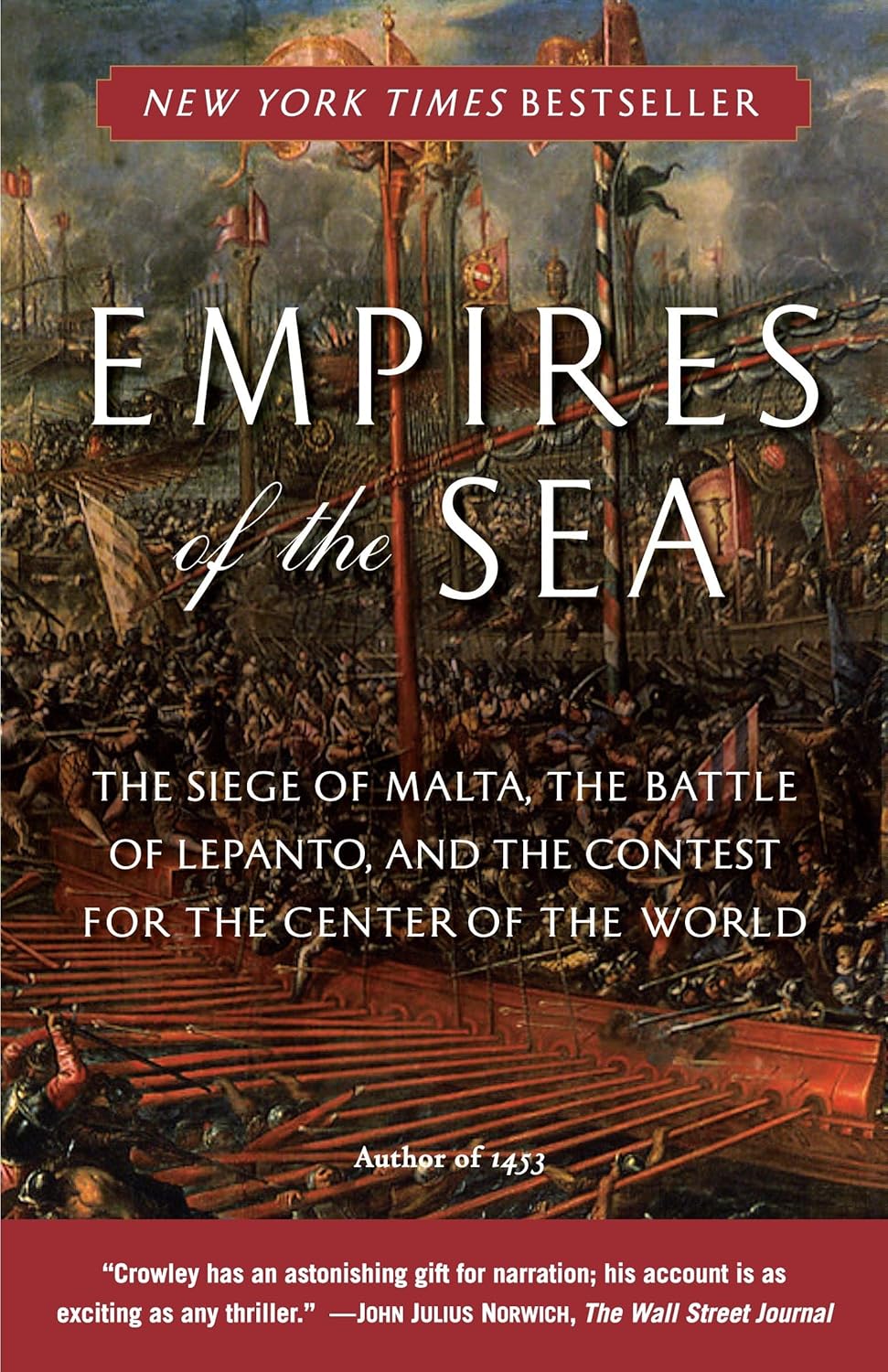
Is Roger Crowley’s “Empires of the Sea: The Siege of Malta, the Battle of Lepanto, and the Conquest for the Center of the World” a substantive and groundbreaking piece of sixteenth century history? No.
Is it an engaging story wonderfully told? Absolutely.
The author breaks the narrative into three equally weighted parts. The first sets the scene of two inimical Renaissance superpowers colliding in the Mediterranean, the center of the known world: the Ottoman Turks under the ambitious Sultan Sulieman, buoyed by a unified base of religiously motivated warriors and a string of strategic victories over his Christian adversaries, and Charles of Spain, funded by the immense specie wealth flowing from conquests in the New World but hampered by a fractured European Christian community of hostile French and Protestants in Germany and the Netherlands to the studiously neutral Venetians more concerned with their commercial rival Genoa than the Turks. “The Mediterranean became a biosphere of chaotic violence,” Crowley writes, “where Islam and Christianity clashed with unmatched ferocity.”
Several personalities play important roles here, namely the dashing and aggressive Sulieman, more than a suiting successor to his grandfather, Mehmet II, conqueror of Constantinople in 1453, and the weak, sickly, ugly, yet surprisingly effective Charles, King of Spain, who challenged the Turks for dominance of the Mediterranean. And then there are the great admirals, Heyrettin Barbarossa for the Muslims and the Genoese sailor Andrea Dorea for the Christians. From 1521, when Rhodes, the last stronghold of the Crusading Knight Hospitalers, finally fell after a long and brutal siege, to 1560 when the Ottoman repulsed a Christian attack on Djerba in North Africa, these two great sea lords led remarkable efforts to disrupt and defeat the other.
A major theme of the first part of this book is the truly terrible and inhumane raids on civilian communities around the Mediterranean, a battle enflamed by religious and racial differences. “It was hate at a visceral level,” Crowley writes, as his vivid descriptions of rape, torture, and impressment as rowers makes clear. The main ship of each fleet was the oar-rowed galley, which the author graphically claimes “consumed men like fuel.” Crowley describes a world that validates Hobbes’ depiction of life as nasty, brutish, and short. By 1560 the Muslim power of Sulieman’s Ottoman Turks was firmly in control of the eastern Mediterranean and eyeing the new home of the Hospitalers ousted from Rhodes: Malta, “the key to the central Mediterranean.”
The second part of the book tells the story of the siege of Malta in 1565, easily one of the largest amphibious assaults in military history regardless of the era. The importance of Malta cannot be overemphasized, Crowley claims, nor can the challenges it presented to the attackers. Sitting bestride the narrow sea lane between Italian Sicily and North Africa and thus controlling free access to the western Mediterranean and the coasts of Christian Spain and France, Malta was “the Ravelin of Europe.” Moreover, “Defeat would not only expose the heart of Christian Europe; it would also sweep the Order of Saint John away forever.” The Turks possessed staggering numerical superiority over the defending knights (perhaps 25,000 versus <1,000), the element of surprise, and experience. “No army in the world,” Crowley claims, “could match the Ottomans for their grasp of siege craft, their practical engineering skills, their deployment of huge quantities of human labor for precise objectives, their ability to plan meticulously but to improvise ingeniously.” But he also argues that they faced several handicaps not present at the successful siege of Rhodes a generation earlier: namely a fractured command structure (Mustapha, Pasha Piyale, Turgot); long and tenuous supply lines; and an inhospitable terrain devoid of wood and fresh water.
The siege of Malta in the summer of 1565 kept Europe on pins and needles. If victorious, the most likely next target would be Rome itself. Nevertheless, the Christian response was slow, uncoordinated and underwhelming. Crowley describes a game of wits and incredible courage and sacrifice between the Maltese Knight Master La Valette and the Ottoman army commander, Mustapha. Both sides employed ingenious strategems, such as irregular artillery attacks (concentrated attacks against weak points in the defenses followed by indiscriminant shelling of civilians followed by terror raids at odd hours of the night) coupled with visible efforts to parley with the defenders, all in the hopes of sapping morale. During all of this, there were intelligence coups via defectors and captured men, accentuating the “intelligence war” aspect of the campaign.
Despite the many physical differences, Rhodes and Malta took on some similar characteristics. In the end, the latter “survived through a combination of religious zeal, irreducible willpower – and luck.” Mainly, it was the timely arrival of a Christian relief force from Italy that made the difference.
The third and final part of “Empires of the Sea” chronicles one of the greatest naval battles in history: Lepanto in 1571. Shortly after the victory on Malta, two key leadership roles on each side turned over. In 1565, Pope Pius IV – an urbane and cultured man – was succeeded by Pope Pius V, a man of humble birth and genuine religious zeal. In 1566, Sultan Sulieman was succeed by Selim, a man of lesser talent but determined to maintain the Sultan’s role as conqueror and defender of the faith, especially given the Spanish campaign against the Moriscos, the last remaining Muslims on the Iberian peninsula. Pius V’s determination to unite Christiandom against the Turks and Selim’s determination to solidify Ottoman domination of the Mediterranean pushed both powers headlong toward the monumental clash as Lepanto.
After the fall of Rhodes in 1521 the most forward Christian stronghold was the Venetian-held island of Cyprus. Crowley maintains that Selim needed a dramatic victory to cement his position as Sultan. Although the Turks had a treaty with Venice (it would be the only treaty that the Ottoman’s violated for a century), Selim decided to take the island, which sat on the strategic sea lanes to Egypt and for pilgrims on the Hajj. The Turks quickly took the capital city of Nicosia and then inexorably advanced on the eastern port city of Famagusta with a siege engine that dwarfed the efforts of Malta and Rhodes. Pope Pius V frantically maneuvered to establish a Holy League combining the forces of Spain, Venice, Genoa and the papacy, an effort forever hampered by “bad faith, hidden agendas, mutual lack of confidence, conflicting objectives,” according to Crowley. By May 1571, the Pope had broken the impasse and established a formidable Christian alliance, but it was too late to save Famagusta.
The author turns the story of Lepanto into a clash of noble sea warriors, who made up with courage and aggressiveness what they lacked in naval experience. The Christian fleet was led by the dashing 22-year-old Don Juan of Austria, a fabulous and gifted character according to Crowley, and a man spoiling for a fight and glory. The Turks, meanwhile, put their faith in Ali Pasha, an ethnic Turk from outside the traditional Ottoman ruling class whose direct and bellicose orders from Sultan Selim left him little option but to engage the combined Christian fleet whenever and wherever it was found.
The two fleets, each itching for battle, groped toward one another in the Adriatic at the very end of the sailing season. The Turkish fleet had been at sea since March and was exhausted and debilitated by disease. The Christian fleet was fresher but riven by the factionalism that had prevented a Holy League for so long, a“…brawling, bad-tempered, quarrelsome assortment of conflicting egos and objectives,” according to Crowley. Perhaps the greatest advantage possessed by Don Juan, however, was the faulty intelligence of the Turks. Ali Pasha greatly underestimated the size and effectiveness of the Christian fleet and had no knowledge of the floating gun batteries that would decimate the front lines of the Ottoman fleet.
The scale of the naval battle at Lepanto was staggering, “The greatest event witnessed by ages past, present and to come,” according to Cervantes, who served in the Christian fleet at Lepanto and was wounded. Some 600 galleys took part in the battle, roughly 70% of the entire inventory in the Mediterranean, with 140,000 fighting and rowing in a chaotic tangle of wood and iron that “…resembled street fighting in a narrow alley.” Crowley distills the battle of hundreds of vessels down to the epic clash between the two flagships, Don Juan on the Real and Ali Pasha on the Sultana, from which Don Juan emerged victorious, reminiscent of a Republican Roman consul achieving the rare and prestigious spolia opima.
Crowley writes that that waters off Lepanto after the battle were a “…devastated scene of total catastrophe…of staggering devastation, like a biblical painting of the world’s end.” Some 40,000 men had been killed in the matter of hours, a rate of carnage not equaled until Loos in 1915.
On the one hand, “Lepanto was Europe’s Trafalgar, a signal event that gripped the whole Christian continent.” On the other hand, Lepanto was “the victory that led nowhere.” Seventeen years later an even bigger and more historic naval battle occurred off the coast of England as the Catholic Armada was defeated by the Protestant forces of England.
“Empires of the Sea” is exactly the type of book that I love. It marries great historical events with engaging storytelling and character-driven narratives. I only wish that every culture and every era had such accessible and engaging histories to read.
 What's Tim Reading Now?
Leave a comment