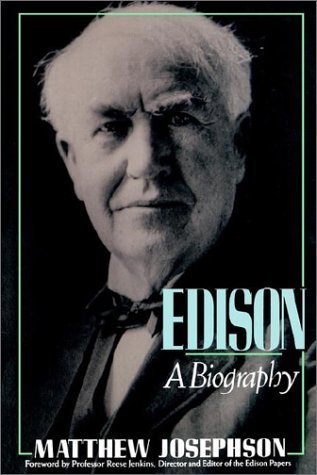
I had wanted to read a biography of Thomas Edison for a long time and put a bit of effort into finding the right one. There are several more recently published books on the market, but I found that Matthew Josephson’s 1959 classic was the consensus pick as the “definitive” single volume life of the “Wizard.” I’m glad I did the research as “Edison” is simply phenomenal, perhaps one of the 10 best biographies I’ve ever read. I can’t understand how Josephson didn’t win the Pulitzer Prize for the effort.
Edison is a colossal character and Josephson captures his life and times brilliantly. The narrative is expertly structured with a perfect blend of the personal, the scientific, and the industrial strands that made up his life. Each chapter is tight and fluid; each theme well developed and clear.
Having spent the past decade of my professional life in Silicon Valley, I found many parallels between Edison’s era and our own.
To begin with, Edison was a practical inventor, rather than a theorist or academic – and proudly so. Today, PayPal co-founder and early Facebook investor Peter Thiel is encouraging bright young Americans to forego college in favor of unleashing their creative talents before they are corrupted by higher education. It’s a sentiment Thomas Edison would certainly have endorsed. In Edison’s famous words: “Do you think I’d have amounted to anything if I went to school?” For all of his bluster against academics, however, it’s notable that Edison consistently employed some of the best educated scientists in their field in his research facilities.
Perhaps more than anything, Edison introduced the concept of commercial scientific discovery; the quest to unlock the secrets of nature in the pure pursuit of profits. Again, in Edison’s words: “I’m not a scientist. I’m an inventor…I measure everything I do by the size of the silver dollar. If it don’t come up to that standard then I know it’s no good.” Despite that professed capitalist focus, many (perhaps most) of Edison’s commercial enterprises were woefully managed, the Edison General Electric Company (more accurately under the leadership of Henry Villard) offers a dramatic case in point, where the much smaller Thomson-Houston Company, ably led by Charles A. Coffin, consolidated the industry to create the modern corporate juggernaut we know as GE.
The most surprising insight I took from this wonderful book was that Edison’s most profound inventions were startling unoriginal. He was, on balance, much more of an improver or “perfecter” than an innovator. Beginning with the telegraph (e.g. the “Quadruplex”), and including his monumental work on the carbon filament electric light and the motion picture machine, Edison’s preeminent gift was “the ability to adapt or combine ideas or materials already existing as to effect results at once distinctively new and thoroughly practical.” Much like a Web 2.0 entrepreneur, Edison took the work of others and made it useful, often revolutionarily so.
There was, however, one aspect of Edison’s world that was utterly alien to me: the patent wars. As Josephson writes: “Virtually everything [Edison] ever devised, every idea of his, was disputed by claimants who seemed to spring up on every hand as soon as he executed a patent. If a rival group were wealthy enough they could always dredge up some unknown with prior claims to Edison’s inventions, tying him up in the courts for five years.” There are patent trolls in Silicon Valley today, for sure, and my old employer, Oracle Corporation, has recently been embroiled in some ugly fights, and the issue is growing in intensity around mobile applications, but generally speaking the life of the tech entrepreneur is not a necessarily litigious one. As “Edison” makes clear, however, it defined the inventor’s world in the late 19th century, absolutely negatively so.
An aspect of Edison’s era that rings true today, however, is the stultifying impact of monopolies. Josephson describes the technical innovation around the telegraph in the 1870s as white hot and cut throat. But once Western Union zipped up the market through patent consolidation nothing new was introduced for literally decades. The best technical minds in the field simply abandoned the field. The same is true of the telephone and its eventual monopolist, the Bell System, which bought out the essential improving Edison patents on the invention. The unmistakable lesson here is: If you want a better, cheaper product, then you must encourage competition.
Another part of Edison’s story that I found relevant was the unanticipated market development of many of his inventions. Most took much longer to gain traction with the consumer than originally calculated, the electrical light being the most conspicuous example. The exception to this rule was the motion picture, which exploded commercially in the late 1890s. Other inventions gained an audience completely unanticipated, at least to Edison and his associates. The phonograph, for instance – perhaps Edison’s most original, most technically simple, most socially breathtaking invention – was originally conceived as a device to supplant the amanuensis; the prospect of selling musical records and creating an entertainment industry was completely missed, much to Edison’s financial misfortune. And when the radio began to make inroads into the entertainment niche phonographs had created, he resisted movement in that direction believing it was all a passing fad, allowing RCA to become the Google of the Roaring Twenties stock market.
Returning to the theme of contemporary comparison, where some venture capitalists on Sand Hill Road won’t consider investing in any entrepreneur over 30-years-old, Edison’s most heartbreaking failures or critical lapses in judgment occurred later in life. For example, his ore-separating scheme (including the massive “Baby Ogden” rock crusher), which consumed nearly ten years of his productive life and nearly all of the wealth he gained from the General Electric buyout, was a dismissal failure, even before Rockefeller discovered the Mesabi range in Minnesota that cut the price of iron ore by 75%.
And Edison’s “victory” with the motion picture machine was marred by his forced association with Thomas Armat, whose new projection lantern (the so-called “vitascope”) provided the critical technical breakthrough that allowed for the screen projection of motion pictures, the same type of tinkering improvement that Edison would have come up with in his earlier days. And just as Edison failed to see the appeal of radio, he also originally failed see the potential for movie theaters, fearing that ten screens nationwide would capture the entire market demand and thus undercut his nickelodeon operations. In short, Edison, the great inventor, was often “disrupted” by the competition.
Just when Henry Ford began to perfect his gasoline driven automobile – a concept that Edison enthusiastically endorsed when he met the young auto entrepreneur who idolized him – Edison devoted himself to a battery powered version of the horseless carriage, a solid century before its time. (Although one could go dizzy thinking about the implications of an Edison discovery that made an electrical automobile practicable in 1900, with its consequent impact on geopolitical affairs in the Middle East.)
Finally, for everything that Edison did to establish electrical power in the United States – indeed, the world – he sunk to disreputable levels to combat the superior AC distribution system developed by the competing Westinghouse organization. The publicity fight including nothing less than the repeated public electrocution of stray dogs and cats to demonstrate to the press the danger of the AC system, a campaign the ignominiously culminated in the successful introduction of the electric chair as the preferred form of capital punishment in the state of New York, a form of execution that the Edison team lobbied to be called “being Westinghoused.” Even Josephson asks: Did Edison really switch from being a bold, forward leaning innovator to an ossified conservative in just a decade (1876 to 1888)? For sure, Edison’s early years of unclouded glory become strikingly overcast in his later years, as he shifted from one failed ambitious venture to the next, from efforts to help develop technology to defeat the German U-Boat menace during World War I to his botanical pursuit of alternatives to rubber in the twilight of his life, along with the great disappointments of the ore-separating and storage battery schemes.
Thomas Edison was, like many of his inventions, a true original. There were aspects of his style and work found elsewhere, but the sum of this great man was far in excess of the parts. There has never been another like him; there may never be.
 What's Tim Reading Now?
Leave a comment