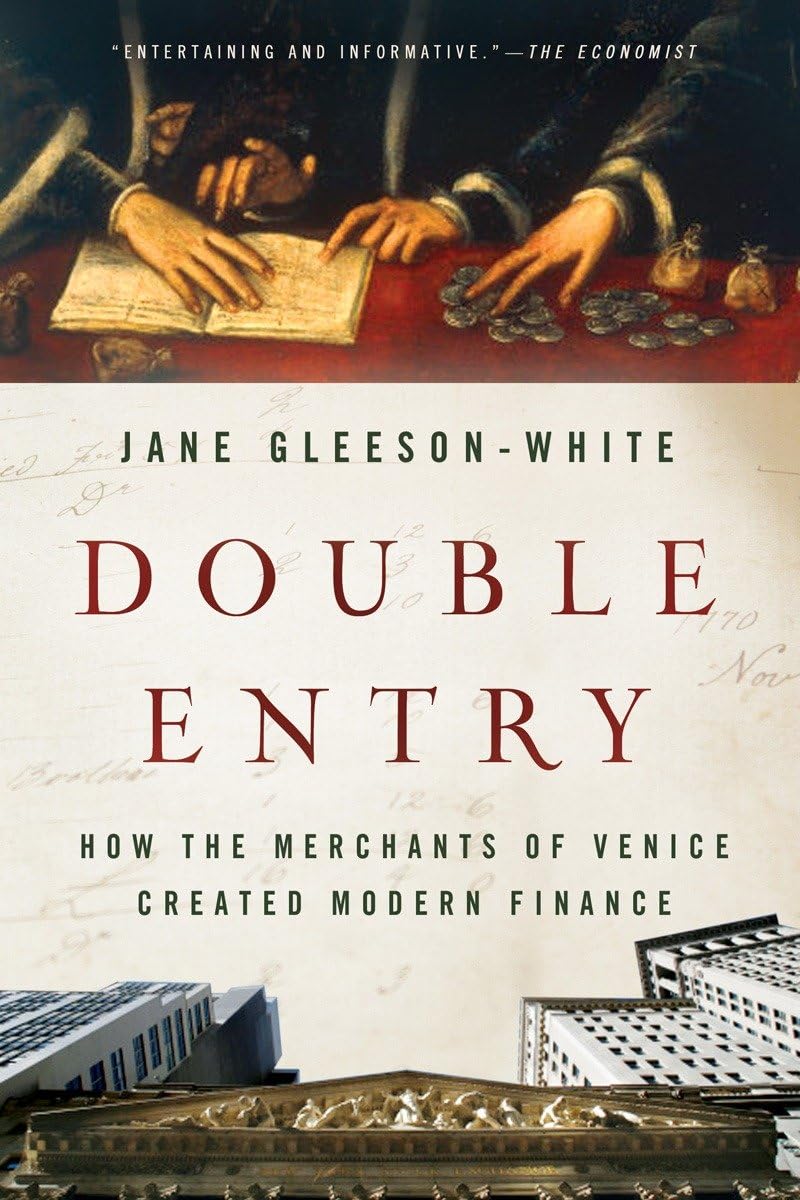
I thought this book was going to be right up my alley. My manager gave it to me as a Christmas gift this year (I hadn’t heard of it before). We are in the business of making small business accounting software and he knows that I’m an avid reader of history. Two of my all-time favorite books – “Against the Gods” by Peter Bernstein and “The Wordly Philosophers” by Richard Heilbroner – craft an absorbing character-based historical narrative on the development and growth of a field of study, probability/risk and economics, respectively. I presumed (and hoped) that author Jane Gleeson-White would do the same for the profession of accounting with “Double Entry: How the Merchants of Venice Created Modern Finance.” Unfortunately, that was not the case.
There are four main arguments/insights in “Double Entry,” although they don’t string well together.
First, accounting as we know it today was born due to a confluence of events and inventions. The development of the printing press, the adoption of Arabic numerals, and the growth of mercantile economies in the Mediterranean collectively provided the foundation for modern bookkeeping, Gleeson-White claims. Beginning in the thirteenth century, the merchants in Venice began to use a system of bookkeeping that stressed double entry for all transactions. In 1494, around the time Columbus was sailing the ocean blue, an itinerant, Italian polymath (and close friend of Leonardo di Vinci) named Luca Pacioli penned a 27-page pamphlet explaining the Venetian bookkeeping process, using simple real-life examples and written in the common man’s language of Italian rather than Latin. It was an immediate bestseller and made Pacioli wealthy and a celebrity. More importantly, the author says, it carried the double-entry system of bookkeeping across Europe and beyond, firmly cementing the Venetian system of accounting as the de facto best practice in the Western world. The system that Pacioli elucidated in the late fifteenth century is still in use today, a half-a-millennium later. “That is amazing,” Gleeson-White gasps. And she’s right.
Second, the use of double entry accounting became the norm over the next several centuries for merchants across Europe, but nothing like the modern concept of professional accountants emerged until the nineteenth century in England and the Industrial Revolution. Capital and labor intensive industries, particularly railroads, which required massive upfront capital investment, brought bookkeeping to heightened prominence as cost accounting (first used by Josiah Wedgewood in the 1760s) proved capable of identifying efficiencies in large manufacturing operations. The first “chartered accountants” appeared in England in 1854, just as Englishmen with names like Deloitte, Price, Waterhouse, and Coopers were hanging out their shingles. By the dawn of the twentieth century, and propelled by the rise of the limited liability joint stock corporation, “Pacioli’s Venetian bookkeeping had morphed into a flourishing profession whose services were essential – and required by law.” Indeed, Gleeson-White argues that accounting is more than just an enabler of big business, but rather “…the very concept of capitalism encapsulates the double-entry system and could not have come into being without it.”
Third, heading into World War II, the basic principles of double entry accounting were used, reluctantly and only as a necessary expedient, to measure national income and productivity to help more efficiently allocate resources to the war effort. Thus the measure of Gross Domestic Product (GDP) was born, an inherently flawed and imperfect number that was never intended to be a metric that drives national fiscal and monetary policy, as it does today.
The final part of “Double Entry” is an impassioned but disjointed polemic by Gleeson-White on the inadequacy of GDP as a true measure of national wealth because of all that it fails to take into account, most notably the pernicious impact of modern economic activity on the environment. Somehow and for some reason a book that starts as a history lesson suddenly turns into an exhortation for environmental activism. The book literally ends like this: “In one way or another, this century will be the one in which we learn to account for our planet. Because unless we start accounting for our transactions with the earth, we will bankrupt it for all future human habitation.” That’s a long trip from Luca Pacioli in fifteenth century Venice. That’s not to say that her arguments are off base, they just feel out of place. She quotes extensively and frequently from a speech by Bobby Kennedy in 1968 at the University of Kansas that targets the flaws in national economic measures – and he makes some compelling points. His words are worth quoting generously here: “Gross National Product counts air pollution and cigarette advertising, and ambulances to clear our highway of carnage. It counts special locks for our doors and the jails for the people who break them. It counts the destruction of the redwood and the loss of our natural wonder in chaotic sprawl…Yet the gross national product does not allow for the health of our children, the quality of their education or the joy of their play. It does not include the beauty of our poetry or the strength of our marriages, the intelligence of our public debate or the integrity of our public officials…It measures everything, in short, except that which makes life worthwhile.”
In the end, Gleeson-White offers up this disingenuous assessment: “For better or worse, accounting is our way of measuring the way we use all the precious resources of this planet, human, natural and synthetic.” Nothing about “Double Entry” suggests anything other than that the verdict should be that it is only for the worse that accounting is how we measure our resources. Accounting, as a profession, she seems to argue, is critical yet deeply and critically flawed. “Accounting’s use of numbers gives it an air of scientific rectitude and certitude, and yet fundamental uncertainties lurk at its heart,” she writes. For instance, “accountants still cannot agree on how to define income” let alone the “chimerical practice of asset valuation.” The upshot has been that “corporations and accounting scandals go together like Gordon Gekko and greed,” from Samuel Insull in the 1930s to Jeffrey Skillings of Enron (and many others) in the 2000s. One can’t help but think that the author sees accounting as a witch’s art, the way some view organized religion: insincere and malevolent.
“Double Entry” is a relatively short and easy read. If you’re an accountant or work with accountants you may find a few gems in these pages. But as a work of history and scholarship it is not anywhere near the class of Bernstein and Heilbroner.
 What's Tim Reading Now?
Leave a comment