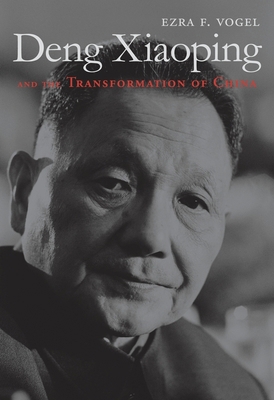
“Did any other leader in the twentieth century do more to improve the lives of so many? Did any other twentieth-century leader have such a large and lasting influence on world history?” This is how Ezra Vogel concludes his massive 700-page tome, “Deng Xiaoping and the Transformation of China.” Indeed, who else in history has raised more people out of poverty? There may be no definitively right answer, but Vogel makes a convincing case that Deng Xiaoping has a better claim than anyone else.
While lengthy, this book is an easy read and provides fascinating insights and lots of detail on how Deng and his forward-thinking policies turned China from a backward, poverty stricken basket case in the wake of the disastrous Cultural Revolution to an economic superpower in a single generation. It has been a revolution every bit as astonishing and impactful to world history as the Japanese Meiji Restoration of the late nineteenth century.
Vogel’s narrative focuses mainly on the years from Mao’s death in 1976 to Deng’s retirement in 1992. Deng’s quite eventful first 65 years of life are covered in just 45 pages; China’s dramatic growth over the two decades since his retirement receive a mere 20 pages of attention. This book could have been called the “Deng Restoration,” the decade-and-a-half period when the Chinese leader blazed a new path, normalizing Chinese foreign relations and assiduously laying the political and economic groundwork for China’s improbably rapid rise from a self-isolated Third World Country into a global leader in manufacturing and burgeoning superpower just beginning to stretch its legs and demand its rightful place in the sun, to paraphrase Bismark.
What struck me most about Deng’s leadership and policies, besides their remarkable success, was their consistency – and authority. His power was strictly personal, not positional; Deng was never chairman of the Chinese Communist Party, nor Premier of the Chinese government. Rather, he was something else, the “preeminent leader,” officially only vice chairman of the party and chairman of the Central Military Commission. Aging and hard of hearing, he rarely attended Politburo meetings. Yet, “it is doubtful that anyone [other than Deng] had the combination of authority, depth and breadth of experience, strategic sense, assurance, personal relationships, and political judgment needed to manage China’s transformation with comparable success,” Vogel writes. When he came to power in the late 1970s, he had very firm ideas on what needed to be done, plans that Vogel claims matured in Deng’s mind during his long and humiliating five year exile in Jiangxi working at a tractor factory during the Cultural Revolution.
First, stability and unity were paramount in Deng’s plans, according to Vogel. He knew that the economic transformation China must go through would be wrenching and tumultuous, and he believed that only the Communist Party, with its discipline and order, could effectively manage the change. He had to maintain a delicate balance between encouraging innovative thinking and freedom of expression while maintaining the unquestioned rule of the Communist Party. In 1978, Deng formulated the Four Cardinal Principles, essentially four red lines that could not be crossed in China (socialist path; dictatorship of the proletariat; leadership of the Communist Party; Marxism-Leninism and Mao Zedong Thought), and he never waivered from them. In fact, his most controversial and unpopular decision – the military crackdown at Tiananmen Square in 1989 – was taken precisely because the protests were openly challenging the Four Cardinal Principles. Although he was an ambitious reformer, he was a Communist first-and-foremost. When his two top lieutenants and official heads of party and state, respectively, Hu Yaobang and Zhao Ziyang, were seen as going soft on dissidents, he had them unceremoniously cashiered. It was the outpouring of love for Hu at his death in 1989, along with frustration at how he had been treated by Deng and the Party, that sparked the Tiananmen protests, a movement that became truly dangerous when Zhao resigned rather than acquiesce to Deng’s call for martial law.
Second, vast improvements in science, technology and education would be the cornerstone of Deng’s policies. Vogel describes Deng as obsessed with the importance of education and the critical role in advanced technology in China’s future. At roughly the same time that Deng formulated the Four Cardinal Principles to guide political discussion in China, he also developed the Four Modernizations, the areas in which the government would concentrate efforts to learn, grow and improve: 1) science and technology; 2) industry; 3) agriculture; and 4) defense. Again, Deng and the Chinese government remained steadfast in pursuing these objectives even when they led in politically sensitive directions, such as dropping class background from college admission criteria and instead relying solely on meritocratic entrance exams; encouraging thousands of students to study overseas, especially in Western countries, exposing them to potential “dangerous” ideas; establishing special economic zones (SEZ) along the coast to promote capitalist investment and trade, even though they encouraged graft and corruption; and the dramatic downsizing of the People’s Liberation Army to create a more highly educated and technologically savvy armed forces. “Deng was unique in that he pushed doors open far wider – to foreign ideas, foreign technology, and foreign capital – than his predecessors, and he presided over the difficult process of expanding the opening despite the disruptions it caused,” Vogel writes.
Third, Deng was adamant that China must be fully engaged in world affairs. He was very much his own foreign policy strategist and built his policies around a few basic objectives. Above all, Soviet expansion must be stoutly resisted. Deng went to war – “Deng’s War,” Vogel says – with communist neighbor Vietnam in 1979 to “teach Hanoi a lesson.” Namely, that China refused to allow Vietnam to become a hegemonic power in Southeast Asia while serving as the Soviet’s “Cuba in the East.” China’s month-long invasion captured five northern Vietnamese provincial capitals at the cost of 25,000 PLA soldiers killed in action, according to Vogel (that is, China lost half as many men in one month in Vietnam as the US did in a decade!). Next, Deng sought to normalize and improve relations with the Western world, an objective he largely achieved, although the backlash from Tiananmen Square was sharp and prolonged. Finally, Deng desperately wanted to consolidate Chinese territory in his lifetime, achieving peace and stability in Tibet, reintegrating Hong Kong, and, most important of all, reunifying with Taiwan. The last goal was one of Deng’s great disappointments, although he did successfully prevent the Reagan administration from formally recognizing Taiwan and worked to reduce arms shipments to the island nation. “Under Deng’s leadership,” the author writes, “China truly joined the world community, becoming an active part of international organizations and of the global system of trade, finance, and relations among citizens of all walks of life.”
Finally, Deng was a political virtuoso, albeit of a distinctly communist variety. Deng was well-described by US Secretary of State Cyrus Vance as “remarkable… impatient, feisty, self-confidently outspoken, direct, forceful, and clever.” Standing just five-feet-tall, with limited formal education and a lifelong habit of using a spittoon even when negotiating directly with world leaders in the West, Deng was nevertheless a man of immense natural ability and innate political instincts. Unlike the “mercurial” Mao, who Vogel describes as “ranked high among world leaders” in megalomania and lust for power, Deng was personally humble, wanting nothing more than to serve his country and then be forgotten. Upon his death, he donated his corneas for eye research, his internal organs to medical science, was cremated and had his ashes scattered into the sea. There would be no “Cult of Deng” if he had anything to say about it.
A deeply and sincerely committed communist, he was nevertheless open-minded and had no use for communist dogma. He was highly opposed to Mao’s revolutionary radicalism, yet sensitive to charges of being the “Chinese Khrushchev.” He quickly worked to overthrow the so-called “Gang of Four” after Mao’s death, but steadfastly espoused a flexible, results oriented approach to reform. “It doesn’t matter if the cat is black or white, just so long as it catches mice,” he liked to say. He used his liberal approach to outmaneuver and then oust Mao’s handpicked successor, the middle-aged cipher Hua Goufeng, who stumbled badly in 1977 when he penned an editorial claiming that future policy “will resolutely uphold whatever policy decisions Chairman Mao made, and unswervingly follow whatever instructions Chairman Mao gave” (the so-called “Two Whatevers”). Deng had different ideas – and they would prevail.
Although he a had clear vision for where China should go conceptually, Deng honestly admitted that he had to “grope for stones as he crossed the river” the entire time, never knowing for certain which approach was best, but always open to learning-by-doing. “Don’t argue, just push ahead,” was a favorite mantra. His SEZ experiment at Shenzhen was controversial, but ultimately successful beyond anyone’s wildest expectations. And unlike Dahzai, Mao’s experimental ideal collective community, Chinese leaders and others flocked to Shenzhen out of genuine interest rather than political expediency.
Twenty-first century China is Deng’s China. If the sun is setting on the American century and rising in the East, no one man had more to do with it than Deng Xiaoping, a man Vogel believes may be one of the greatest men in his nation’s long history. “The transition from a predominantly rural to a predominantly urban society and the spread of common national culture are among the most fundamental changes that have occurred in Chinese history since the country’s unification in 221 BC,” Vogel declares, and it was mainly the work of one little, unassuming man from a small village in Szechuan.
 What's Tim Reading Now?
Leave a comment