It is interesting and usually insightful to contrast influential theses on great topics in history. Take business innovation and capitalist-driven growth in the developed western economies. Alfred Chandler won the Pulitzer Prize with “The Visible Hand,” a comprehensive and penetrating review of US economic history, which argued for the powerful impact of two roughly simultaneous technology and management driven revolutions: 1) mass distribution, a result of a continental transportation and communication network brought by the railroad and telegraph and innovative new retail channels (department stores and mail order services mainly); and 2) mass production, where energy and technology intensive industries generated nearly inconceivable gains in output to meet the white hot velocity of inventory turnover enabled by the new distribution network. The complexity and speed of the new system was so intense it required something novel to enterprises: the professional, salaried manager. It is necessary to note that nary a word was spoken about marketing in that seminal piece of economic history.
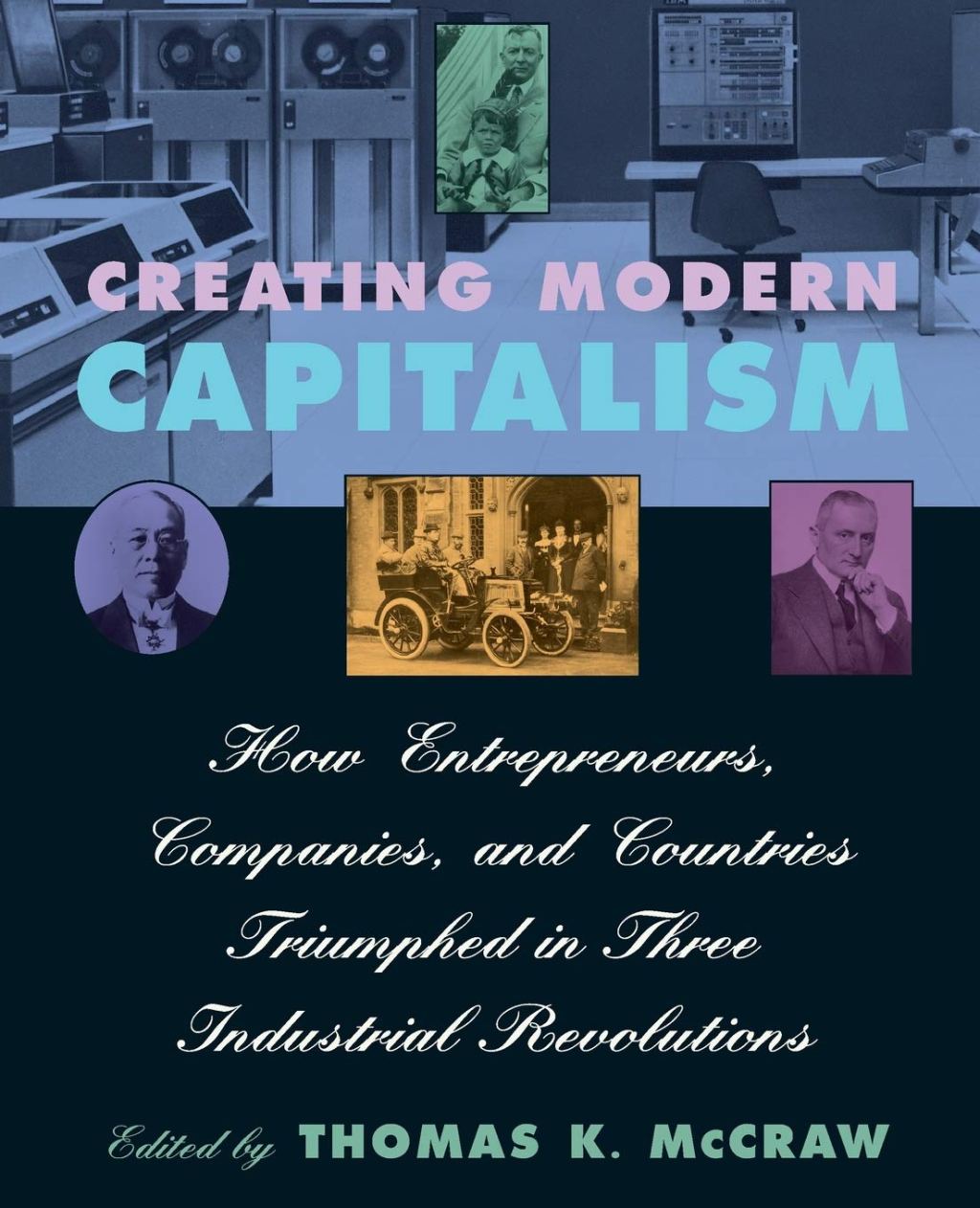
A Harvard MBA colleague of mine was so impressed with “Creating Modern Capitalism: How Entrepreneurs, Companies, and Countries Triumphed in Three Industrial Revolutions,” an assigned textbook at HBS, evidently, that he bought me a copy. I found that the authors widen the geographic and temporal scope taken by Chandler, looking at the economies of Britain, Japan and Germany, as well as the US, while profiling some iconic entrepreneurs from those dynamic, but essentially unique capitalist engines, and ultimately landing on a very different driver of success for such diverse enterprises as Wedgwood pottery, Rolls Royce automobiles and aircraft engines, IBM, Thyssen Steel, and 7-Eleven Japan.
The authors cite three discrete industrial revolutions, which form the basis of their investigation. The first (1760-1840) was British led and was propelled by innovations in water and steam power, the growth of canals and turnpikes and the new factory system. The second (1840-1950) was US led and closely mirrors the developments highlighted by Chandler, including the rise of large corporations and professional management, along with stressing the importance of transportation and communication revolutions, although with a longer view, so that the automobile, truck, airplane and telephone are lumped in with the railroad and telegraph, while accentuating the importance of mass marketing, which (in this reviewer’s opinion) forms the basis of this entire book. The third industrial revolution (1950-present) is all about information technology and services, which the authors conclude is driven globally, although I’m not sure how anyone could realistically claim that the US wasn’t the leading force in computers, Internet and services more broadly defined.
There is one chapter chronicling the economic development of each country, often over the period of a century or more. I found all of these essays to be disappointing. When trying to cover something as broad as the growth of capitalism in Japan, for instance, you either need to distill it down to a four page summary of key events and themes or else deal with the subject in a full length book. A forty-page essay is, at once, too much and not enough.
What did resonate for me here was the frequent focus on the importance of brand and marketing, topics that were virtually neglected by Chandler. The authors write that most think of revolutions in industry as being technology driven, a fundamentally supply side phenomenon that result in dramatically greater and cheaper production. However, in almost direct contradiction to Chandler, the authors of “Creating Modern Capitalism” write that marketing, broadly defined as “inducing people to want the product” (to paraphrase Joseph Schumpeter) was equally, if not more, important.
Josiah Wedgwood, for example, one of the entrepreneurs profiled here, created one of the first and ultimately one of the most enduring consumer luxury brands, a product that was desirable simply because of its name, which endured for over 230 years. Wedgwood innovated with “celebrity endorsements,” making much of his role as supplier to Catherine the Great of Russia and Queen Charlotte, wife of England’s George III. He charged twice the price of his competitors, but offered free shipping and a money back guarantee. The foundation of Wedgwood’s success, the authors argue — and the same would be true of another British entrepreneur profiled here, the automaker Henry Royce — was quality and the value of the brand that became associated with that superior quality. In short, a status symbol. As a fascinating sidebar, the wealth that Wedgwood generated was in large part combined in the (bizarre by modern standards) marriage of his granddaughter Emma to his grandson, Charles Darwin, who then used the Wedgwood fortune to fund the voyage of the Beagle to the Galapagos Islands.
The authors draw the most important distinction between the successful technology innovator and the successful marketer by comparing and contrasting Henry Ford and GM’s uber-manager, Alfred Sloan. Clearly, the authors argue, being a successful marketer sets you up for longer term success than being an innovative mass producer. The authors introduce the basic concept of the “Three Phases of Marketing” to make their point more clear: Phase 1) Fragmentation (high margin, low volume, small markets, many start-ups); Phase 2) Unification (low margin, high volume, national or global markets, and industry consolidation); and Phase 3) Segmentation (market segmentation, brands and value pricing). Ford and GM epitomize Phases 2 and 3, respectively. Ford, which owned roughly 80% of the US car market for the first decade of the automobile era, was ultimately trumped by Sloan’s segmentation strategy — and GM beat Ford in profitability ever year from 1927 to 1986.
Another highly entertaining chapter focuses on the two Thomas Watsons, the patriarchs of IBM, another American enterprise that the authors argue owes much more of its enduring success to marketing and sales than technology and product innovation. What really struck me here was the fascinating character of Tom Watson, Sr., the man who didn’t join IBM until 1914 when he was a forty-year old unemployed executive recently fired from arch competitor NCR. He held the reins and imparted his own brand of leadership and culture until 1956, when he stepped down rather reluctantly in favor of his son. The authors describe the imprint of Tom Sr., as he was known, at IBM as something akin to Kim Il Sung in North Korea, complete with company songs that everyone had to memorize, polished photographs of the chief executive hanging in offices around the company, a sense of paternal protection, including a job for life and full benefits, a standard company uniform (the stereotypical IBM navy blue suit), and a collection of pithy sayings emblazoned on walls everywhere (“Spend a lot of time making customers happy”; “Give full consideration to the individual employee”; “Go the last mile to a thing right”; and, most memorably, simply “THINK”).
All told, “Creating Modern Capitalism” is informative and rewarding, at least many parts of it are. It isn’t necessary to read front-to-back and may be most rewarding by selectively sampling the juiciest pieces.
 What's Tim Reading Now?
Leave a comment