The military explanation for the fall of Rome is a familiar one, and it remains popular. It goes something like this: by the third century barbarians began to outnumber native Roman citizens in the ranks of the army; cavalry units eclipsed the traditional foundation of Roman strength found in the infantry legions; frontier units became soft and lost their professional edge; training and discipline suffered across the board; and the once vaunted imperial army completely lost its ability to perform its core function – providing for the security of the empire.
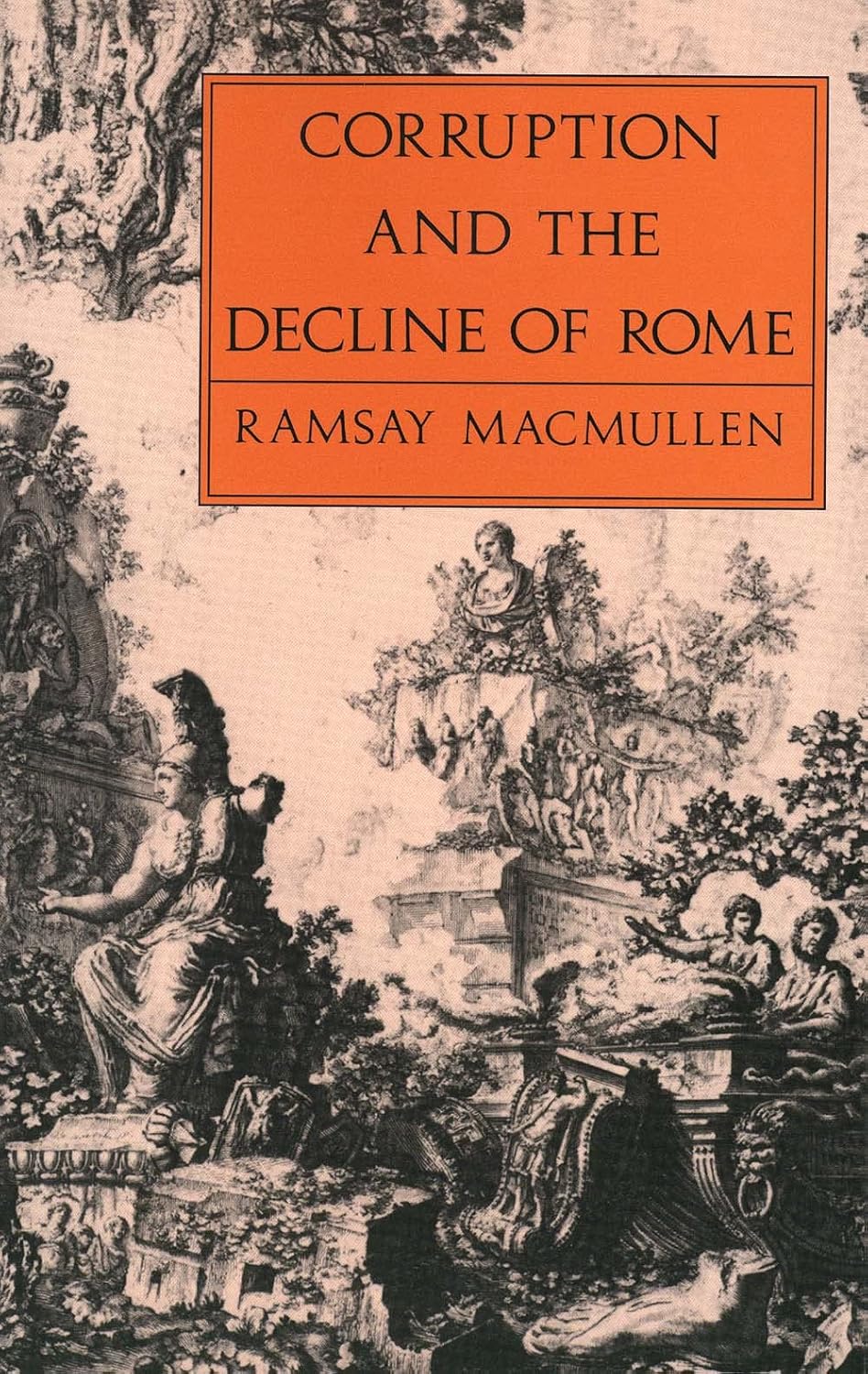
The distinguished Yale classicist Ramsay MacMullen subscribes to that general theory in “Corruption and the Decline of Rome,” but agrees with Momigliano that no one wants to hear that Rome fell “simply because the barbarians were stronger.” That may be true, but it’s unsatisfying. This book seeks a root cause analysis in an attempt to better understand how that erosion of military power came about in the first place.
To begin with, MacMullen remarks that the decline, to the extent there was one, was remarkably uneven over the centuries. Some provinces and cities flourished while others shriveled or collapsed. Any explanation behind the fall of Rome, therefore, needs to take these regional variations into account. And that explanation, he says, can be found around the capacity of government, or lack thereof as the case may be. It was the fundamental political weakness resulting from the destruction of the age old Roman client system that ultimately under laid both social and economic regression, according to the author.
MacMullen maintains that an army’s ability to achieve its prime objective is more complex than just the ability to fight and win on the battlefield. It is the ability of the state to direct and support the whole infrastructure required to make the army a reality that really matters, he says, things like “…planning, conscripting, taxing, equipping, constructing, supplying.” MacMullen asserts that a good benchmark for measuring that capacity is the size of the army the Romans were able to put in the field against an enemy. He notes that for centuries the Romans could support field armies of over 100,000, from the battles against Hannibal in the third century BC to the battles of Trajan in the second century AD, but only perhaps 15,000 or so by the beginning of the fourth century. In that relatively short period of the third century the whole connective tissue of the empire that supported the army had been severely degraded. The explanation, MacMullen writes, is that “pervasive venality in government…must have produced systemic deficiencies in defense.” He goes on, “an army assembled and ready to engage can emerge only from a broad texture of consent…implying a central government able to identify the needs of the state and to issue effective orders.” By the fourth century, that was no longer true.
The basic thesis is that corruption (or to use a word MacMullen prefers: “venality”) grew during the third and fourth centuries, during which time it went from something frowned upon but grudgingly accepted to something systemic and codified. As the Roman bureaucracy ballooned, so did those looking for a piece of the take. The upshot, and critical foundation of the overall argument MacMullen puts forward, is that the traditional web of patronage extending downward from the emperor (or leading Republican families) came undone as soon as money could buy whatever you wanted. The ties that once bound the entire empire into a cohesive, often overlapping and reinforcing network of personal obligations first became brittle, and then broke apart. It became “every man for himself.” Things that once had to be earned by expressing loyalty and support, often over generations, to a powerful patron could now be had by anyone, if they had the cash. Buying military commissions, legal acquittals, imperial posts and so on was no different than purchasing “meat and vegetables.”
The real loser in all of this, MacMullen says, was the emperor, who saw his position at the apex of the vast patronage system fatally undermined. Once the rule of gold took hold, his power was dissipated with each new functionary, who represented his imperial authority in some far off province, because he bought the privilege and didn’t earn it through the great web of loyalty and patronage. What once buffeted the strength of the empire now frittered away that power base.
In closing, MacMullen doesn’t believe in any one clear event in the decline of something as complex and non-monolithic as the Roman Empire. However, he argues that the key to understanding how a state that once could dominate the known world was no longer able to hold it revolves around the public use of power, which he calls the flip side of obedience. He concedes that the military and its inability to maintain physical security was critical, but that its failure to do so was a sign of a deeper, much more fundamental problem at the political level.
 What's Tim Reading Now?
Leave a comment