had the privilege to join Eliot Cohen, the distinguished military historian and my graduate school advisor, on an extended “staff ride” exploring the 1776-1777 Lake Champlain campaign in the summer of 2001. We hiked the beautiful trails overlooking the cobalt blue waters of Champlain, discussed the merits of Benedict Arnold as a field commander on the shores of Valcour Island, held a mock court martial of Major General Arthur St. Clair at Fort Ticonderoga, and generally enjoyed the warm weather, cold beer, good company, and spectacular scenery. Weeks later the Twin Towers fell, I joined the Navy Reserve, was later deployed to southern Afghanistan in 2009, and in the summer of 2010 found myself back in upstate New York briefing the leaders of the 10th Mountain Division at Fort Drum on the situation on the ground around Kandahar. During that short official visit I had the opportunity to tour Sacketts Harbor and explore one of the most visually stunning, not to mention strategic waterways in the world, the St. Lawrence Seaway.
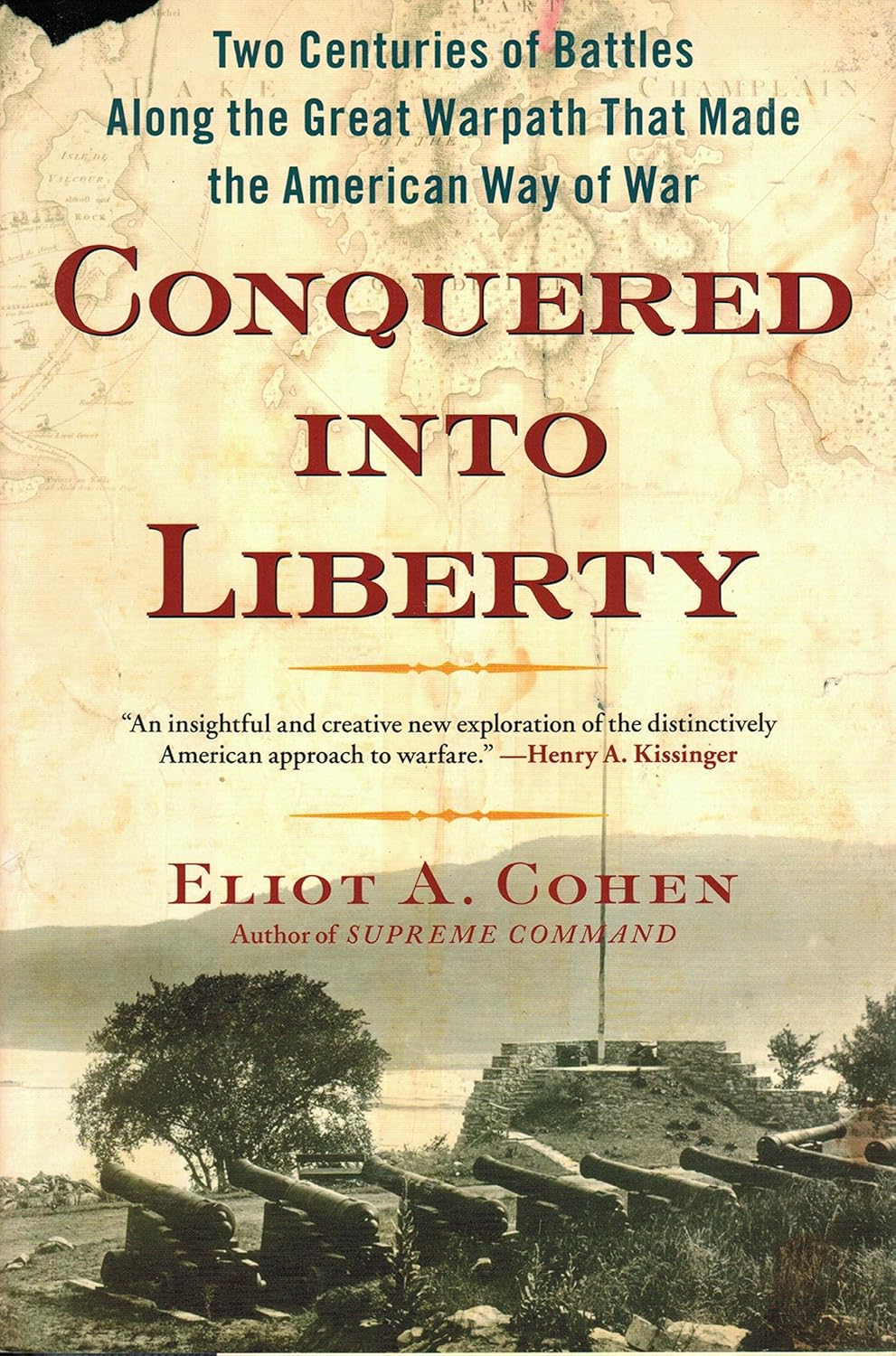
It was on that second visit – with my mind very much on war and reflecting on the strategic importance of geography, even in the most modern of campaigns – that my thoughts returned to the campaigns of the French and Indian War and American Revolution along the “Great Warpath,” a 500-mile watery sweep from New York City up the Hudson River to Lakes George and Champlain to the Richelieu River and into the St. Lawrence Seaway, flowing past the great cities of New France, Montreal and Quebec. It’s an area often neglected or treated as distinctly subsidiary in other histories. Cohen clearly saw an opportunity to put these events – some epic (Burgoyne’s surrender at Saratoga in 1777), others barely remembered (Battle of the Snowshoes in 1758) – into a broader historical context and suggest the larger role they may have played in the development of a distinctly American way of war.
The author argues that some of these early events on what was then the frontier heavily influenced American thinking for centuries to come: a desire to not merely defeat an enemy, but to utterly annihilate them (after the murderous French and Indian raid on Schenectady in 1690); the persistent attempt at codifying irregular warfare into principles and didactic manuals (from Roger’s Rangers experience in 1759); and the predisposition to blend lofty idealism with calculating realpolitik to justify military adventures (beginning with the dual-thrusted American invasion of Canada in 1775). Overall, I found the author’s attempt to weave the foundations of American foreign and military policy into the experience of the early history along the Canadian frontier to be intellectually engaging, but far from convincing.
Rather, it was the various historical anecdotes and character explorations which Cohen crisply delivers that I found most engaging and compelling. He ably explains the importance – often decisive importance – played by obscure American officers, such as engineer Colonel Jeduthan Baldwin at Fort Ticonderoga in 1776 and Lieutenant Thomas Macdonough at the Battle of Plattsburgh in 1814. He also presents fascinating sidebar stories from the campaigns, such as the court martial of St. Clair or how Ethan Allen and his fellow Vermonters, exhausted by British raids on their property and aggrieved by the politically more powerful New Yorkers who contested their land claims, seriously toyed with making a separate peace with England in the early 1780s.
Finally, Cohen puts forth a rather passionate and persuasive defense of Benedict Arnold, “…the most disturbing figure in American military history, perhaps because he is one of its most extraordinary,” whose courage and leadership played essential roles in delaying the British invasion on Lake Champlain in 1776 and subsequently defeating Burgoyne in 1777. The author argues that Arnold is at least as worthy of our respect and admiration today as are Generals Lee and Stonewall Jackson. After all, Cohen writes, “When Arnold, a mere civilian, took up arms, he had no country to which he had sworn allegiance; the soldiers of the United States Army who doffed blue for grey uniforms most definitely had.”
If you live or vacation anywhere along the Great Warpath and have at least one historically curious bone in your body, you’ll want to read “Conquered Into Liberty.” If you are a student of American military history, particularly the colonial and early republic periods, you won’t want to miss this sharp, entertaining and thought provoking read. However, allow me to offer this one final bit of advice: try to find some good modern maps of the area of operations (from the upper Hudson River to Quebec) as there are none in the book.
 What's Tim Reading Now?
Leave a comment