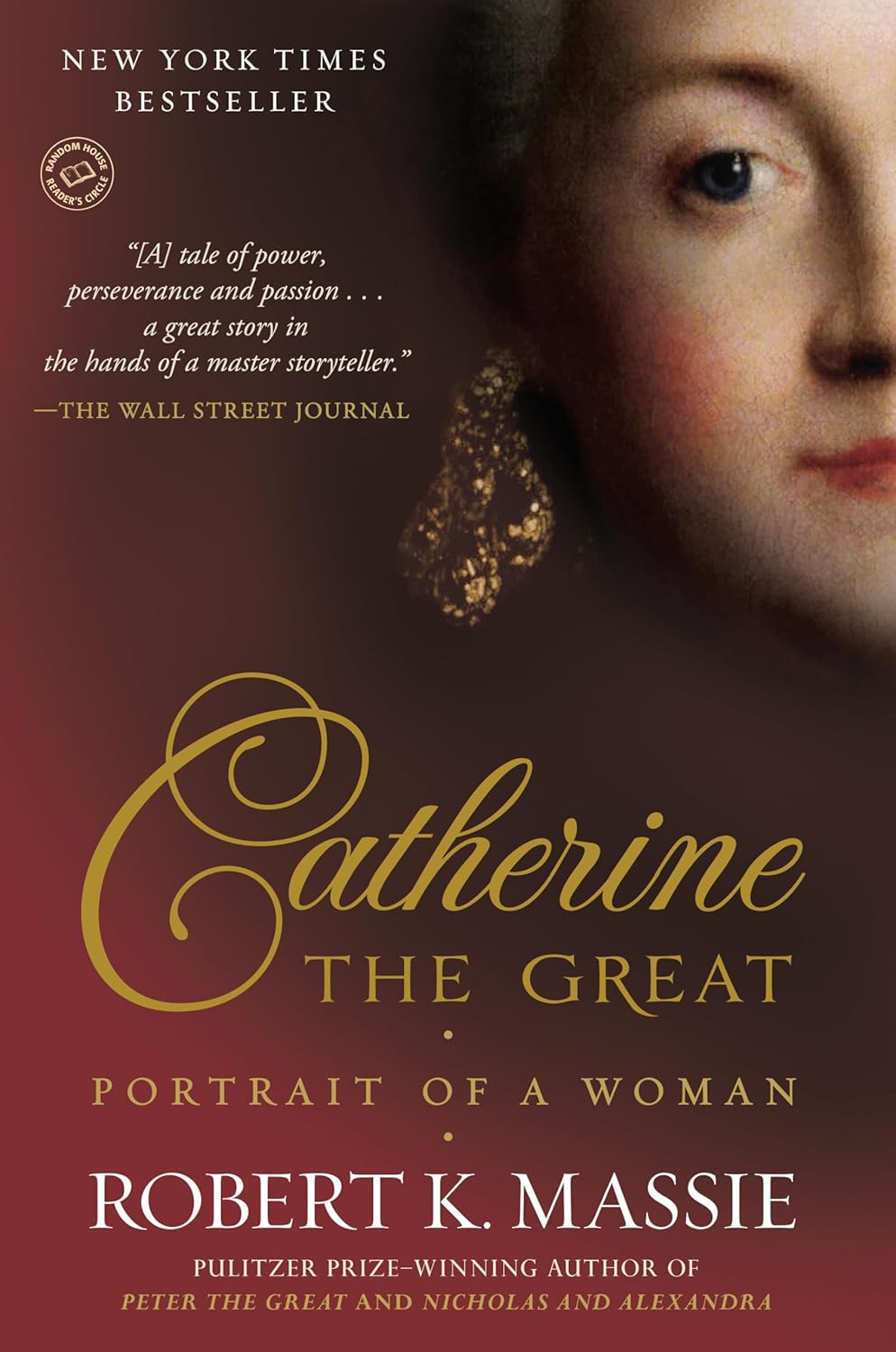
I’m a passionate reader of non-fiction. My living room wall is lined with books from floor to ceiling. Just the other day, as I scanned my hundreds of books – including a wide variety of biographies on presidents, writers, generals and business titans – it occurred to me that I did not own and had never read a biography of a woman. That didn’t feel right to me. I immediately picked up “Catherine the Great: Portrait of a Woman” by Robert K. Massie, easily one of my favorite writers.
Massie is one of those rare authors who can make distant characters from distant lands come to life on the page. This he does with skill and grace for Catherine, an obscure German princess plucked from a dreary existence at the age of fourteen merely to serve as the biological vessel to deliver a future emperor of Russia through her husband, Peter III. That she herself would one day overthrow Peter and rule the empire for over thirty years, emerging in the eyes of history as a leader rivaling Peter the Great himself was an outcome beyond comprehension when she first stepped foot in St. Petersburg in 1744, a shy, modest looking Lutheran girl who could not speak a word of Russian. Indeed, Massie concludes: “Catherine was Peter’s equal – his only equal – in vision, strength of purpose, and achievement during the centuries the Russia was ruled by tsars, emperors, and empresses.” And “the only woman to equal her on a European throne was Elizabeth I of England.”
That Catherine was capable of greatness was not quickly or easily discerned by imperial officials in Russia. However, her husband Peter’s incompetency was obvious to everyone from the very start. A “feather brained,” sickly boy whose face was badly scarred by smallpox, Peter was ill-suited for his historical destiny. To begin with, he hated Russia and loved all things Prussian, Russia’s historical adversary, positively worshiping Peter the Great. Juvenile and clumsy, he passed his days playing with toy soldiers well into adulthood. Worse yet, at least as far as reigning Empress Elizabeth was concerned, he never moved to consummate his marriage to Catherine, who endured the trials and humiliations of her station in St. Petersburg with dignity and aplomb, finding escape in the writings of Tacitus, Montesquieu, Voltaire and other philosophes, readings that would profoundly influence her future views on leadership. Massie suggests that beneath the calm exterior and readiness to submit in her station laid a brilliant and fiercely driven woman. “There was one promise to which Catherine was faithful throughout her life; one commitment, on which she would never renege: this was to her own ambition.”
Catherine came to power in a swift and nearly bloodless coup in 1762, a victory owed mainly to a series of disastrous policy decisions during her husband’s short six-month reign. The new Emperor immediately offended the military by striking peace and then an alliance with hated Prussia and then alienated the Orthodox clergy by seeking to confiscate their property by the state. On top of these political blunders he added other foolish, nonsensical personal behavior. Catherine may have been placed on the throne mainly as an alternative to the incompetent Peter, but once installed at the still youthful age of 33 she firmly grasped the reins of power.
Catherine’s rule, it seems to me, was broken into two parts: the idealistic early years and the cynical later years after she had been bludgeoned by reality.
The new Empress came to the throne intent on ruling as an enlightened autocrat, specifically the type of ruler that the leading voices of the Enlightenment had been writing about. Catherine regularly corresponded with Voltaire, who sent her blushing tributes, and once hosted Diderot in St. Petersburg, later purchasing his library to save him from financial ruin, allowing him to keep his books, along with an annual stipend, until his death. And, above all, she was inspired by Montesquieu and in 1768 embarked on an ambitious attempt to reform the Russian legal system based on Enlightenment principles. She hand-drafted a new legal code, or “Nakaz”, and convened a representative assembly from all over Russia to debate and approve her startlingly innovative work. After 203 assembly sessions, however, it came to nothing. Catherine had attempted a revolution in government nearly a decade before the American founding fathers, but it would take well over a century before another representative Russian legal body would convene, the 1906 Duma.
Roughly a decade into her reign the peace and calm of her sprawling domain was rocked by a revolt that was as violent and widespread as it was unusual and unanticipated. In 1773, just when things were coming to a revolutionary head in Boston, a backwater Don Cossack of humble birth, Emelyan Pugachev, launched a revolt against Catherine’s rule, claiming to be the Emperor Peter III, Catherine’s former husband who died under mysterious circumstances shortly after the putsch in 1762. He quickly raised an army numbering in the tens of thousands, defeated Russian army detachments sent to quell the revolt, and sacked a number of major Russian cities, including Kazan, during a two-year civil war along Russia’s southern frontier. A Russian Revolution as sweeping as those in America and France, appeared to be at hand. The events of the Pugachevshchina, as it was called, rattled Catherine’s Enlightenment principles. The events of the French Revolution a few years later would solidify her reactionary position, enforcing strict censorship across Russia and putting the country on alert to squash any signs of the “French madness” on Russian soil. Her leading role in first the partition and then the wholesale liquidation of Poland can be seen as deriving from the same fearful source.
Perhaps more than any questions of governance or diplomacy, however, “Catherine the Great” is concerned with the woman and her unbroken string of lovers. First, there was the slippery cad Saltykov, who took Catherine’s virginity when her husband wouldn’t and gave Empress Elizabeth what she most wanted from Catherine, a male child and heir. Next, the congenial, sympathetic Pole Poniatowski, who would later prove most useful to Catherine as the quisling King of Poland as she and the Prussians and Austrians carved up Poland out of existence. Third, and longest serving, there was the dashing and handsome, but philandering and indolent Gregory Orlov, whose brothers and military connections were instrumental in Catherine’s ascendance to the throne. Fourth, and ultimately most impactful, there was the brilliant but quarrelsome Gregory Potemkin, Catherine’s all-time favorite “favorite” and possibly her formal husband. Beyond these long term and/or intellectually weighty lovers, Catherine kept in succession a series of scandalously young Guard Officer “boy toys” that she showered with gifts and titles, but kept as virtual prisoners in the Winter Palace to provide the increasingly doughty sexagenarian cougar companionship and sexual gratification. If ever a young officer deserved a medal for stepping into the breach and sacrificing himself for his nation, surely these later lovers of Catherine did. One of the disappointments for me in this book is that the reader learns much more about each of these lovers, most of them ciphers, than about the principle men of Russian imperial affairs during her rule, such as Alexei Bestuzhev, Nikita Panin, Ivan Shurov, and Alexander Bezborodko. Indeed, “Catherine the Great” sometimes feels like an eighteenth century royal palace reality TV show, featuring an interminable series of over-the-top parties, rip-roaring road trips, glass-shattering arguments, shameless backstabbing, and steamy hook-ups.
That leads me to a final shortcoming I found in this book. There is very little discussion of the Russian treasury during the years Catherine ruled (1762-1796). Massie informs us that she was the richest and most powerful woman in the world, and the greatest art collector in the history of Europe to boot. She somehow financed Potemkin’s massive economic development projects in southern Russia along the northern shore of the Black Sea (Massie specifically refutes the notion of false “Potemkin villages”); built the Black Sea naval fleet; constructed new hospitals and schools across Russia and hired some of the world’s finest architects to build her new palaces and monuments; and fought two major wars against the Turks and another against the Swedes. Meanwhile, she showered her lovers and other court favorites with jewels and property and staggering sums of cash. Where exactly all this money came from, how it was collected and managed, is left unclear. Yes, she was an unabridged autocrat sitting at the top of a social system that included 25 million slaves/serfs, but how was Russia, still a very backward and sprawling agricultural society, able to generate the national income to afford all of this? After all, it was the very real threat of bankruptcy that compelled Louis XVI of France, a nation far more advanced and wealthy than Catherine’s Russia, to call the Estates-General in 1789 to consider raising new taxes. Assuming Catherine managed to keep Russia solvent during her eventful reign, how she did it remains a mystery.
In closing, this is a wonderful book. Obviously, there are some things I would have liked to see more of, but Massie does such a great job developing characters, telling a story, and breaking it all up into tasty little morsels that I would recommend it strongly to any reader with a healthy curiosity about people and times from long ago.
 What's Tim Reading Now?
Leave a comment