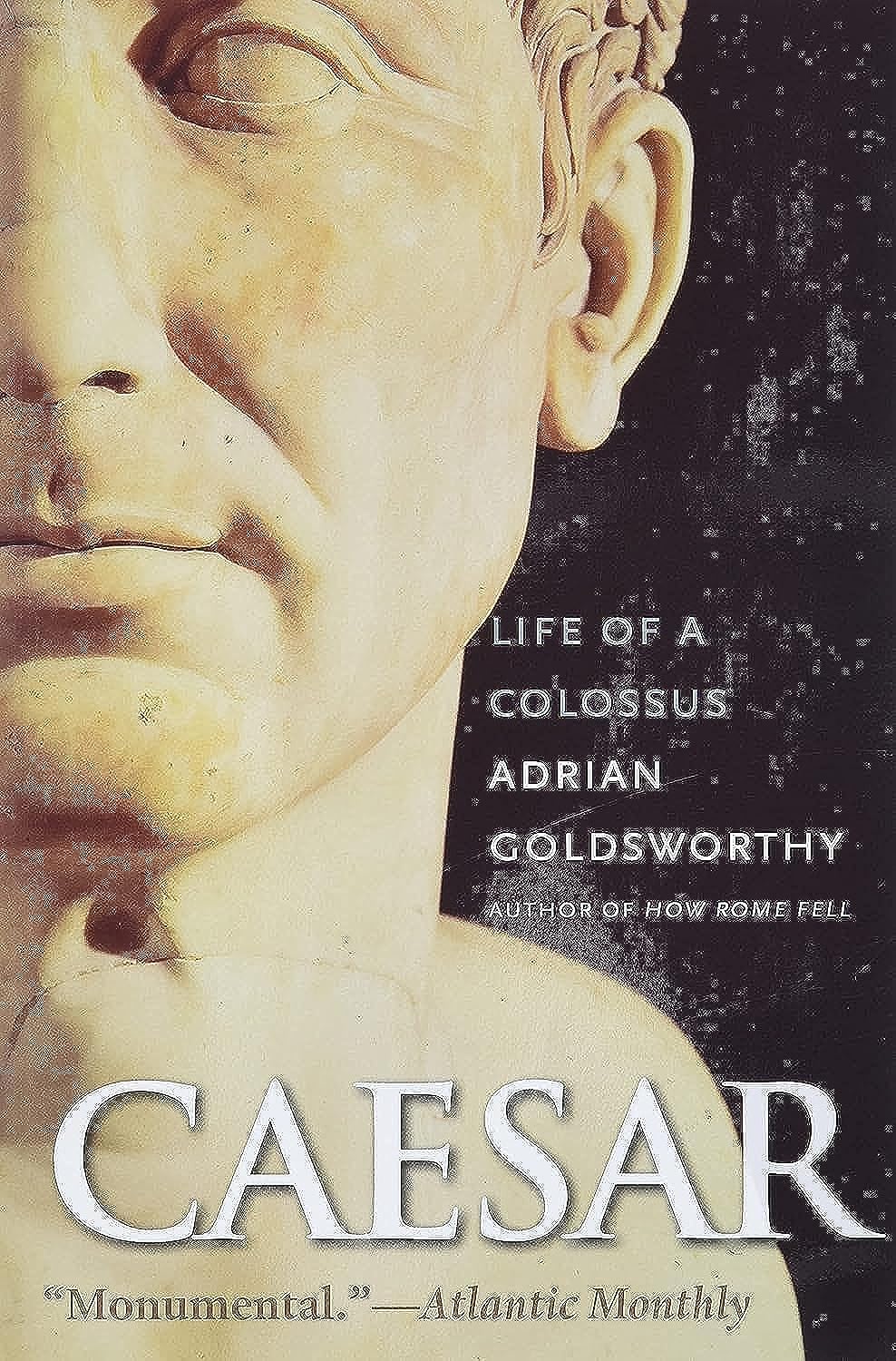
If Jesus Christ is the greatest story ever told, I’d like to put my vote in for another “JC” as the second: Julius Caesar. And Adrian Goldsworthy tells that remarkable story marvelously well. I’ve read several other biographies on the great Roman general and statesman before (Fuller, Meier, Gelzer) and “Caesar: Life of a Colossus” is far-and-away the best.
Goldsworthy makes several core arguments and makes them convincingly. To begin with, he notes that while Caesar was certainly eccentric – a dandy and a rake who regularly bedded other senator’s wives (including those of his triumvirate mates, Pompey and Crassus) – he was not unusual for the time and his career was largely conventional, too. The author stresses that Caesar almost certainly had no grand political plan for radically reforming the republic nor was he driven by a unique political ideology that put him at odds with the aristocratic senatorial elite. Goldsworthy emphasizes that until Caesar’s consulship in 59 BC with Bibulus (the so-called year of the consulship of “Julius and Caesar”) and his extraordinary proconsulship in Gaul and partnership with Crassus and Pompey, Caesar’s political career and actions were quite normal. He was an exceptionally talented and ambitious man (Sulla supposedly warned: “There are many Mariuses in this Caesar”) from an aristocratic but undistinguished family who wanted the Senate to afford him the due respect that he rightfully earned in his many conquests and service to the Republic. Or as Goldsworthy puts it: “The Roman world was…plunged into chaos and bloodshed because one was as determined to protect his dignitas as others were to destroy it.”
What made Caesar so exceptional? The author calls out several character traits that served the future dictator well. First, he was courageous, both physically and politically. As a teenage he defied Sulla’s order to divorce his wife, Cornelia, and nearly paid for it with his life; he was awarded the civic crown for heroism in battle at Mytilene a few years later; he brought back the statues of Marius when the shadow of Sulla’s anti-Marian proscriptions were still fresh and terrifying; he argued against Cicero, Cato and the moral authority of the Senate to spare the lives of the captured conspirators of Catiline in 63 BC; and he often led his troops from the front. When he plunged across the Rubicon with just one legion in 48 BC the odds were heavily stacked against him, Goldworthy says; Pompey and the optimates in the Senate having many reasons to believe that they held insuperable advantages in available wealth and manpower to say nothing of political influence and the aura of the Republic behind them.
Second, he was charismatic and possessed great political instincts. In the opening days of the civil war Pompey refused to meet with Caesar face-to-face likely, the author says, because he knew that the renegade general would be difficult to resist in person. The loyalty he inspired in his troops in Gaul is legendary. His reputation as a lothario also confirms his preternatural ability to capture attention and affection. He was vain but good humored (one of the few jibes that stung throughout his life was “Queen of Bithynia,” a mocking reference to his purported homosexual relationship with King Nicomedes). His ability to “feel” the crowd and make political moves at just the right time was indisputable. Indeed, some of the most notable events of Caesar’s life and career are the exceptions to these rules of his influence and ability. For instance, his miscalculation of political stability in Gaul in 52 BC and at home before his assassination in 44 BC or the defection to the Pompeians of his two most senior and successful legates from the campaigns in Gaul, Labienus (who fought to the bitter end, killed at Munda in Spain in the last stand of the Pompeians in 45 BC) and Quintus Cicero, the orator’s brother.
Finally, and related to the first two, Caesar was a born risk taker. The political stakes in the Republic in the first century BC were high and the price for failure was catastrophic. Yet, he never shrunk from a challenge, no matter how steep (“I will come back at Pontifex Maximus or not at all!” he supposedly shouted to his mother before his dark horse but successful bid for the influential religious post in 63 BC). “Caesar kept winning,” Goldworthy writes, “but other men were not so lucky and failed, losing everything.”
The ensuing Civil War was a tragedy, at least that is how Goldsworthy tells it. “A peaceful return to take up a pre-eminent position within the Republic, his prestige, influence and auctoritas acknowledged by all other senators, even those who disliked him, was what Caesar craved. Having to resort to armed force to protect his position was a sign of political failure, for Pompey as much as Caesar.” In many ways as dictator Caesar was a generous, thoughtful and clement leader. But he had upset the old traditions of the Republic, even though those traditions had led to disturbing political upheaval and violence over the preceding decades. “Caesar’s regime was not repressive…yet discontent remained widespread.” The Roman elite would rather see the city in flames, their fortunes ruined, than to see one man stand so far above the rest. “Under Caesar many decisions were made behind closed doors by the dictator and his close advisors, and even though they were often good ones, this was not the way the Republic was supposed to work,” and for that he was murdered.
At over 600 pages, this is not a short or light read, but Goldsworthy writes with a certain swiftness and clarity that makes this epic one volume biography a fast, invigorating read. Whether this is your first or one hundred and first book on the Roman Republic, it is highly recommended.
 What's Tim Reading Now?
Leave a comment