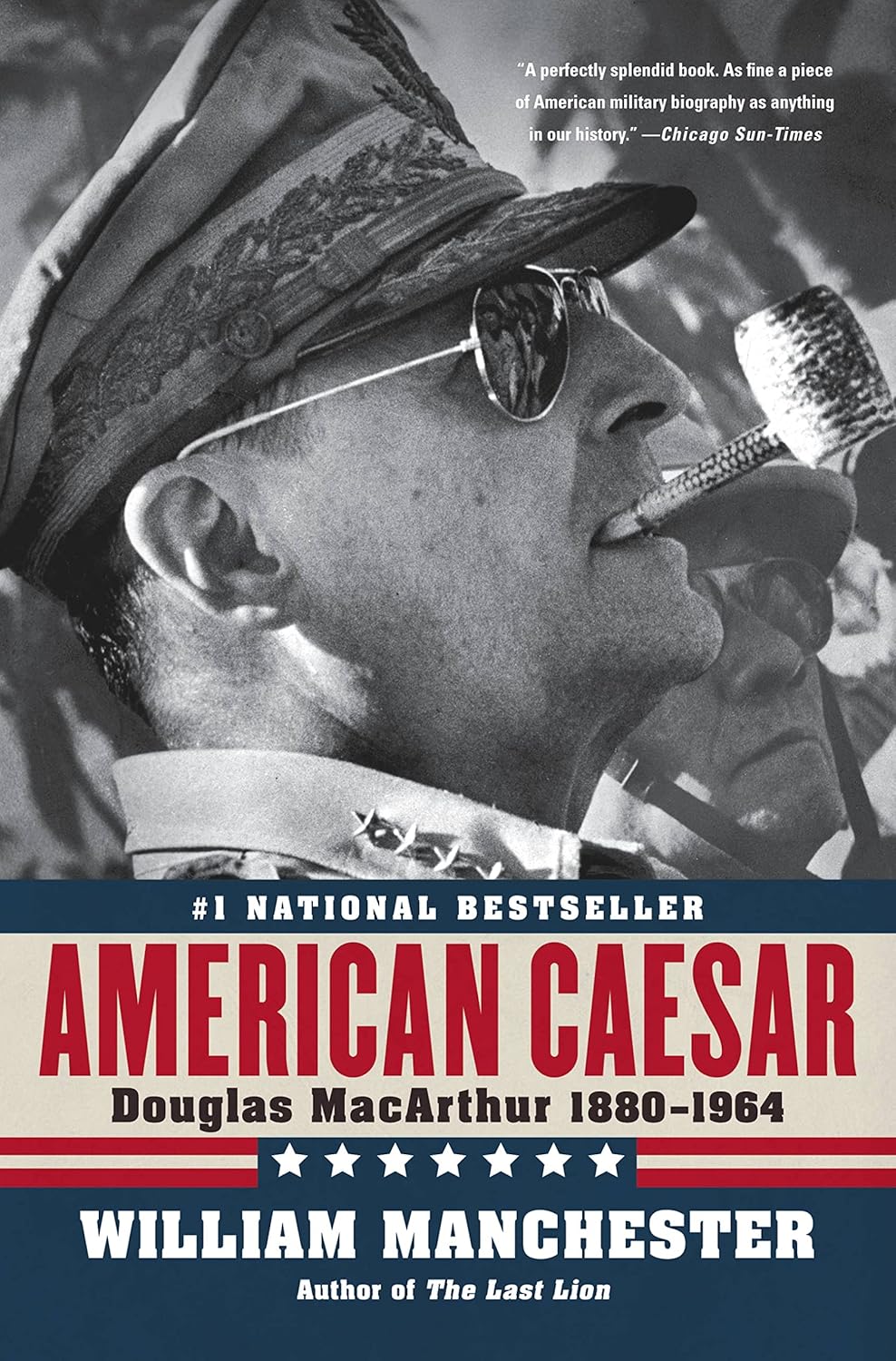
Few figures in twentieth century American history cast a longer shadow than Douglas MacArthur. Fewer still have seen their legacy sink so inexorably over the years. But there was more to the man than the pompous, dangerous, ego maniacal insubordinate, as he has become known to history, as the late William Manchester demonstrates in this persuasive and remarkably balanced mega hit from the mid-1970s. He explores the man in full and really succeeds in bringing him to life, as great biographers do, with all the general’s faults and all his strengths: intelligent, fearless, articulate, vain, ambitious, petty, bombastic, compassionate, paranoid, well-read, self-absorbed and a military genius.
Manchester writes with fluidity and crafts an absorbing narrative, although, on occasion, his prose is as purple as a MacArthur cable (e.g. “In retrospect [MacArthur’s daring assault on Hollandia] looms as a military classic, comparable to Hannibal’s maneuvering at Cannae and Napoleon’s at Austerlitz.”).
This biography succeeds on multiple levels and there are a number of aspects of MacArthur’s complex personality worthy of note, but I will only comment on one. The general was, in his own way, an effective leader and one who placed paramount importance on personal loyalty; he demanded it of his staff and returned it in kind. In the general’s mind, it was never advisable to move outside of his personal orbit. And if one did, they bore a black mark for life, committing a veritable mortal sin against the high god of the United States Army. The case of MacArthur’s former staff aide in the pre-war Philippines, Dwight Eisenhower, being the most obvious, but not only, example.
In turn, MacArthur was loyal to subordinates, just so long as they didn’t try to steal any of his thunder or share any of the limelight. “The General’s talents were rare and varied,” Manchester notes, “but his judgment of men was often appalling.” None was worse than his WWII era chief of staff, Richard K. Sutherland. A deceitful, abrasive man who was, according to Manchester, “Feared just as Nixon’s staffers feared H.R. Haldeman.” Yet, MacArthur stood by him until, after repeated warnings, Sutherland persisted in keeping his mistress — the wife of an Australian army officer — in an official residence near headquarters deep into the Pacific campaign.
On the other hand, MacArthur could also cultivate more amiable characters, thoughtful men of integrity who were willing to challenge their boss, while offering unconditional loyalty, men like air chief George C. Kenney, who Manchester lauds as a particularly effective lieutenant. And nowhere was MacArthur more successful in selecting a congenial subordinate than in his second wife, Jean, a rock of unwavering love and commitment who gladly shared some of her husband’s most draining defeats, including his time on Corregidor and the harrowing sea and air escape to Australia.
Manchester captures the motive force behind MacArthur’s stunning triumphs and disastrous setbacks this way: “During his lifetime, his admirers saw only his victories; his critics saw only his defeats. What neither appreciated was the identical traits led to his winnings and his losses. His hauteur, his willingness to defy his superiors, his fascination with the political process, his contempt for vacillation – these would be his undoing in the end. But along the way they reaped historic fruit.”
 What's Tim Reading Now?
Leave a comment