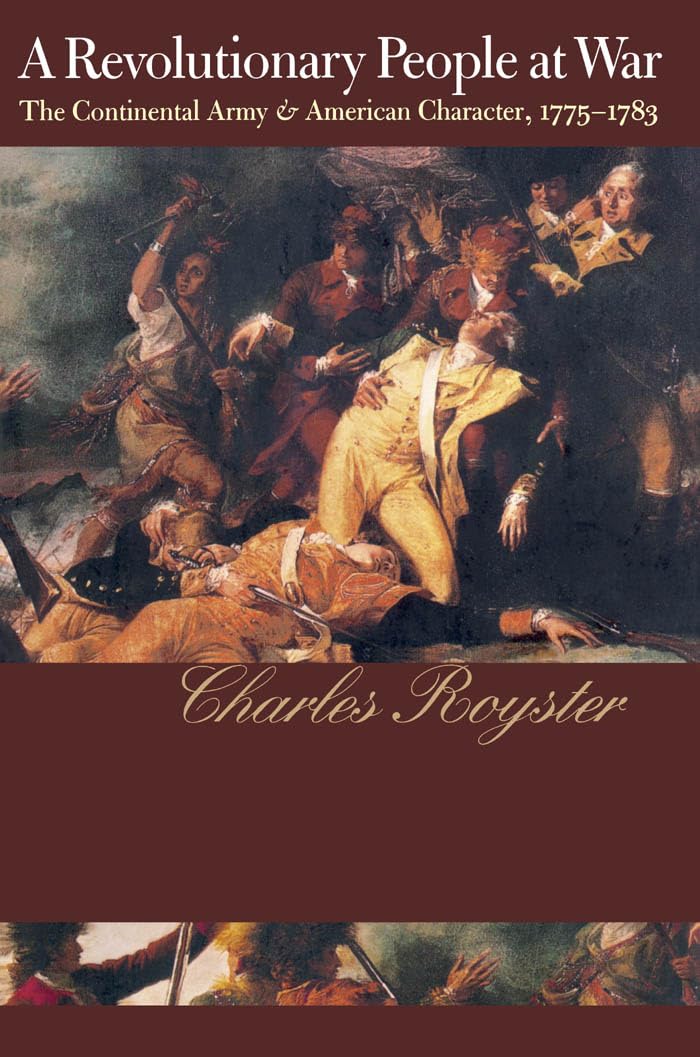
Doctoral dissertations rarely make interesting reading. Fewer still win the Parkman Prize. “A Revolutionary People at War: The Continental Army and American Character, 1775-1783,” based largely on Charles Royster’s University of California PhD dissertation, is a notable exception.
Royster argues that a number of issues motivated the American soldiers who fought the Revolution, but above all was the belief that they were fighting for God and posterity. He says that they sincerely believed that their actions would be remembered and revered for centuries, a powerful source of motivation heading into a conflict against great odds. He also describes the centrality of religion to the cause; indeed, he makes the Revolution sound a lot like a jihad. The colonists were all too aware of British strength and their own weakness, but felt that success was assured because of God’s grace and goodwill.
In this spirit of godly sacrifice, Royster writes that some specific words resonated most with the soldiers of the cause: benevolence, disinterestedness and virtue. These concepts would be severely tested during the long conflict. At the heart of the friction and discord was the relationship between the men, particularly the officers, of the Continental Army and the citizens of the American colonies at large. Citizens tended to think of a standing army as generally abhorrent in theory, but recognized its necessity in meeting the overwhelming British threat. This dichotomy — the simultaneous fear and need of a standing army — forms the axis upon which Royster’s historical narrative turns.
After the initial glow of resistance, the author writes that heading into the 178s the hostility and mistrust between the officers of the Continental Army and the public grew to fever pitch. At issue was the realization among many military leaders that the public was putting private, personal interest ahead of the army, which the officers saw as the center of gravity of resistance against the British occupation. Many American colonists, even those claiming to be true patriots, avoided the draft, continued to trade with the British army when opportunity presented itself, sent local convicts to fill the enlisted ranks, and made precious little effort to supply the myriad logistical needs of the Continental Army.
By the time of Yorktown, Royster continues, the Continental Army had become quite disciplined and effective, far more professional than many contemporary Americans recognize — and was almost completed isolated from the society it served. The army increasingly saw itself as the true embodiment of the revolutionary ideals of 1775; they had all earned special claims to being the vanguard of the Revolution and the new US republic. Thus, they were entitled to a privileged place in society and due the pension they lobbied (and threatened) for. Meanwhile, Royster writes, the general population felt they all had shared equally in the victory and that the army represented the very vices they had just collectively defeated — tyranny, hierarchy, placemen, class privilege, nobility, force, confiscation, etc.
The author credits George Washington with smothering the Newburgh crisis when the army in New York essentially threatened Congress with force if their demands on pensions, once promised, weren’t met. Washington’s deference to civil authority was critical and the fact that there was a yawning chasm between officer and enlisted meant that even if the officers tried something rash they likely wouldn’t have had an army to command. At the center of the debate and crisis was that to one significant group in American society a standing army based on discipline and social hierarchy and led by a powerful central government were the prerequisites for achieving and maintaing the victory of the Revolution, not the very antithesis of the Revolution as many others claimed.
The whole controversy over the continental officers was best expressed by the debate over pensions. On the one hand, there was fear that the US would set up a new community of placemen — the exact model they had hoped to defeat in the Revolution. But Royster says the crux of the issue was that a pension for officers in the continental army, no matter how small or short-term, in itself seemed to confirm that their effort toward the achievement of independence was somehow greater than everyone else’s. They would be sanctified as the true founding fathers, and that struck many people the wrong way. In short, the people were reclaiming the war and victory from the army — the army that really had won the battle with great sacrifice and against all odds, according to Royster. Of course, the Society of the Cincinnati only added to the controversy, especially that they wore special badges, had titles, and that membership was hereditary to first born sons.
Royster notes that the dispersement of the continental army was a sad affair. No pomp or celebration. Many just went home, poor and begging for food along the way. The crisis was over, pensions and the Society of Cincinnati quickly abated. It was a mini-revolution of the public over the army, the author writes. For their part, the army’s claim to preeminence wasn’t due to any inclinations to European despotism, but rather was grounded in the moral absolutism of the Revolution itself.
In the end, Royster claims, the Revolutionary generation authored a phony history of their generation, one that focused on a whole society built on virtue and honor. It was an unrealistic, almost fatuous vision, intentionally created, that lasted for over 150 years. Its a verdict Royster desperately wants to overturn with this book, and I think he’s succeeded.
 What's Tim Reading Now?
Leave a comment