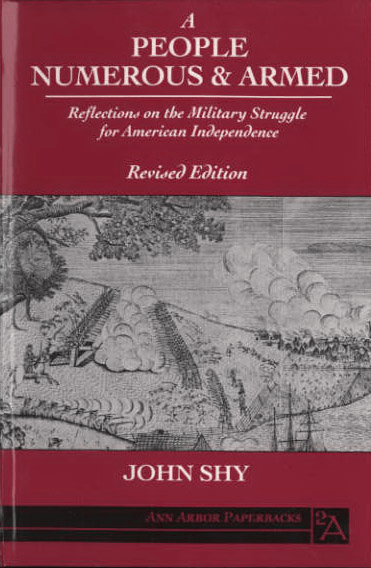
“A People Numerous & Armed” is a collection of twelve essays written by John Shy in the late 1960s and 1970s when he was an up-and-coming historian at the University of Michigan. In his own estimation, the themes that unite the varied pieces are “that war changes society, that strategy and military policy are aspects of politics, that the incidence of military service reflects and affects social structure, [and] that events and patterns of armed struggle help to shape the way people think about themselves and others.” It’s difficult to argue with such high-level and sweeping claims. In this reviewer’s opinion, the leitmotif is that the British consistently underestimated the abilities of the Continental Army and the American militias based largely on the poor performance of colonial soldiers in the French and Indian War.
Several of Shy’s essays focus on secondary and largely forgotten figures from the revolutionary period, men like the ambitious American general Charles Lee, the second-rate British general Thomas Gage, disagreeable former colonial governors Thomas Pownall (Massachusetts) and Henry Ellis (Georgia), and the implacably courageous New Hampshire militia captain Bill Scott. Each vignette is ably researched and illuminates different aspects of the conflict.
That said, what I loved about this collection are monographs nine and ten, which look at the American Revolution from the perspective of the British and as a counter-insurgency. Shy argues that British war strategy went through three distinct and discrete phases. First, from the Stamp Act crisis of 1765 to the Boston Tea Party in 1773, the British treated the conflict as a police action aimed at providing law and order, while seeking reconciliation with an increasingly hostile colonial population.
The second phase, lasting from the introduction of the Intolerable Acts in 1774 to the defeat at Saratoga in 1777, was a conventional military conflict aimed at destroying the Continental Army and isolating New England, which London perceived to be the nidus of rebellion.
The final phase, beginning in 1778 and lasting till the final British defeat at Yorktown in 1781, focused on pacification in the South and the gradual Americanization of the war. For the first time, the colonial population itself was the primary focus of war strategy. The British perceived the South to be “the soft underbelly” of the rebellion according to Shy and at first it looked like a winning approach as Charleston fell in 1780 (resulting in the largest cache of American prisoners of the war) and the main rebel army under Horatio Gates was destroyed at Camden soon after. In a classic COIN approach, the British sought to balance “hearts and minds” programs with raids along the New England coast and other punitive actions. Moreover, they found that the loyalists, once armed and as part of the Americanization plan, turned out to be uncontrollably violent in seeking revenge on their rebel neighbors. In the end, some 100,000 loyalists, former slaves, and British-allied Indians were forced to emigrate.
Shy writes that the British were by no means incompetent, but were nevertheless “slow to learn, almost blind to certain key elements of their problem, badly confused beneath a veneer of confidence and expertise and political traps of their own making.” He suggests that King George III held a “domino theory” perspective of the conflict, fearing that losing the American colonies would lead inexorably to other colonial losses. The strategy employed in the third phase was textbook twentieth century COIN operations. “The basic concept was to regain control of one major colony [such as South Carolina], restore civil government, and then expand both control and government in a slowly advancing screen of British regulars.” In other words, the “ink blot” strategy often associated with Edward Lansdale.
The author claims that the truth about the Revolution is that it was neither a victory of the virtuous American spirit nor the result of dumb luck, French intervention, and British blundering. That is, it was neither as irresistible nor as fragile as many have made it out to be. Rather, he stresses that the majority of the colonial population were “dubious, afraid, uncertain, indecisive.” This “apathetic majority,” as he calls it, was the backbone of the militia – and that militia was a key component in eventual victory as it served as the reservoir of American manpower (some 200,000 men served during the course of the war) and acted as the “sand in the gears of the [British] pacification machine.” Introducing yet another metaphor, Shy equates the militia to “a great spongy mass” that impossible to meet head-on, let alone eradicate.
In closing, this is a great collection of scholarly essays for those with a serious interest in the politico-military history of the American Revolution. A couple of the essays are particularly useful for those looking to explore the Revolution from the perspective of a counter-insurgency operation.
 What's Tim Reading Now?
Leave a comment