“The Spirit of ’76” has many positive connotations in contemporary America: liberty, freedom, and bravery foremost among them. Archibald Willard’s 19th century painting of the same name – depicting three ragged but steely-eyed and steadily advancing American soldiers…a fifer, a drummer and a flag bearer – remains an enduring symbol of national pride and power.
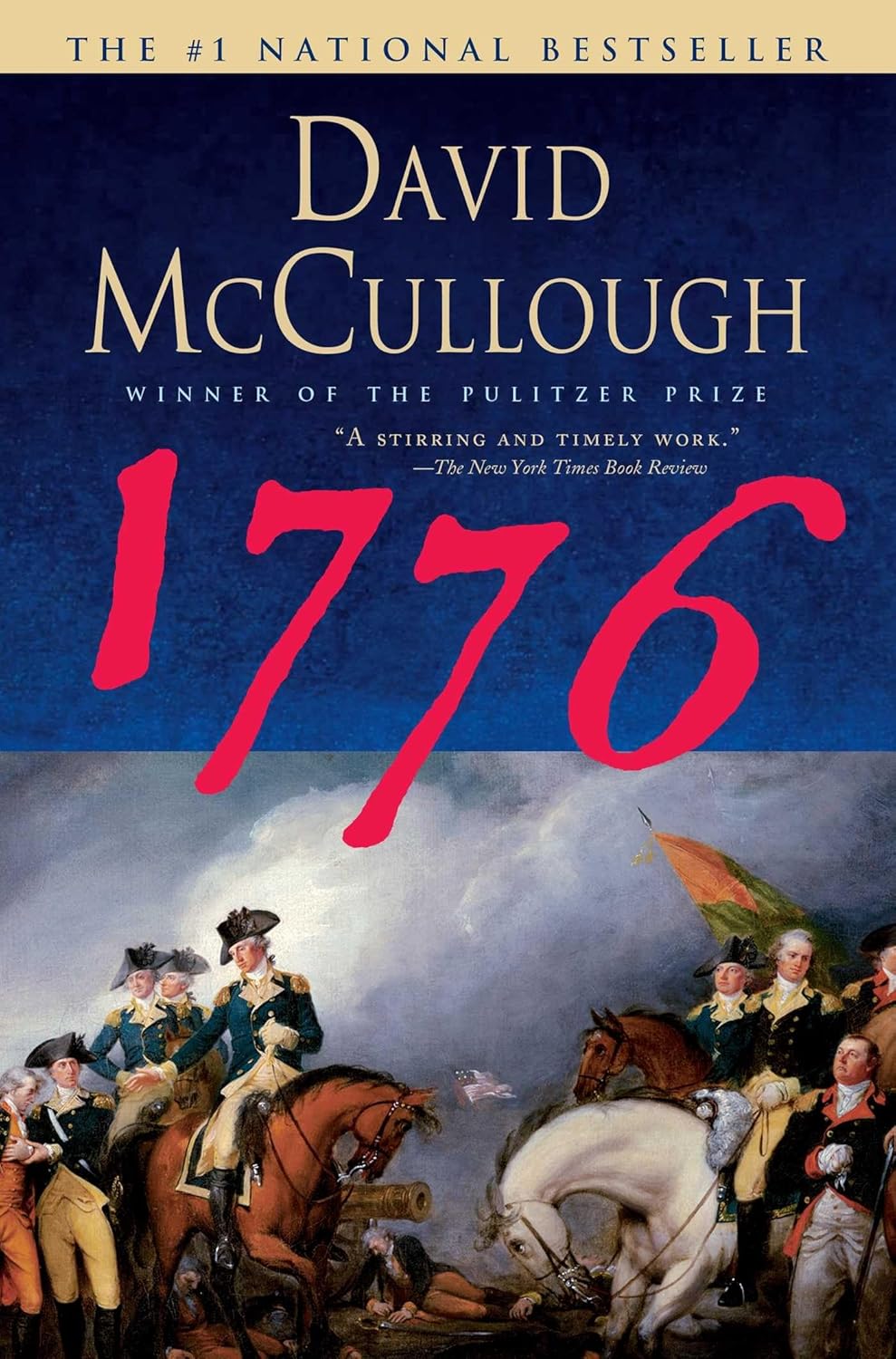
David McCullough, our most celebrated and successful popular historian, shows us in “1776” the wild inaccuracy of that heroic collective national image. Far from being the annus mirabilis, our celebrated year of declared independence, 1776, was in actuality “a year of all-too-few victories, of sustained suffering, disease, hunger, desertion, cowardice, disillusionment, defeat, terrible discouragement, and fear.” Indeed, witness the letter that Robert Morris, a prominent member of the Continental Congress, sent General George Washington on New Year’s Day 1777: “The year 1776 is over. I am heartily glad of it and hope you nor America will ever be plagued with another.” Even with over two centuries worth of reflection McCullough only confirms that dispirited, almost hopeless assessment, arguing it was “as dark a time as any in the history of the country.”
Thus, the War of American Independence was nearly lost before it really began. In fact, by November 1776, the conventional wisdom on both sides of the conflict was that the rebellion had been hopelessly, irrecoverably crushed. “By all reasonable signs,” McCullough writes, “the war was over and the Americans had lost.” But in that darkest hour there remained a few faint glimmers of hope. And, according to the author’s narrative, those faint glimmers happened to have names: Washington, Knox, Greene – and, possibly, Reed (I was a bit surprised that Alexander Hamilton was not part of McCullough’s fraternity, although I suppose he only emerged as a close Washington aide after 1776).
George Washington was once a god in this country. By 1860 the only thing every American could agree upon – just as they were about to rip each other’s throats out – was that he was the one and true father of the nation, practically deified like Caesar, deserving of our eternal and humble gratitude. Yet somehow, by the mid-twentieth century, Washington’s star had faded, and immensely at that. In the eyes of many Americans, most certainly the intellectual elites, he had become a false idol, almost a pariah – a stodgy and dim-witted aristocrat possessing a plantation overflowing with black slaves and a military record embarrassingly under populated with victories. This book (along with recent pieces by arguably the greatest living American historian and biographer, respectively: David Hackett Fischer’s “Washington Crossing” and Ron Chernow’s “Washington”) mark a general and rather unapologetic rehabilitation of his reputation, re-establishing him as a national hero, a giant of near biblical proportions. Indeed, McCullough claims that Washington was the indispensible man of American independence, especially in the long, dark days of humiliating defeat in the summer of 1776. “Without Washington’s leadership and unrelenting perseverance,” he writes, “the revolution almost certainly would have failed.”
However, for all of his enormous, if often subtle, talents, McCullough claims that Washington was only as good as the men he had around him – and that there were only a handful of lieutenants that really mattered. First was Henry Knox, 25-years-old in 1776, a modest Boston bookseller before the war, who was handpicked by Washington to lead the expedition to transfer the captured cannon from Fort Ticonderoga to Boston that ensured the victory of the siege of Boston in March and who expertly coordinated the crossing of the Delaware on Christmas night before the surprise attack on Trenton, two critical and nearly impossible logistical achievements that may very well may have spelled the difference between the America we know today and something more like America as a member of the broader British Commonwealth, with Kate Middleton waving warmly to her subjects at a parade in downtown Chicago.
The other critical player in “1776” is Nathaniel Greene, 33-years-old, a talented but formally uneducated (yet widely read) Rhode Island foundry owner, who, McCullough claims, also turned out to be “the most brilliant American field commander of the war.” The story of Nathaniel Greene is inspiring – and perplexing. How could a young man of such obvious skill and commitment, who gave so much for his country against such heavy odds, who suffered and struggled so terribly, who abandoned his wife and large family literally for years, who led his American troops to astounding victories against such improbably odds, be largely forgotten today by the benefactors of his sacrifice? It is one of the unanswered mysteries of “1776.”
Finally, there is Joseph Reed, 35-years-old, a well-to-do Philadelphia lawyer who had been educated at the finest schools in England and who joined Washington’s staff in New York quite reluctantly. But, according to McCullough, he was persistently the apple of the general’s eye, the one lieutenant he wanted – indeed, demanded – at his side more than any other. When Reed lost faith in his leader, a fact that Washington learned only when he accidently opened a private letter from Charles Lee to Reed shortly before the Trenton campaign, it was a crushing personal blow to the general. Reed’s proper place in the pantheon of American heroes during that first critical and frequently soul crushing year is left conspicuously vague in “1776.”
Beyond the personal stories of Washington, Knox, Greene and Reed, McCullough’s narrative revolves around the campaign for New York City in the summer of 1776. In short, it had been a terrible strategic blunder for Washington and his inexperienced, fragile army to attempt to defend it. The fate of American independence was nearly altered because of it. The author highlights a few essential themes that emerged during the summer. First, the population of New York and the surrounding communities of Long Island, Staten Island and New Jersey were far more loyalist in composition than Boston, the most recent theater of war for the early American army in that first year of independence.
Second, Washington and his army were virtually blind in New York owing to the lack of a robust sympathetic population in the new theater of operations. McCullough stresses that British General Gage was incapacitated in Boston in 1775 due to complete lack of operational intelligence and that Washington experienced the same affliction in New York in 1776, much to his surprise and deep concern.
Third, Washington’s determined attempt to hold New York against a British landing, an action Congress left solely to his discretion, was, in a word, foolish. It was obvious to many thoughtful men, including those closest and most trusted by Washington, such as Greene, that New York was indefensible against the vaunted British Royal Navy, which ruled the waters of the deep draft East and Hudson Rivers. American defeats at Brooklyn, Kipps Bay and Fort Washington were decisive and more or less inevitable, McCullough writes, yet could have been much worse, indeed fatal, if it were not for Washington’s steady hand and some providential help from the weather that aided the retreat of the last remnants of the Continental Army from New York and into New Jersey and Pennsylvania.
But the Americans weren’t just defeated in battle as at Bunker Hill in Boston a few months before, where they gave up the battleground but remained intact as a fighting unit and inflicted serious casualties on the British. In New York the army was shattered both physically and morally. The army often broke at the mere sight of a Hessian skirmish line; soldiers deserted by the dozens every day; some fired upon their own officers during pell-mell retreats. The army and the American cause were evaporating at an alarming rate: from 20,000 men in August to maybe 3,000 just 100 days later. It was a “near run thing.”
In sum, this is a vibrant and important book, one that should be read widely by Americans, regardless of your political persuasion or areas of interest. We owe it to Washington and Greene and Knox and those other nameless men who could have wavered in the face of such daunting odds and humiliating defeats in 1776, but who did not break and in the process founded a nation.
 What's Tim Reading Now?
Leave a comment