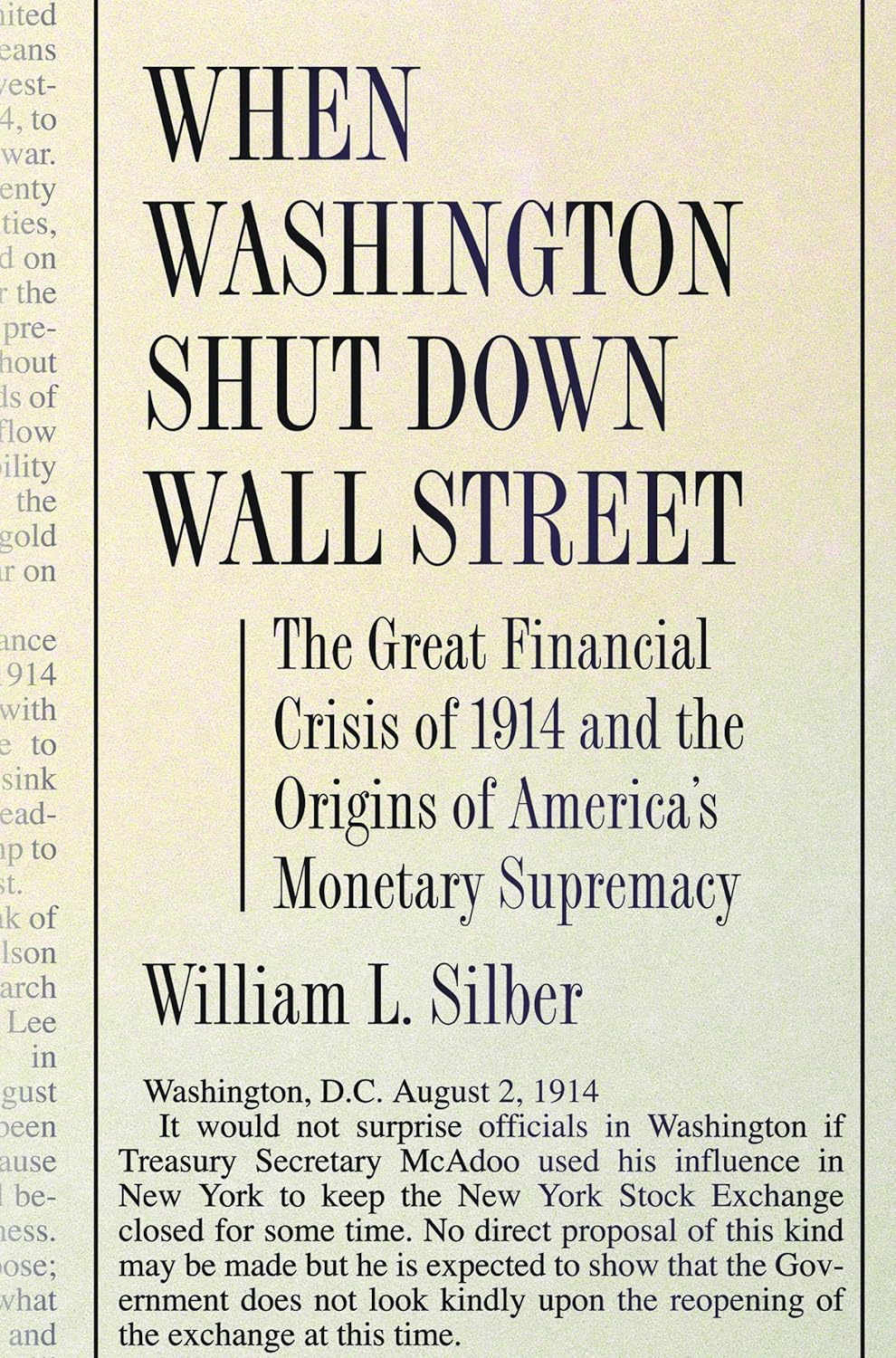
The proverbial “Almighty Dollar” hasn’t always been so almighty. In fact, if you believe William Silber, it only just recently celebrated its 100th birthday. “When Washington Shut Down Wall Street: The Great Financial Crisis of 1914 and the Origins of America’s Monetary Supremacy” argues that because of a series of bold, controversial, but above all decisive moves by US Treasury Secretary William Gibbs McAdoo, the American dollar emerged as a dominant instrument on the world financial stage.
“The book traces William Gibbs McAdoo’s battle for financial credibility during four months in 1914…a brief period that changed the course of US financial history,” according to the author. Perhaps even more important than what McAdoo did, Silber argues, is how he did it. “Leadership matters,” he trumpets, and McAdoo, a 51-year-old, small-time Georgia lawyer with no formal education in economics and only limited experience in banking, had it in in spades. “McAdoo succeeded in August 1914 because he did not hesitate to bludgeon the crisis with a sledgehammer.” He contrasts the dilettante McAdoo’s decisiveness with the disastrous diffidence of Arthur Burns, the brilliant Columbia economics professor and Federal Reserve Chairman who failed to cage inflation in the 1970s.
The United States was not necessarily poised to challenge Great Britain for global financial dominance in 1914. The recent Panic of 1907 seriously damaged America’s already shaky reputation for macroeconomic financial management. The country was clearly emerging as an economic powerhouse, but not a financial one. “American capital attracted foreign governments to Wall Street but the banking system repelled them,” Silber writes.
The foreign exchange market served as a barometer of American financial credibility, and in the summer of 1914, as war clouds gathered over Europe, the market showed that it had little faith in the dollar. As governments scrambled to prepare for war there was what we today call “a flight to safety.” In the summer of 1914, the flight was to gold, and therefore to British pounds sterling. “Sterling reined supreme, in part, because London never waffled when asked to exchange pounds for gold.”
Both the pound and the dollar were tied to gold in 1914. The “mint parity exchange rate” between the dollar and pound was $4.8665. (The US Treasury fixed the price of an ounce of gold at $20.6718, while The Bank of England fixed the price at £4.2477.) Theoretically, the dollar exchange rate with the pound should never fluctuate outside of a small band defined the by export ($4.90) and import ($4.83) parity rates. During the tumultuous days of August 1914, however, the dollar exchange rate skyrocketed to $6.50. When push-came-to-shove, few people had faith in the dollar – and by extension the United States government and banking system.
As Silber tells the story, McAdoo almost single-handedly and masterfully guided the country through the crisis. He turned the outbreak of the First World War – a true “black swan” event and potential economic catastrophe – into an opportunity the United States needed to emerge as a world financial superpower. He did this by making a series of gutsy decisions.
First, and most fundamentally, he decided that the United States would remain on the gold standard. All debts and foreign exchanges would be honored in gold and at the fixed price. Indeed, Silber writes, “America would take a giant leap forward if it could remain true to gold, just like a financial superpower – just like Britain.” In July 1914, however, under the unprecedented strain of a massive continental war, such a proposition appeared risible. The United States simply did not possess enough of the yellow metal to meet all of its obligations all at once. Moreover, the newly legislated Federal Reserve System had not yet even been introduced.
Once the decision was made to stay on gold, the first order of business was to devise ways to keep it onshore. Europeans owned some $4 billion in US securities, including 20% of railroad securities, the largest segment of industrials trading on the New York Stock Exchange. Silber estimates that Europeans had the power to liquidate some $75 million a month. Once sold, those dollars could lawfully be converted into gold at $20.67 an ounce. The entire stockpile of gold in all New York banks was $308 million. Thus, the sale of stocks alone could potentially drain the financial capital of the country in a matter of months. McAdoo acted posthaste. On July 31st he had the New York Stock Exchange closed indefinitely. The longest the stock market had ever been closed was for 10 days during the Panic of 1873. McAdoo would keep it closed 137 days, until December 12, 1914.
At the same time, McAdoo blunted the panic by pumping liquidity into the market. After the Panic of 1907, Congress passed the Aldrich-Vreeland Act that provided for $500 million in emergency currency in the event of a crisis. McAdoo deployed the emergency currency on July 31st, the same day the stock market was closed. Some $370 million was eventually dispersed across 39 states, increasing the amount of national currency by 7%. Yet by June 1915 it had all been withdrawn from circulation. The Aldrich-Vreeland Act may have been unpopular at the time (Carter Glass, Chairman of the House Banking & Finance Committee, called it “a makeshift legislative deformity”), but Silber notes “The Congressional blueprint for emergency currency as a temporary safety net could not have been implemented more faithfully.”
Stocks and liquidity weren’t the only immediate worries. Europeans also held large amounts of American municipal debt. Almost $500 million in bonds were coming due by the end of 1914, including a full $82 million in short-term notes for the City of New York. McAdoo arranged for a consortium of 124 New York banks to purchase $100 million of New York debt, at par, to mature in three years, using the proceeds to meet the short-term European obligations. To do this, the banks had to violate their federally required reserve limits. McAdoo ensured that the government turned a blind-eye. Silber claims “McAdoo’s assistance in New York City in 1914 marks the birth of the ‘Too Big To Fail’ doctrine in American finance.” In September a trainload of gold was shipped to the new Ottawa office of the Bank of England. “The triumph of the New York rescue meant that America had defended its credit reputation.”
Stopgap measures to preserve gold and meet obligations were critical. So too was ensuring that European gold had good reason to flow in the opposite direction. McAdoo, a true southerner, saw agricultural exports, particularly cotton, as the most promising near-term opportunity to attract gold. Only there were two major problems. First, the war had made insuring transatlantic shipments virtually impossible. Second, the British Navy could deem some key crops, including cotton, contraband and liable to confiscation and/or destruction. McAdoo addressed the first challenge by creating the Bureau of War Risk Insurance, a government entity that insured against any and all war-related losses. The Bureau supported some 1,200 shipments to Europe, including those destined for Germany and Italy, from September 1914 till the end of 1915. Meanwhile, on October 26th, Britain announced that cotton would not be on their contraband list. The price of pounds sterling immediately dropped below $4.89.
Finally, the United States desperately needed a central bank. The country had been rocked by financial panics at relatively regular intervals because there was no “lender of last resort” to thwart bank runs. The Federal Reserve Act was passed on December 23, 1913, to address the issue, but had not yet come into being. Two of the strongest voices on the new Federal Reserve Board of Governors, New York bankers Benjamin Strong and Paul Warburg, argued stridently to postpone the opening of the Reserve Banks. Their primary concern was that the system did not possess enough gold ($250 million out of a total US gold stock of $1.5 billion, or 16%). Strong felt the new bank needed “an immense safety factor beyond the legal minimum…” while Warburg warned specifically “a gold reserve of $250 million is not sufficient to safeguard the immense financial structure of currency and bank credits of the United States.” With pounds sterling trading above the export parity rate of $4.90, the risk of significant gold outflow was enormous. Strong feared “the whole future of the System might be jeopardized if the Reserve Banks were subjected to heavy demands when they were … weak in resources and prestige.” McAdoo, on the other hand, with the full support of President Wilson, was critical of “an effort to protect the System against the strains of the emergency which it is designed to relieve it to cast doubt on the System itself.” McAdoo strong-armed the decision, opening the Reserve Banks on November 16th.
Thanks to McAdoo’s drastic actions, within a period of six months (August 1914 to January 1915) the foreign exchange for pounds sterling swung from $6.50 to $4.79 (i.e. beneath the import parity point). Dollar bills had gained credibility because they were convertible into gold even under the most severe pressure. Silber claims “November 11, 1914, the day the discount on the dollar disappeared for good [i.e. under $4.90] marks the turning point in US financial credibility… [it] marks the birth of America as a financial superpower.” The US would share that status with Britain for decades to come until the Second World War “destroyed the illusions of British power” for good. But the process was well underway after the summer of 1914 and, if you believe William Silber, one man deserves the credit for making it all happen. “An important distinction between a great thinker and a great leader,” Silber writes, “is that a leader knows when to get the job done – and does it.” The United States was fortunate to have such a leader as William Gibbs McAdoo as treasury secretary in 1914 to get the job done.
 What's Tim Reading Now?
Leave a comment