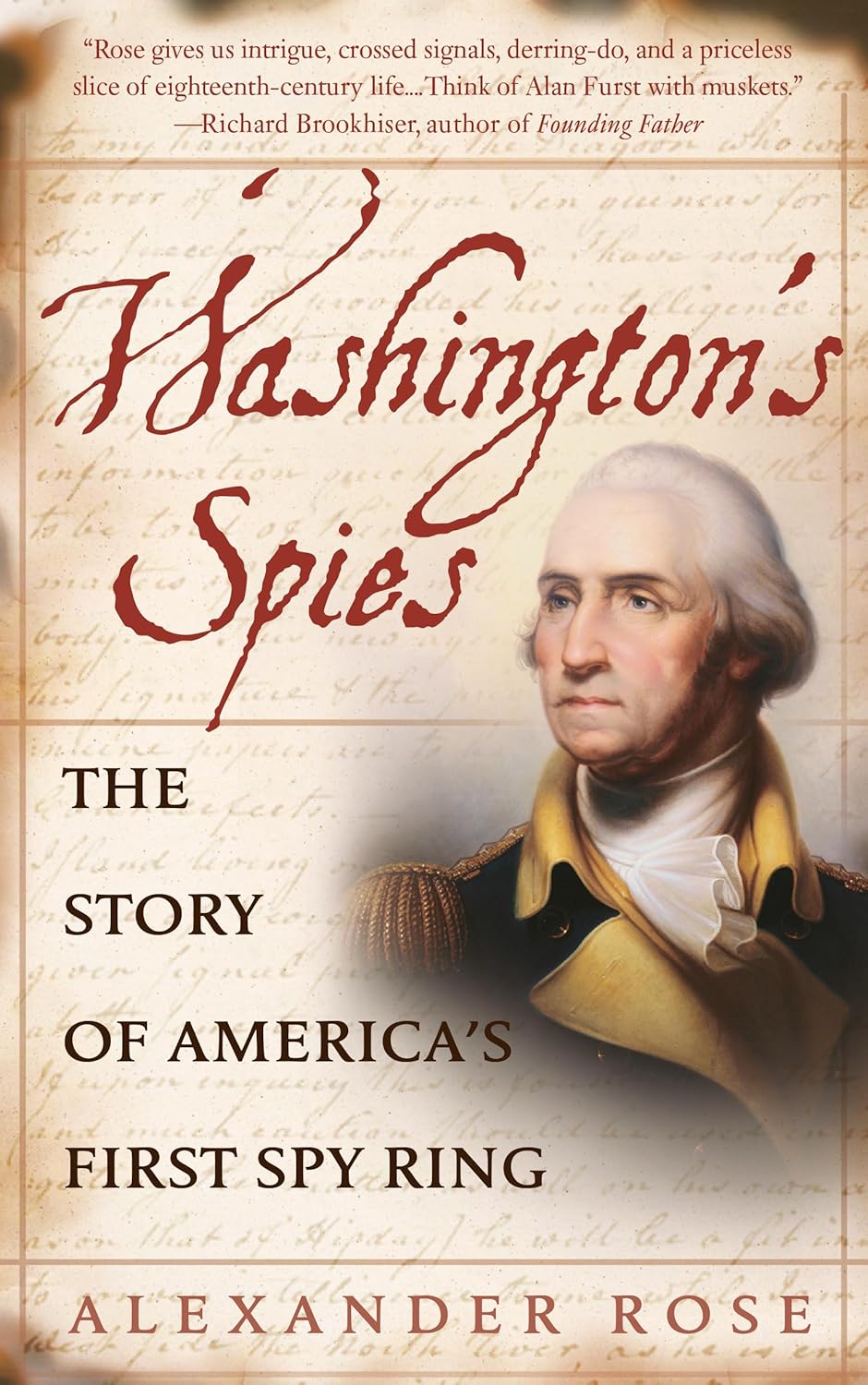
I suppose many prospective readers of “Washington’s Spies” will also be enthusiastic viewers of the AMC Original Series “Turn,” which is loosely based on the book. The key word, readers will find, is “loosely.”
The core cast of characters in “Washington’s Spies” will be familiar to any faithful watcher of “Turn”: The Yale educated intelligence chief of the Continental Army Benjamin Tallmadge, the swashbuckling Caleb Brewster, the antsy Long Island farmer-turned-spy Abraham Woodhull and his even more antsy New York-based accomplice Robert Townsend. Other key characters in “Turn” (such as Robert Rogers, Anna Strong and John Simcoe) are only bit players in Alexander Rose’s narrative. In other words, the writers at AMC used Rose’s rich tableau of real life characters to create a largely fictionalized account of the famed Culper Ring.
New York City served as the headquarters for the British Expeditionary Force from 1776 till the end of hostilities in 1783. Washington desperately needed timely and accurate intelligence from inside the enemy-held city in order to most effectively husband his resources while parrying British offensives. He presented the challenge of establishing an espionage network to the young and enterprising Major Tallmadge, who was, according to Rose, “one of Washington’s most promising golden boys.” He used boyhood contacts from his home in Setauket on the northern shore of Long Island to crack the British veil of secrecy around New York. Rose describes in fascinating detail the tradecraft employed by the so-called Culper Ring (after Woodhull’s alias of Samuel Culper) to communicate via ciphers and codebooks and clandestine dead drops.
The Culper Ring was the most extensive and successful espionage network of the entire war, but it was far from the only effort. The Continental Army spent just under 2,000 pounds total on acquiring intelligence during the war, according to Rose, a full quarter of which went to supporting the Culper Ring. What Rose does not do is detail how the other 75% was spent, although he does emphasize that third party verification of information was critical to the commander in chief of the Continental Army. “Washington … appreciated the craft of intelligence far more than did [British commander] Clinton (or other senior commanders),” he writes, “and naturally grasped the need to acquire reports from myriad, often contradictory sources behind the lines, to cross-reference their information to distinguish between fact and fiction, and to analyze and evaluate their timeliness and utility before acting.” Unfortunately, we hear almost nothing about these other “myriad, often contradictory sources.”
“Washington’s Spies” is more than just the story of the Culper Ring, however. It is also a history of life in British occupied New York and Long Island. If the British were fighting a Patriot insurgency, Rose argues that they did a terrible job of pacification and winning the hearts & minds of the locals. “Loyalists had sided with the British, who they believed were defending their rights as free Englishmen against the tyrannical American revolutionaries,” he says, “yet in the very epicenter of Loyalism [western Long Island], such customary Englishman’s rights as trial by jury, privacy, sanctity of property and elected representation did not exist.” Indeed, one of the key members of the Culper Ring, Robert Townsend, was likely converted to the rebellion in response to British depredations he witnessed in and around New York. In the words of one British officer, “We planted an irrecoverable hatred wherever we went, which neither time nor measures will be able to eradicate.” Washington took advantage of such alienation to the fullest.
Finally, Rose also tells a number of fascinating side stories often neglected in other narratives of the American Revolution. For instance, shortly after the defection of Benedict Arnold in 1780, Washington approved an audacious plan to kidnap the traitor from British-held New York, a story told in a dramatic way in Turn. A young and ambitious sergeant from Virginia, John Champe, volunteered for the assignment. He succeeded in “defecting” from his Continental Army unit and made it behind enemy lines to New York to join Arnold’s new Loyalist unit. Arnold barely escaped the attempted kidnapping and Champe managed in a harrowing journey to defect back to his American compatriots. It’s an incredible story and one that I had never heard before.
In sum, “Washington’s Spies” is an informative and satisfying read. Fans of “Turn” may be disappointed to learn that what they watched over four seasons was almost completely fictionalized, but they will be better off knowing the true story of Benjamin Tallmadge and his Culper Ring.
 What's Tim Reading Now?
Leave a comment