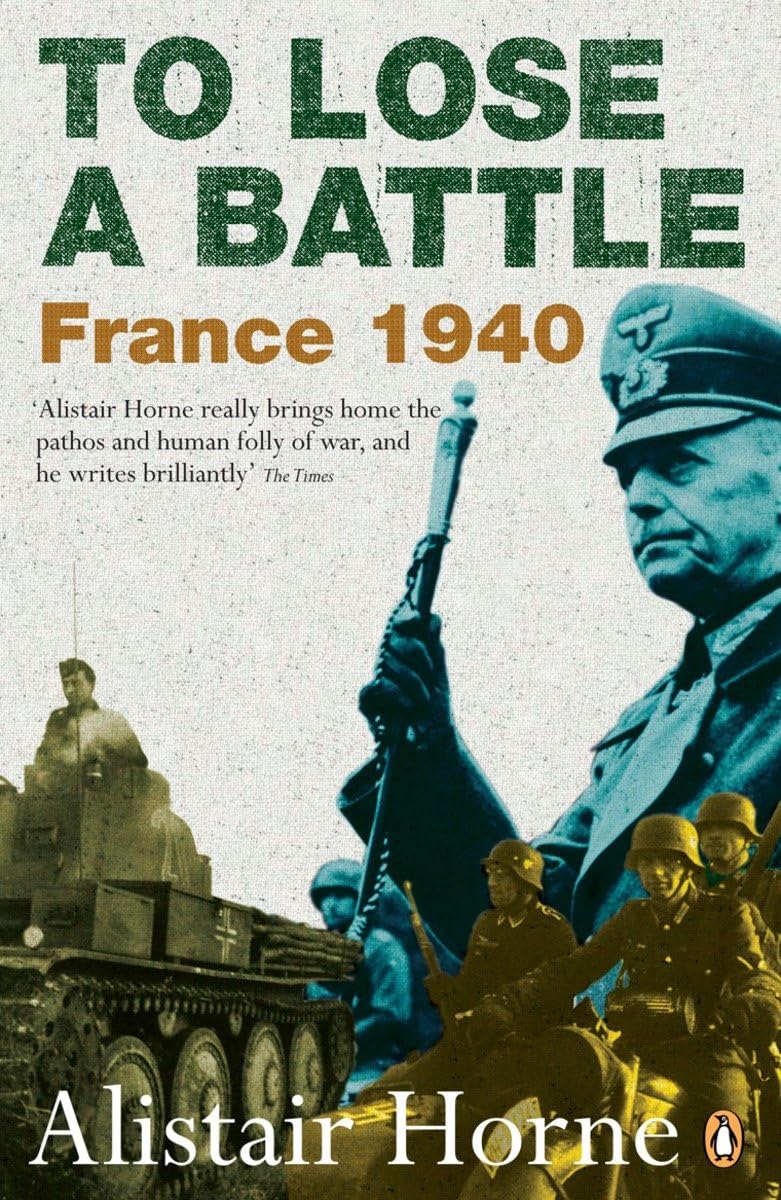
The final installment in Alistair Horne’s epic trilogy on the Franco-German military rivalry, “To Lose a Battle: France 1940” is by far the longest and most tactically detailed of the three.
The book is broken into two parts. The first, covering about a third of the book, chronicles the political turmoil and military missteps in France during the interwar period. Before launching his surprise invasion of the Soviet Union in 1941, Hitler famously stated: “We have only to kick in the door and the whole rotten structure will come crashing down.” He was wrong about Russia, but it would have been spot on if he applied it to France in 1940.
The country was virtually paralyzed by political and personal rivalries. The Third Republic had 21 governments in its final ten years. Right and Left embraced radically different views of their society: one patriotic, as represented by Verdun, the other revolutionary as represented by the Paris Commune, according to Horne. The French army’s two top leaders, the chief of staff, Maurice Gamelin, and his deputy, Alphonse Georges, were barely on speaking terms. Thus, in addition to the deep fractures in French society, the command of the French army was dangerously split into camps that supported either Gamelin or Georges. Chronic labor strikes and legislatively reduced workweeks crippled the production of war materials, especially aircraft. The memory of the bloodletting at Verdun hung over the nation like a dark cloud. Meanwhile, next door the Germans were more united, more ambitious, and more innovative than ever before. “Seekt and Guderian had provided the Wehrmacht with a revolutionary doctrine [combined arms warfare], Hitler and Nazism a revolutionary spirit to go with it,” Horne writes. Meanwhile, the French general staff barely took notice of German armored tactics in Poland.
The first third of the book moves quickly as Horne neatly sets the stage for France’s impending disaster. The author relies heavily on Clare Booth and William Shirer for observations of civilian life during the crisis in France and Germany, respectively. He also supports the line of argument that the German army and high command fully embraced Blitzkrieg and employed the operational concept as envisioned by Guderian, which others have disputed. Horne stresses the importance of previous German campaigns of mobility, both on the Eastern Front during the First World War and the recent invasions of Austria, Czechoslovakia, and Poland, which greatly informed their views on how best to employ armor and airpower. France, on the other hand, was preparing to re-fight the last war they hoped would never come.
The second part of the book is a detailed narrative of the Wehrmacht’s invasion of France, code-named Sichelschnitt (“the cut of the sickle”), which Horne lauds as “one of the most inspired blueprints for victory that the military mind has ever conceived.” The author highlights several reasons why he believes the German campaign was so decisive. First, France was poorly led. The diminutive and diffident new premier, Paul Reynaud, was the wrong man for the job and under the thumb of his mettlesome mistress, Madame Helene de Portes.
Second, the French were outnumbered and outclassed by the German Luftwaffe. For all of the hoopla surrounding tanks, it was air power where the French really fell behind before the war, according to Horne. The French actually possessed tanks that were mechanically superior to the Germans, but were misapplied, often frittered away in “penny packets” all along the front.
Third, the French possessed an irrational belief in both the impenetrability of the Ardennes forest and the indestructibility of the French army. Both would prove to be terribly wrong.
Finally, the French forces positioned at Sedan, the schwerpunkt of the planned German invasion, were third-rate “B divisions” consisting of only a skeletal regular officer corps and NCOs and then filled out with reservists. These raw citizen-soldiers, with virtually no air cover, simply melted away in the face of the well-coordinated Blitzkrieg attack.
The results were staggering. Over the course of just six weeks, the French suffered 90,000 war dead, 200,000 wounded, and nearly two million POWs. The Germans lost 27,000 men and another 111,000 wounded. It was one of the most decisive defeats in all of military history. The lone bright spot for the Allies, according to Horne, was the British general, Lord Gort, who managed the evacuation of 337,000 men (of whom 110,000 were French) from Dunkirk over nine days. It’s never good when your biggest victories are successful retreats.
In closing, “To Lose a Battle” is the definitive history of the French experience in 1940. Much of the narrative takes place from the French perspective and the German performance is treated as majestic from start to finish, which isn’t entirely true. This was my least favorite of Horne’s trilogy, primarily because the tactical phase was just so long, but I’d still recommend it to anyone with a keen interest in the topic.
 What's Tim Reading Now?
Leave a comment