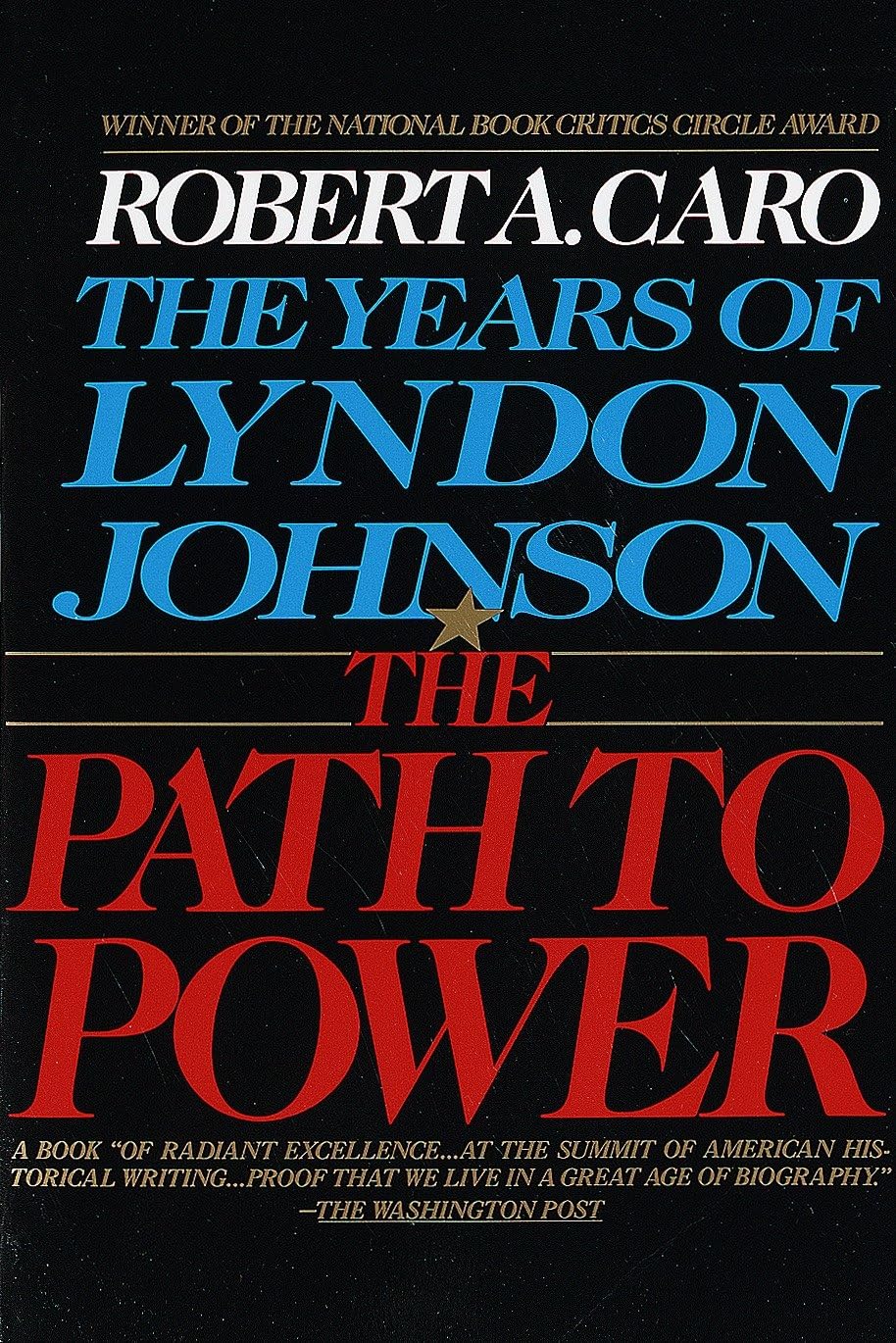
The first in a monumental five volume series on the 36th president of the United States, “The Path to Power” takes nearly 800 pages to cover just the first 32 years of Lyndon Baines Johnson’s life. Often times biographers lose their sense of objectivity about their subject and end up writing a glowing hagiography. Such is not the case with Robert Caro who, if anything, is predisposed to see nothing but the worst in Johnson.
Born in the forbidding landscape of the Hill Country of central Texas, LBJ grew up in grinding poverty. His father was an honest and idealistic six-term Populist state legislator who took his eldest son with him to the statehouse in Austin and while out stumping for votes. He was also a failed businessman farmer and alcoholic whose failures and large debts were a humiliation to the young Johnson.
Caro describes Johnson as a defiant and disrespectful youth, always seeking attention. “He wanted to be somebody, to stand out, to lead, to dominate,” Caro writes. On many occasions during his youth Johnson was known to exclaim that he was going to be president one day. Eventually, people started to believe it.
At tiny South West Texas Teachers College, Caro describes Johnson as a deeply impoverished, unpopular and a middling student, known derisively to his classmates as “Bull” (short for “B.S.”), with a reputation as a braggart, liar, sycophant and coward. The picture the author paints is not pretty. Yet college is also where LBJ first displayed a unique talent for politics. Not accepted into the popular club – the Black Stars – he came to politically dominate another – the White Stars – and led them to unprecedented victories in various forms of campus politics. Early on, Caro says, Johnson demonstrated keen political instincts and a ruthlessness that often shocked his classmates. Nevertheless, his White Stars allies would form the nucleus of his nascent political organization, many remaining with him for decades.
After a quick stint as a high school debate teacher in Houston, Johnson moved to Washington to take up the position of office secretary to a largely absentee Congressman representing Texas’s Fourteenth District. Caro describes Johnson as a force of nature from the moment he stepped onto Capitol Hill at age 23, working with “a frantic, frenzied, almost desperate aggressiveness and energy.” He was no ideologue, according to the author; he was “unencumbered by even the slightest excess weight of ideology, of philosophy, of principles, of beliefs.” Everything was in service to one goal: the personal ambition of Lyndon B. Johnson. It’s a theme Caro hammers home continuously.
Caro sees Johnson as a diabolical manipulator of men – insincere, domineering and abusive. “If Lyndon Johnson was not a reader of books, he was a reader of men – a reader with a rare ability to see into their soul,” Caro writes, “He was more than a reader of men, he was a master of men.” In the author’s view, Johnson picked only lapdogs. But there is a more charitable interpretation, I think. Johnson can also be seen as an incredibly charismatic and hard working leader, the type of man that brings out the best in his subordinates and earns undying loyalty in the process. Moreover, from the very start he consistently earned the friendship and support of powerful men, including such heavy hitters as Sam Rayburn and Franklin Roosevelt. Johnson may have been shamelessly ingratiating, as Caro argues, but experienced men of unquestionably good judgment consistently saw potential in him and supported him in any way they could. In short, there is much more to Johnson’s talent and style than Caro gives due credit for.
Johnson made a conspicuous success out of every opportunity he was given. As secretary to Representative Kleberg and as Texas director of the New Deal National Youth Administration (NYA) his efforts were tireless, his results virtually unprecedented. When a congressional seat unexpectedly came open in 1937 when he was just 28, he simply out hustled his more well established competition en route to an improbable victory. When given a leadership position in the Democratic Congressional Campaign Committee in 1940 his herculean fundraising efforts almost single-handedly saved the Democrat’s majority in the House, according to Caro.
The young Congressman worked assiduously to ensure that his Tenth District received more than its fair share of New Deal largesse. Specifically, he played a pivotal role in promoting rural electrification through the building of a new dam that had previously been stuck in a legislative morass, making a key corporate contractor ally (Brown & Root) in the process. Johnson’s re-election campaigns would be largely unopposed. In the words of top FDR advisor, Tom Corcoran, “[Johnson] was the best Congressman for a district that ever was.” But Johnson had limited ambitions in the House. No sooner was he elected than he started plotting his escape to the Senate. During his 11 years as a Representative he made only a half dozen speeches and championed no national legislation. Caro claims that he didn’t want to be pinned down on any potentially divisive issue that may come back to haunt him.
His opportunity came quickly when, in 1941, a sitting Texas senator suddenly died. Johnson jumped into the race with both feet, this time with the nearly unlimited financial backing (much of it fraudulent and later investigated by the IRS) of Brown & Root and the full-throated political support of the Roosevelt White House. He would lose by just 1,311 crooked votes, thus denying him the chance to become a 32-year-old senator.
The book ends with Pearl Harbor and Johnson’s joining the Navy as a lieutenant commander, fulfilling a campaign promise that if war came he would join the fight.
For Caro, Johnson is a political monster, a modern day Machiavelli with a Texas drawl, a man possessing “a seemingly bottomless capacity for deceit, deception and betrayal.” I tend to take a more nuanced view after reading “The Path the Power.” I see a man of naked ambition, yes, but also a man in possession of enormous political talent and drive, a man who simply worked harder and longer than most men could or were willing to. Caro somewhat reluctantly concedes, “Of the elements in Lyndon Johnson’s career, none had been more striking than his energy.” He was pure energy.
 What's Tim Reading Now?
Leave a comment