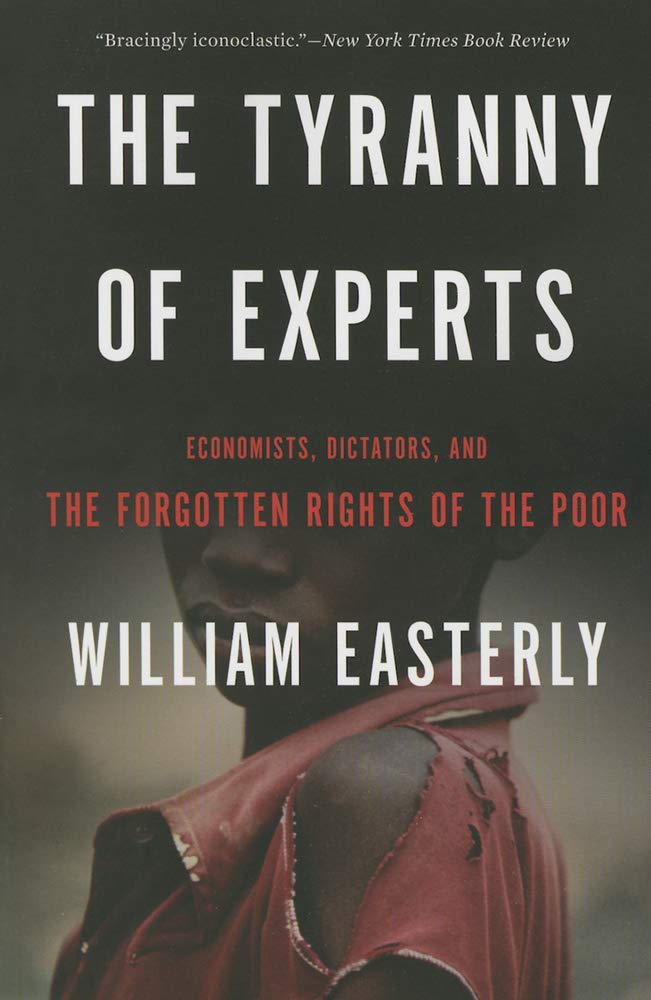
William Easterly is a bur in the saddle of global economic development agencies. Once a true believer is the top-down, technocratic approach to poverty alleviation, he is today the most trenchant advocate for a bottoms-up, individual-rights-first approach. “The Tyranny of Experts: Economists, Dictators, and the Forgotten Rights of the Poor” is his latest double-barreled blast in the face of conventional development policies and practices.
“The Tyranny of Experts” is a powerful, but fitful treatise against the status quo. Easterly tees up three areas where he sees the conventional wisdom around development economics as being flat-out wrong: a blank slate approach to development that denies a central place to historical realities; a narrow focus on nation-states and GDP growth as the sole unit of measurement; and a top-down conscious design for large scale development projects. Easterly argues that what is needed is the exact opposite.
First, Easterly maintains that development professionals need to learn from history and approach each case within its proper local historical context. For instance, some cultures have had little engagement with technology or have suffered from a history of slavery. The long-term consequences of these experiences are tremendous, he argues. One must approach each case as unique and recognize that historical factors will play a large role in how fast (or slow) development takes place.
Second, and far more persuasively, Easterly calls for a focus on individuals rather than nation states. “We care more about Zambia than about Zambians,” he writes. To begin with, he argues that many nations are rather arbitrary creations while the primary means of measuring growth in those nations is riddled with inconsistencies and errors. There is little evidence that development policies work if one looks at GDP figures, which vary widely year to year and might very well be fraudulent. The two best data sets according to Easterly – the World Bank’s World Development Indicators (WDI) and the University of Pennsylvania’s Penn World Tables (PWT) – are often widely apart. “It is unlikely we know with any confidence what [GDP growth rates] really are,” he says. To the extent that anything like sustainable development occurs evidence suggests that it is largely a regional phenomenon and not a national one. Development officials obsess about nation states, Easterly writes, but their most tangible impact – borders – is almost exclusively harmful to growth.
Moreover, this exclusive focus on national GDP growth misses the forest for the trees, in Easterly’s estimation. The entire purpose of development is – or ought to be – the improvement of lives. To that extent, “migration is the canary in the coal mine on development’s attitude toward individual rights versus the prerogatives of nation-states.” Easterly notes that migration and “brain drain” are often viewed negatively by the development community, yet from an individual betterment perspective migration is often the most effective means of improving lives and alleviating poverty.
Finally, Easterly calls for spontaneous solutions as the best means to eradicating poverty. He leans heavily on the teachings of Adam Smith and Friedrich Hayek to make his point. The West “solved” the problems of development without autocrats or aid agencies, he says, and the Rest can evidently do the same in his opinion. (In one of the more bizarre takes in the book, he tries to make his point by telling the 300 hundred year history of one block in New York’s SoHo neighborhood, which changed over the years – with no outside planning, he stresses – from an upscale residential block to a primarily commercial district to a prominent location of brothels to a manufacturing hub to urban blight to its present-day status as a bohemian artist community.) Easterly suggests that it was (and is) the freedom and majority rule of these societies that led to this success. The same can be true for today’s lesser-developed economies, he argues. In short, ‘free society is a great problem-solving system.”
That is not to say that a bottom-up approach is infallible. “The Invisible Hand is not utopia; it is not perfect; it is always a work in progress,” Easterly concedes. But it is infinitely better, he argues, than the top-down, conscious design performed by development agencies and organizations like the Gates Foundation. In one example, the author highlights how development agencies tried to promote economic growth in Zambia by delivering high-speed Internet access to the country. “They promised to end poverty with broadband,” Easterly chuckles, “and they gave us young men watching porn.”
The author also tackles another major issue in development circles: the belief that economic growth requires autocratic government. He admits, “The evidence that autocrats cause rapid growth seems overwhelming.” This view has been articulated by New York Times columnist Thomas Friedman with regard to the stunning growth of China over the past twenty-five years. “One-party autocracy certainly has its drawbacks. But when it is led by a reasonably enlightened group of people, as China is today, it can also have great advantages. That one party can just impose the politically difficult but critically important policies needed to move a society forward in the 21st century.”
Easterly rejects this thesis on multiple levels. First, there is no direct evidence that benevolent autocracies are more successful at promoting growth, he says. The example of the Asian Tigers can be better explained as a regional phenomenon. Moreover, he warns, “For every Lee Kuan Yew, there is a Robert Mugabe.” Rather, what is really called for is a system based on individual rights. And when it comes to economic policy, “Most or all of what you need to give practical policy advice comes from Econ 101.”
Easterly takes specific aim at the so-called “nonpolitical clause” in the World Bank’s 1944 Articles of Agreement (Article IV, Section 10 reads: “The Bank and its officers shall not interfere in the political affairs of any member; nor shall they be influenced in its decisions by the political character of the government of the member or members concerned. Only economic considerations shall be relevant to their decisions.”). For far too long, he says, the international development community has turned a blind eye to autocrats who promised to help with implementing their tops-down solutions for poverty alleviation. This is a travesty and it must end, he says. “A system based on individual rights – both economic and political – tends to reward positive actions and stop negative ones.” While not perfect, it is our best bet in changing the lives of millions for the better. After all, he writes, “freedom is also an end in itself while autocracy is not.”
I enjoyed “White Man’s Burden” much more than “The Tyranny of Experts,” but Easterly makes many valid and convincing points. The book is worth your while if you work in development or are merely curious why such little progress has been made despite decades of effort and hundreds of billions of dollars spent.
 What's Tim Reading Now?
Leave a comment