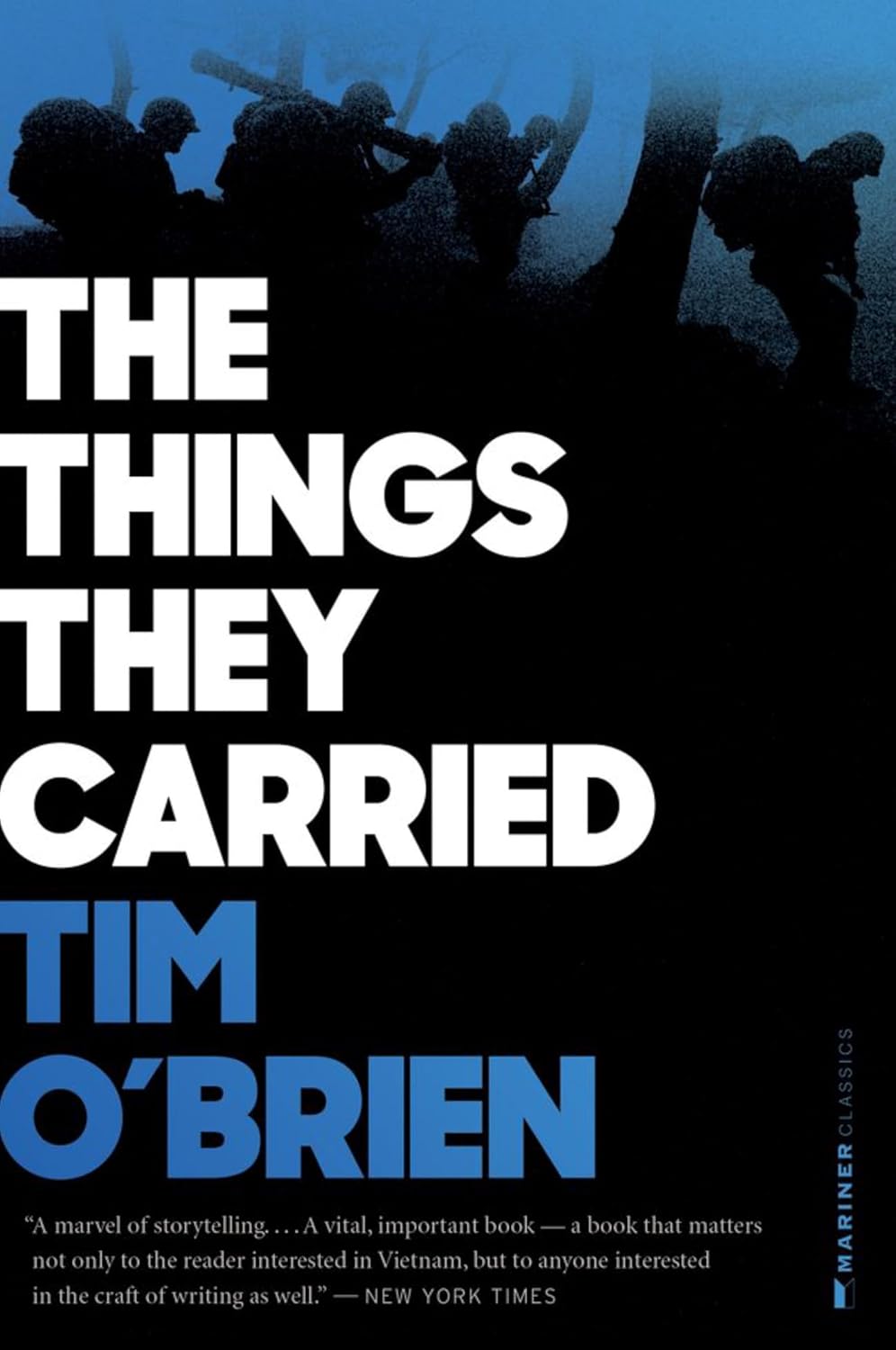
Much ink has been spilled writing memoirs from the Vietnam War. “The Things They Carried” may be the very best. Not because the tale it tells is the most heroic or gut-wrenching or historically significant, but rather because the experience of Alpha Company, 5th Battalion, 46th Infantry Regiment, 198th Infantry Brigade operating in Quang Ngai province in 1969 was so representatively common.
There are three things I love about this book. First is O’Brien’s prose. He writes vividly and beautifully, creating arresting images of what the war was like for those who served in the bush for months on end. Here’s a great example, describing what it was like to be on guard duty at night while the rest of the platoon slept:
“Late a night, on guard, it seemed that all of Vietnam was alive and shimmering – odd shapes swaying in the paddies, boogiemen in sandals, spirits dancing in pagodas. It was ghost country, and Charlie Cong was the main ghost. The way he came out at night. How you never really saw him, just thought you did. Almost magical – appearing, disappearing. He could blend with the land, changing form, becoming trees and grass. He could levitate. He could fly. He could pass through barbed wire and melt away like ice and creep on you without sound or footsteps. He was scary.”
Next, there is the story of the author’s inner struggle about reporting for duty after his draft notice came or fleeing to Canada to sit out the war. O’Brien was by no means your typical grunt. He was class president and graduated summa cum laude and Phi Beta Kappa from Macalester College in St. Paul, Minnesota. He had big plans and undeniable intellectual talent. Even worse, he writes, “I was a liberal!”
There is a man I know at church. He’s in his seventies, short, balding, with beady little black eyes and awkward social manners. I never much liked him. When I learned that he was a draft dodger and had moved to Canada in the sixties, I really didn’t like him. O’Brien’s exquisite telling of his own personal dilemma with the decision, which included a week’s contemplative and emotional stay on the Rainy River on the Minnesota-Manitoba border, has made me more sympathetic to those who fled rather than served. The power of social pressure was overwhelming. Not only what fathers would think, but also the people at the diner down on Main Street and co-workers and old girlfriends, people’s whose opinions you had never cared about before. The truly courageous thing to do, he writes, would have been to flee. But he didn’t. “I was a coward,” he says, “I went to the war.”
Finally, there is the shared experience of combat in a rural counter-insurgency and looking back on it from the same stage of life. (O’Brien wrote this book when he was forty-three-years-old; I read it when I was the same age.) I can empathize with many of his observations and reflections. For instance, “It’s a hard thing to explain to somebody who hasn’t felt it, but the presence of death and danger has a way of bringing you fully awake.” Indeed, I have never felt more alive and in-tuned than when clearing a dirt road outside of Kandahar, Afghanistan for IEDs. There exists a certain contradictory push-and-pull toward and away from danger, at least in my experience and O’Brien’s. When I was outside the wire on some patrol or visiting a forward-operating base in Taliban-controlled areas I desperately wanted to get back to the relative safety of base. Once I was back, my mind went immediately to figuring out how to get on some new, even more dangerous mission. It made no sense. I still don’t understand it.
My son enters high school in the fall. “The Things They Carried” is taught in sophomore English. I can’t think of a better book to read to understand the Vietnam War from the ground level – and what great writing is all about.
 What's Tim Reading Now?
Leave a comment