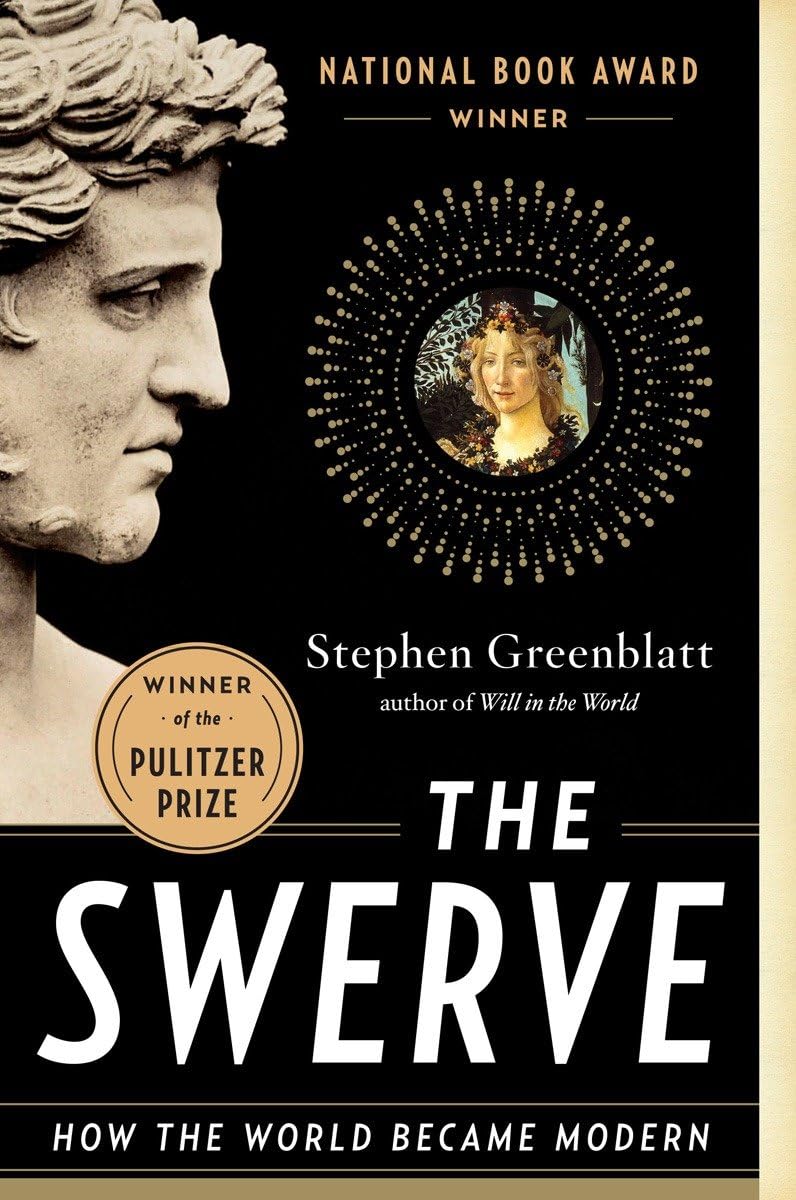
In 1417, at a remote monastery in what is today southern Germany, Poggio Bracciolini – a former apostolic secretary to the disgraced Pope John XXIII and a man renowned for his exquisite handwriting and command of classical Latin – pulled a dusty manuscript from the shelf of the monastic library. It was a long forgotten copy of “On the Nature of Things” (De rerum natura) by Lucretius, a Roman poet who lived during the time Cicero and Julius Caesar. It was a rediscovery that would change the world. Or so author Stephen Greenblatt argues in “The Swerve: How the World Became Modern,” his heralded 2011 Pulitzer-Prize winner.
On the face of it, Greenblatt’s incredible claim – that the rediscovery of some two-thousand-year-old poem literally altered the course of civilization – appears absurd. But the foundations of his case are credible, albeit perhaps oversold.
What was so special about “On the Nature of Things?” To begin with, Greenblatt says, it is beautifully written, a masterpiece of Latin composition, a simple pleasure to read simply for its prose. Second, and far more importantly, it is perhaps the best and most complete articulation of Epicurean philosophy that has survived from ancient times (nothing from Epicurus, the Greek philosopher, survives). Greenblatt summarizes that philosophy this way: “The world is only atoms and void; that, in body and soul, we are only fantastically complex structures of atoms linked for a time and destined one day to come apart…The soul dies with the body. There is no judgment after death. The universe was not created for us by divine power, and the whole notion of the afterlife is a superstitious fantasy…The preachers who tell us to live in fear and trembling are lying. God has no interest in our actions, and though nature is beautiful and intricate, there is no evidence of an underlying intelligent design. What should matter to us is the pursuit of pleasure, for pleasure is the highest goal of existence…Death is nothing to us and no concern of ours.”
When these ideas burst back into circulation in the fifteenth century – the time of the Reformation and Inquisition – they were not merely controversial, they were positively deadly, what Greenblatt calls “an intellectual weapon of mass destruction.”
The challenge Epicureanism posed to the orthodoxy of the Church is obvious. But why would such a seemingly bleak worldview serve as a midwife to modernity? Because knowing the way the world really works awakens “the deepest wonder” to explore the world around us openly, dispassionately, with no fear of impending death or retribution in the afterlife. “Life on earth is all the human beings have,” he says, why not make the most of it? It was this unleashing of curiosity that inspired the great works of the Renaissance and beyond. Indeed, Greenblatt claims that “On the Nature of Things” was Thomas Jefferson’s favorite book (he had four editions in his personal library) and its influence lives with us today in our Declaration of Independence with the phrase “…the pursuit of Happiness,” the foundational concept of Epicureanism.
In closing, I really enjoyed “The Swerve.” I learned quite a bit and found it to be an easy read. That said, it wasn’t nearly as original or profound as the collected accolades (National Book Award, Pulitzer Prize, NYT Bestseller) led me to anticipate.
 What's Tim Reading Now?
Leave a comment