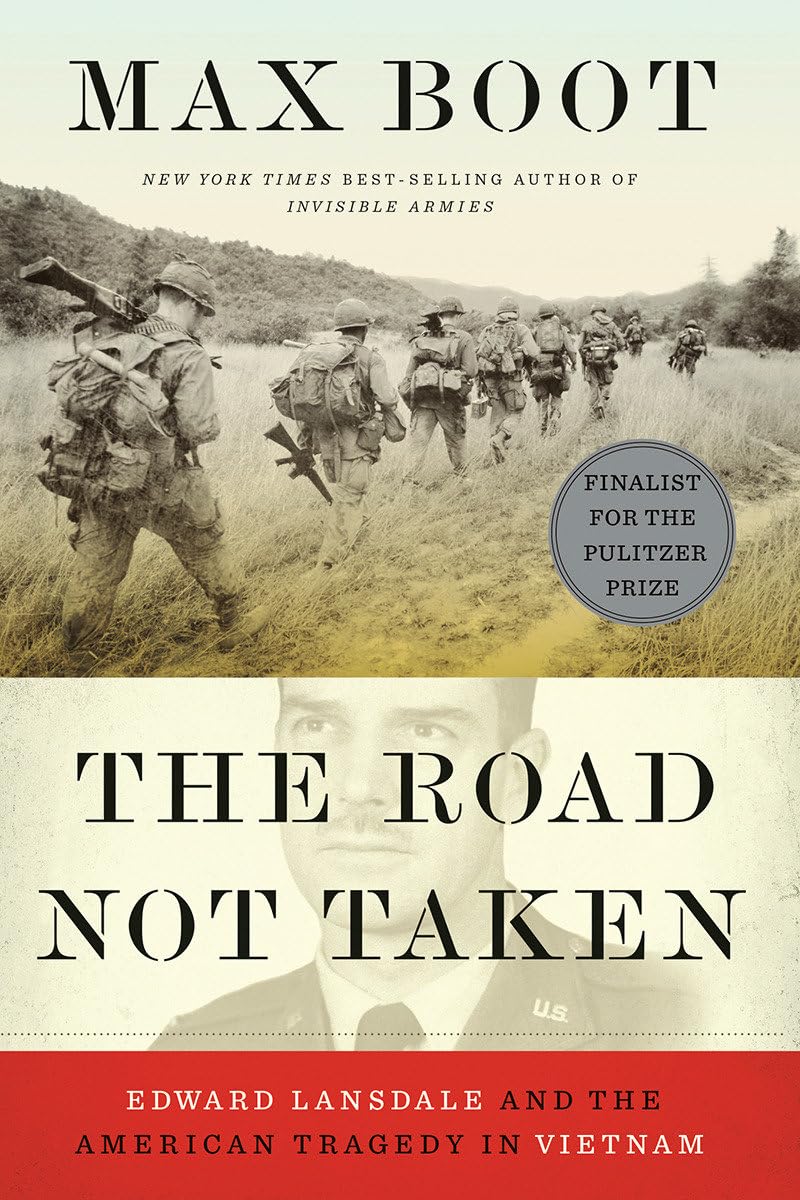
When the Japanese struck Pearl Harbor on December 7, 1941, Edward Lansdale was a 38-year-old advertising executive in San Francisco with a wife and two young children with no background or education in national security or defense policy. Amazingly, within twenty years he would emerge as the country’s leading expert on counter-insurgency. Author Max Boot tells this improbable tale with expert skill and with an eye toward the long view.
Lansdale’s incredible story begins with his induction into the Office of Strategic Services (OSS) at the beginning of World War II. His experience during the war was rather mundane (he compiled intelligence reports from a desk in San Francisco); it was the post-war opportunity to live and work in the Philippines that changed his life, and arguably the course of history. Lansdale immediately fell in love with the land, its people – and a young widow named Pat Kelly. According to Boot, Lansdale would, over the course of several years, establish himself as perhaps the preeminent expert in the entire US government on the Philippines. He did so by ingratiating himself with everyone, from the president to the farmer in the field. The linchpin of Lansdale’s success was empathy with the people. It would form the cornerstone of his counter-insurgency philosophy.
Lansdale finagled his way back to the Philippines in late 1950, this time attached to a unit of the newly created Central Intelligence Agency. He would serve as advisor and consigliere to Ramon Magsaysay, the new minister of defense. The two would form a brotherhood in fighting the Communist Huk rebellion and create the model for effective counter-insurgency operations. “Magsaysay did pretty much everything that Lansdale wanted,” Boot writes, “not because he was a paid American agent but because he had such faith in his friend’s acumen.” Boot gushes that the defeat of the Huks represented “one of the CIA’s biggest covert-action successes ever.” Moreover, “it was achieved largely by one man’s deft manipulation of local politics rather than through costly American spending or heavy-handed American military action.”
The hero of the Philippines was then dispatched to untangle an even more complicated situation: South Vietnam. Boot views Lansdale’s “two and half turbulent and tumultuous years” as head of the Saigon Military Mission as a nearly unqualified success. “Lansdale had labored indefatigably and, on the whole, successfully to construct a stable government against dramatic odds,” he writes. Few expected Ngo Dinh Diem to last two months let alone over two years. In 1956, South Vietnam “stood out as an improbably success story – a ray of sunshine amid diplomatic troubles around the globe.” Lansdale had seemingly done the impossible yet again: build a viable South Vietnamese state as an anti-communist bulwark in South East Asia.
Lansdale became something of a celebrity in the process. The novel “The Ugly American” came out in the fall of 1958. The main character was clearly based, at least in part, on Lansdale, further cementing his reputation as the new Lawrence of Arabia. It also helped get him assigned to lead Operation Mongoose, the Kennedy administration’s slapstick effort to oust Fidel Castro. It would be the low point of his career. Lansdale himself noted sourly that he was treated as if he “were a modern-day Pied Piper capable of magically making governments rise and fall with a few catchy notes from his harmonica.” His fame and notoriety would increasingly alienate him from the bureaucrats at the State Department, CIA, and the military until he was retired from active duty on October 31, 1963 – just weeks before Ngo Dinh Diem was overthrown and executed.
Lansdale refused to go quietly into the sunset. He importuned the administration with his ideas on how best to deal with the war in South Vietnam, always emphasizing meaningful political reforms while reducing direct military action to a minimum. He found an advocate in vice president Hubert Humphrey and was eventually sent back to Saigon in 1965 with returning ambassador Henry Cabot Lodge tasked with leading all pacification efforts. It was a dream job that would quickly turn into a nightmare.
Lansdale in Saigon was a man with a lofty title but no budget or authority. It reminded me of my time in Afghanistan when I worked for the Reconstruction Headquarters at Regional Command – South in Kandahar. With no money and precious little manpower resources there was little reason for anyone to listen to us. The same was true for Lansdale, who was increasingly marginalized and chided for not achieving any miracles in his role. In fairness, like Afghanistan in 2010, South Vietnam in 1965 was a basket case. “A regime that could not pick up the garbage in Saigon,” Boot writes, “was not likely to defeat an entrenched insurgency in the countryside.”
Lansdale spent three years in Saigon in his second tour, which ended shortly after the Tet Offensive in 1968. With the notable exception of the constituent assembly election in 1966, Boot says that Lansdale’s mission was a total failure, although not entirely of his fault. He failed to persuade Westmoreland and other decisionmakers toward his view of counterinsurgency. “We mostly sought to destroy enemy forces,” Lansdale later noted. “The enemy sought to gain control of the people.” Boot concedes that it is impossible to know if Lansdale’s more benign approach would have worked, but concludes “His approach, successful of not, would have been more humane and less costly.”
“The Road Not Taken” is a monument to Edward Lansdale. Boot notes that many people in the national security establishment, some of them quite powerful, such as defense secretary Robert McNamara, held low opinions of him, but he never really explores those critical points of view. We never hear from those who desperately wanted to sideline Lansdale, such as when he was considered for ambassador to South Vietnam in 1963, and why they held such strong positions. The book suffers because of it, I think. Overall, however, “The Road Not Taken” is a striking biography of a fascinating man. It is highly recommended to anyone with an interest in the Vietnam War or counterinsurgency more broadly.
 What's Tim Reading Now?
Leave a comment