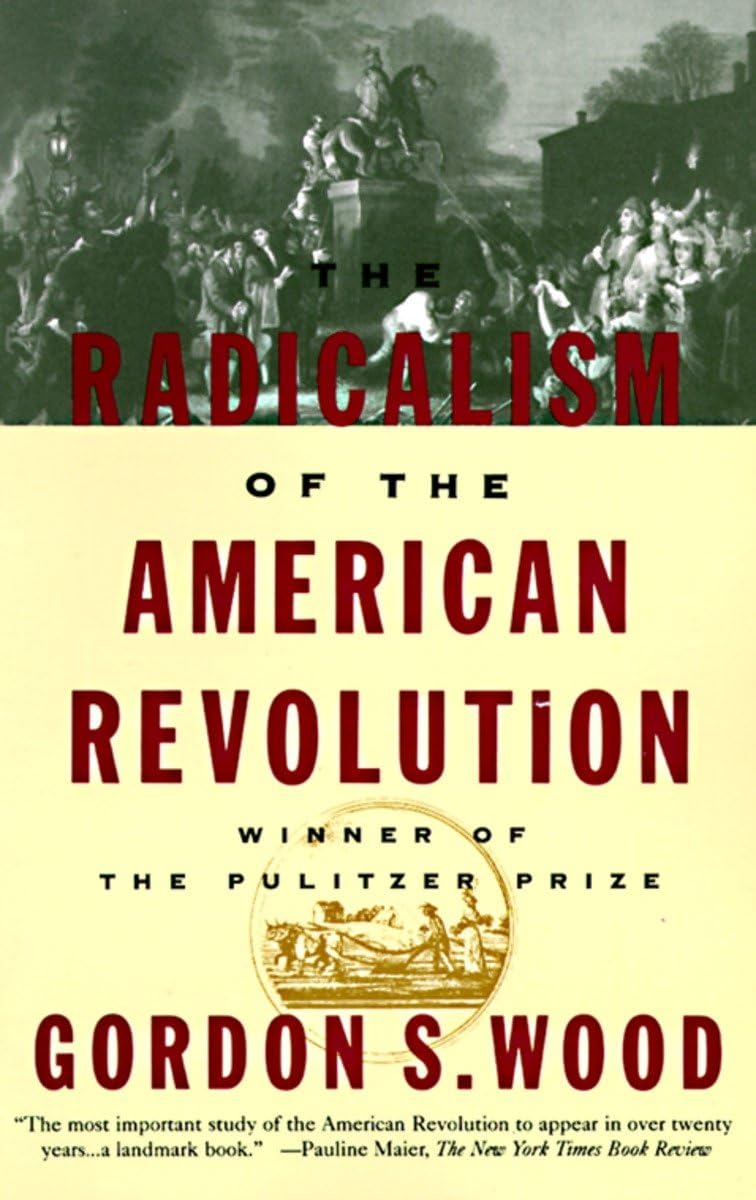
Other historians, such as Arthur Schlesinger, have argued that the revolution had its impetus in the preservation of society, not its transformation, which is what usually defines “revolutions.” Wood claims that this assertion is misguided and limited. He concedes that the American Revolution was unique among national revolutions, but that doesn’t make it any less radical in its results. Although the underlying motivation for the revolution – the purification of a corrupt colonial political and economic system – seems somewhat conservative in light of other revolutions that explicitly sought the overthrow of the ruling elite, Wood stresses the facts that the revolution changed American society and more than any other event in history put the nation on an unprecedented path of modernization, prosperity, and liberal democracy.
Wood breaks his Pulitzer Prize-winning history into three equal parts – Monarchy, Republicanism, Democracy. He argues that first monarchy and then the nascent American brand of republicanism were overthrown by the democracy that survives to this day. In short, the conservative merchants of New England that originally organized resistance to the commerce restrictions of 1765 were ultimately overtaken by Republican radicals. Those radicals eventually led the revolution after usurping the organizations created by the merchants – much to the merchants’ horror as they had only aimed at reform, not revolution. Likewise, the revolution created by the radical republicans was quickly usurped by the ordinary man – much to the horror of the revolutionaries who saw their republic based on Roman virtues degenerate into a democracy of unenlightened, rapacious commoners.
In the first section, Monarchy, Wood describes the deeply personal nature of Colonial American society. In the absence of banks, major manufacturing, and faceless cities, colonial society remained rather cloistered; indeed, Wood calls it “primitive.” Privacy, as we conceive it today, did not exist, nor did political freedom or meritocracy. Because society was so open and so small there was a personal aspect to everything. When something important happened, like an increase in prices, it wasn’t chalked up to market forces but rather to the greed of the maker of the product. Likewise, the colonial government was a personal affair. In Wood’s words: “personal relationships and dependencies were the ligaments that held society together.” What we think of today at nepotism was a normal and accepted part of colonial society. One could simply not “make it” on his own, no matter how great their talent might be (everyone, even Benjamin Franklin, needed a gentleman patron to get ahead). The power and credibility of government thus derived from the officeholder, not the office itself. This focus on the individual explains the absence of political parties, Wood says.
In the second section, Republicanism, Wood cites the weakness of the American colonial aristocracy as critical in undermining the British crown’s authority. Antiquity, particularly the work and lives of Cicero and Cato, was of cardinal importance to the leaders of the Revolution. The classical Roman ideals of integrity, virtue, and self-sacrifice were consciously emulated. Rather than putting the burden on the monarchial system to hold society together in an intricate web of patronage relationships, Republicans stressed the importance of individuals and his duty to selflessly serve the public. In the end, the goal was to ensure that men of virtue wielded power and did their best to rein in the avarice and ambition of his fellow man. These ideas were able to take root best in America, Wood argues because the colonies had been “a truncated society.” The presence, influence, and tradition of the monarchy with all of its powers of patronage and connection were missing; the galvanizing effect of organized religion, especially the Anglican church, was limited; the paucity of inherited titles led to a relative weakness of the traditional social hierarchy; and the huge debts of the southern planters all contributed to the weak ties of the old monarchical system in the colonies. The aristocrats weren’t nearly as rich nor were the nobles as influential, while the crown itself was rarely seen or involved.
The final section, Democracy, describes the overthrow of classical ideals by an energetic populace. Revolutionary leaders perceived the growth of commerce, facilitated by paper money and internal trade, as the base corruption of republican ideals. Moreover, as ordinary men took places in government they pursued their personal interests, for instance by seeking legislation for debt relief. The leaders of the Revolution quickly learned that not all men were Samuel Adams. As much as they tried to keep private interests out of government by the 1790s it was evident that those personal interests were actually the new ligaments of society. Ultimately, Wood says, the republican aristocracy that produced the Revolution became the target of contempt all throughout the new United States of America. The inherent weakness of the American gentry – lack of real wealth or title – greatly contributed to its demise.
Wood maintains that the commercialism that emerged from the revolution radically changed the American economy. The pursuit of luxury items by commoners, long perceived as a detriment to society, was now appreciated as an engine of growth. People didn’t work simply to keep mind and soul together, but rather to “get ahead” and enjoy the fruits of their labor. As society shifted toward this self-interested pursuit of personal advancement, the economy grew rapidly. As a result, Wood writes, an elaborate, self-serving connection of exchange emerged as the new means by which the nation was held together. In other words, the revolutionary leaders had succeeded so well that they failed in the end – and they knew it as early as 1790. The goal of an enlightened republic led by disinterested, enlightened elite, based on ancient ideals of honor and virtue, was summarily rejected by the mass of ordinary citizens who used the revolution as a vehicle for their own unabashed self-interest.
A learned synthesis and reassessment of thirty years of American history, “The Radicalism of the American Revolution” is a fantastic, if a dense piece of scholarship. However, note that a solid understanding of colonial American history and the Revolutionary War are required to fully enjoy and digest the book.
 What's Tim Reading Now?
Leave a comment